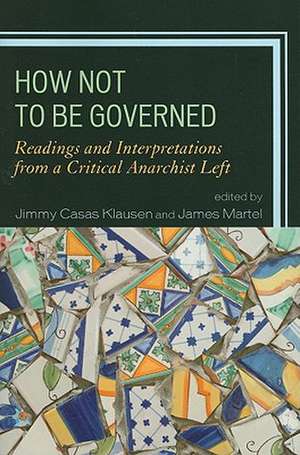
How Not to Be Governed
en Limba Engleză Paperback – 13 ian 2011
| Toate formatele și edițiile | Preț | Express |
|---|---|---|
| Paperback (1) | 307.05 lei 6-8 săpt. | |
| Bloomsbury Publishing – 13 ian 2011 | 307.05 lei 6-8 săpt. | |
| Hardback (1) | 603.03 lei 6-8 săpt. | |
| Bloomsbury Publishing – 13 ian 2011 | 603.03 lei 6-8 săpt. |
Preț: 307.05 lei
Preț vechi: 395.20 lei
-22%
Puncte Express: 461
Preț estimativ în valută:
54.28€ • 63.54$ • 47.40£
54.28€ • 63.54$ • 47.40£
Carte tipărită la comandă
Livrare economică 06-20 martie
Specificații
ISBN-13: 9780739150351
ISBN-10: 0739150359
Pagini: 244
Dimensiuni: 152 x 229 x 13 mm
Greutate: 0.37 kg
Editura: Bloomsbury Publishing
Locul publicării:New York, United States
ISBN-10: 0739150359
Pagini: 244
Dimensiuni: 152 x 229 x 13 mm
Greutate: 0.37 kg
Editura: Bloomsbury Publishing
Locul publicării:New York, United States
V-ar putea interesa
-
 The Conquest of BreadPeter KropotkinPreț: 75.15 lei
 -
 An Enquiry Concerning Political JusticeWilliam Godwin-20%Preț: 82.87 lei103.45 lei
 -
 On AnarchismNoam Chomsky-22%Preț: 47.64 lei60.79 lei
 -
 Gramsci is Dead: Anarchist Currents in the Newest Social MovementsRichard J. F. DayPreț: 223.70 lei
 -
 Post-AnarchismDuane RoussellePreț: 242.95 lei
 -
 The Anarchist TurnJacob BlumenfeldPreț: 222.60 lei
 -
 Kropotkin and the Anarchist Intellectual TraditionJim MacLaughlinPreț: 201.01 lei
 -
 The Politics of PostanarchismSaul Newman-18%Preț: 171.06 lei209.04 lei
 -
 -18%Preț: 611.37 lei745.56 lei
 -
 Individual LibertyBenjamin R. TuckerPreț: 110.86 lei
 -
 Anarchist Cookbook - Volume TwoUltra Mega KubedPreț: 68.00 lei
 -
 Gott Und Der StaatMichail BakuninPreț: 42.27 lei
 -
 The Coming InsurrectionThe Invisible Committee-19%Preț: 68.21 lei83.93 lei
 -
 Introduction to Civil WarTiqqun-18%Preț: 74.63 lei91.09 lei
 -
 Hacker, Hoaxer, Whistleblower, SpyGabriella ColemanPreț: 210.67 lei
 -
 The Method of Freedom: An Errico Malatesta ReaderErrico MalatestaPreț: 135.14 lei
 -
 No Gods No Masters: An Anthology of AnarchismDaniel GuerinPreț: 174.35 lei
 -
 -26%Preț: 98.55 lei133.12 lei
 -
 The Failure of AnarchismKeith PrestonPreț: 154.55 lei
 -
 Future Primitive RevisitedJohn ZerzanPreț: 80.59 lei
 -
 Everyday AnarchyMolyneux, StefanPreț: 73.43 lei
 -
 Preț: 90.33 lei
Cuprins
1 1. Introduction: "How Not to Be Governed"
2 2. Anarchist Methods and Political Theory
3 3. An Anarchism That Is Not Anarchism: Notes toward a Critique of Anarchist Imperialism
4 4. Beside the State: Anarchist Strains in Cuban Revolutionary Thought
5 5. Kant via Rancière: From Ethics to Anarchism
6 6. Nietzsche, Aristocratism and Non-domination
7 7. Max Stirner, Postanarchy avant la lettre
8 8. The late Foucault's premodernity
9 9. The ambivalent anarchism of Hannah Arendt
10 10. Emma Goldman and the Power of Revolutionary Love
11 11. "This is what Democracy looks like"
2 2. Anarchist Methods and Political Theory
3 3. An Anarchism That Is Not Anarchism: Notes toward a Critique of Anarchist Imperialism
4 4. Beside the State: Anarchist Strains in Cuban Revolutionary Thought
5 5. Kant via Rancière: From Ethics to Anarchism
6 6. Nietzsche, Aristocratism and Non-domination
7 7. Max Stirner, Postanarchy avant la lettre
8 8. The late Foucault's premodernity
9 9. The ambivalent anarchism of Hannah Arendt
10 10. Emma Goldman and the Power of Revolutionary Love
11 11. "This is what Democracy looks like"
Recenzii
It is clear that only the abolition of the state structure can solve a number of oppressions, not least in relation to undocumented migrants. This book invites us to think of emigration not only in the perspective that the world is our homeland, but also because this population movement is a character of dissent from the left of both countries in respect of the so-called home, as Banu Bargu suggests. In short this book does not fail to stir the debate it deserves.
This is a unique and exciting collection of inquiries into anarchism and political theory, anarchism as political theory. Martel and Klausen's introduction usefully situates anarchism in relation to contemporary political struggles. The authors make use of a wide variety of political theorists, including Foucault, Arendt, Benjamin, and Nietzsche, to discern and develop anarchist themes.
Rather than simply rehashing classical anarchism, this work offers a genuinely original and innovative re-engagement with the properly heterogeneous and heretical dimension of anarchist thought, emphasising its untimely timeliness. With the category of 'critical anarchism,' anarchism is taken beyond the epistemological boundaries of the old masters like Bakunin and Kropotkin, revitalized through a dialogue with alternative perspectives such as post-structuralism, and reconsidered in the context of today's struggles against neo-colonialism and global capitalism. Critical anarchism thus brings to light the diversity and liveliness of anarchism, showing that it is more productively thought as a horizon of becoming. Above all, in pointing to the potential of anarchism as an alternative to the failures of statism on the one hand, and capitalism on the other, the book reminds us of the original libertarian-egalitarian impulse at the heart of radical politics and thus makes a vital contribution to what I see as the fundamental political challenge of today: reclaiming the ethical project of how not to be governed from the grasp of the radical Right.
Fresh, brave, and excellent to think with. Nothing beats this as an original, critical and sympathetic reassessment of anarchism as a body of evolving emancipatory practices and as a body of knowledge. I can't wait to teach it.
This is a unique and exciting collection of inquiries into anarchism and political theory, anarchism as political theory. Martel and Klausen's introduction usefully situates anarchism in relation to contemporary political struggles. The authors make use of a wide variety of political theorists, including Foucault, Arendt, Benjamin, and Nietzsche, to discern and develop anarchist themes.
Rather than simply rehashing classical anarchism, this work offers a genuinely original and innovative re-engagement with the properly heterogeneous and heretical dimension of anarchist thought, emphasising its untimely timeliness. With the category of 'critical anarchism,' anarchism is taken beyond the epistemological boundaries of the old masters like Bakunin and Kropotkin, revitalized through a dialogue with alternative perspectives such as post-structuralism, and reconsidered in the context of today's struggles against neo-colonialism and global capitalism. Critical anarchism thus brings to light the diversity and liveliness of anarchism, showing that it is more productively thought as a horizon of becoming. Above all, in pointing to the potential of anarchism as an alternative to the failures of statism on the one hand, and capitalism on the other, the book reminds us of the original libertarian-egalitarian impulse at the heart of radical politics and thus makes a vital contribution to what I see as the fundamental political challenge of today: reclaiming the ethical project of how not to be governed from the grasp of the radical Right.
Fresh, brave, and excellent to think with. Nothing beats this as an original, critical and sympathetic reassessment of anarchism as a body of evolving emancipatory practices and as a body of knowledge. I can't wait to teach it.