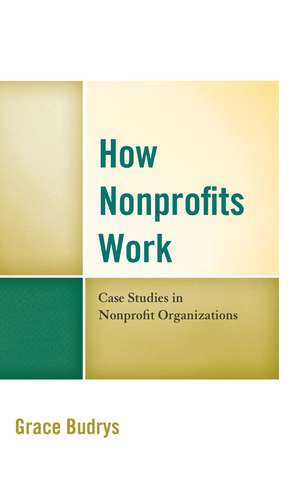
How Nonprofits Work: Case Studies in Nonprofit Organizations
Autor Grace Budrysen Limba Engleză Paperback – 8 dec 2016
Preț: 257.89 lei
Preț vechi: 313.33 lei
-18%
Puncte Express: 387
Carte tipărită la comandă
Livrare economică 09-23 noiembrie
Livrare prin curier în România Termenul estimat este afișat lângă disponibilitate.
Transport gratuit de la 400.00 lei Plată online sau ramburs, în funcție de opțiunile comenzii.
Retur gratuit în 14 zile Comandă securizată și suport în română.
Specificații
ISBN-13: 9781538101445
ISBN-10: 1538101440
Pagini: 242
Dimensiuni: 150 x 231 x 18 mm
Greutate: 0.41 kg
Editura: Bloomsbury Publishing
Colecția Rowman & Littlefield
Locul publicării:New York, United States
ISBN-10: 1538101440
Pagini: 242
Dimensiuni: 150 x 231 x 18 mm
Greutate: 0.41 kg
Editura: Bloomsbury Publishing
Colecția Rowman & Littlefield
Locul publicării:New York, United States
Cuprins
1: Introduction
2: What Makes Nonprofit Organizations Special?
3: The Size and Scope of the Nonprofit Sector
4: Analytical Framework
5: The Case Presentation Framework
6: Two Classic Case Studies
7: Delivering Nursing Case in a Person's Home
8: Confronting a Highly Contagious Disease
9: Needs of People with a Significant Physical Impairment
10: Helping People with Various Disabilities
11: Battling the Spread of HIV/AIDS
12: Helping to Overcome Hunger
13: Addressing the Need for Affordable Housing
14: Conclusion
2: What Makes Nonprofit Organizations Special?
3: The Size and Scope of the Nonprofit Sector
4: Analytical Framework
5: The Case Presentation Framework
6: Two Classic Case Studies
7: Delivering Nursing Case in a Person's Home
8: Confronting a Highly Contagious Disease
9: Needs of People with a Significant Physical Impairment
10: Helping People with Various Disabilities
11: Battling the Spread of HIV/AIDS
12: Helping to Overcome Hunger
13: Addressing the Need for Affordable Housing
14: Conclusion
Recenzii
Budrys puts empirical flesh on the bones of theory with lively, in-depth case studies of how nonprofit organizations operate, delving into their mission, history, structure, funding, and evaluation.
In the highly readable language of someone who has thoroughly investigated and understands her subject matter, Dr. Grace Budrys provides a robust introduction to the nonprofit sector for both proponents and critics and for those new to or conversant with this sector.
This book will make a valuable contribution to those in the nonprofit field who are interested in a framework that can be used to assess their own organizations and/or others that exist in the field. Students who are preparing for and seeking volunteer, internship, or employment opportunities in the nonprofit sector will find this book to be a helpful guide into that world. And, instructors should use it in prepping students for those experiences. In addition, this book could be useful to philanthropic entities who have longed for a readable, non jargon-ladden discussion of nonprofit organizations of varying types that seek them out for funding.
Budrys' readable, sociological presentation of the nonprofit sector is one of the best I've read. She escapes the managerial perspective that dominates most research on nonprofit organizations. She has a strong theoretical voice, gives a thorough review of the literature, and offers an accurate statement of key ideas. This would be a fine book to use in an undergraduate or beginning graduate course.
In a very readable prose, Budrys shows how the case study method can be employed to effectively illustrate pressures faced by U.S. non-profits to sustain themselves and pursue their missions within an increasingly competitive fundraising environment. Through a careful comparative analysis of nonprofits social service providers, the reader is given a window into the primary vulnerabilities and challenges faced by these organizations as they struggle to deliver services, fundraise, and evaluate themselves. How Nonprofits Work poses critical questions about the stability and future of a central institution of the U.S. social safety net.
Budrys (sociology, DePaul Univ.) provides a highly accessible presentation of nonprofits that should appeal to libraries collecting for social work programs. The author's use of bullet points, enumeration, and plain language will be welcome to social work students who typically read works that are far more theoretical during their studies. Budrys makes use of annual reports, websites, and "extensive interviews," Overall, a pragmatic and focused set of case studies sure to engage readers. Summing Up: Recommended. Upper-division undergraduates and above
In the highly readable language of someone who has thoroughly investigated and understands her subject matter, Dr. Grace Budrys provides a robust introduction to the nonprofit sector for both proponents and critics and for those new to or conversant with this sector.
This book will make a valuable contribution to those in the nonprofit field who are interested in a framework that can be used to assess their own organizations and/or others that exist in the field. Students who are preparing for and seeking volunteer, internship, or employment opportunities in the nonprofit sector will find this book to be a helpful guide into that world. And, instructors should use it in prepping students for those experiences. In addition, this book could be useful to philanthropic entities who have longed for a readable, non jargon-ladden discussion of nonprofit organizations of varying types that seek them out for funding.
Budrys' readable, sociological presentation of the nonprofit sector is one of the best I've read. She escapes the managerial perspective that dominates most research on nonprofit organizations. She has a strong theoretical voice, gives a thorough review of the literature, and offers an accurate statement of key ideas. This would be a fine book to use in an undergraduate or beginning graduate course.
In a very readable prose, Budrys shows how the case study method can be employed to effectively illustrate pressures faced by U.S. non-profits to sustain themselves and pursue their missions within an increasingly competitive fundraising environment. Through a careful comparative analysis of nonprofits social service providers, the reader is given a window into the primary vulnerabilities and challenges faced by these organizations as they struggle to deliver services, fundraise, and evaluate themselves. How Nonprofits Work poses critical questions about the stability and future of a central institution of the U.S. social safety net.
Budrys (sociology, DePaul Univ.) provides a highly accessible presentation of nonprofits that should appeal to libraries collecting for social work programs. The author's use of bullet points, enumeration, and plain language will be welcome to social work students who typically read works that are far more theoretical during their studies. Budrys makes use of annual reports, websites, and "extensive interviews," Overall, a pragmatic and focused set of case studies sure to engage readers. Summing Up: Recommended. Upper-division undergraduates and above