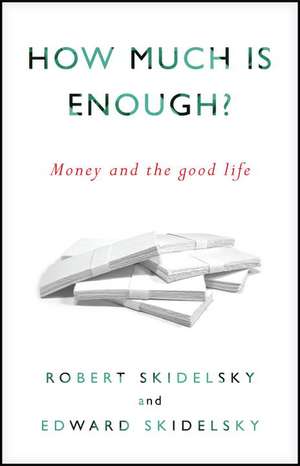
How Much Is Enough?
Autor Robert Skidelsky, Edward Skidelskyen Limba Engleză Hardback – 19 iun 2012
După lectura acestei lucrări, veți fi capabili să reevaluați fundamental relația dintre veniturile proprii și timpul liber, dobândind instrumentele intelectuale necesare pentru a defini pragul personal de 'suficient'. Notăm cu interes modul în care How Much is Enough? demontează eroarea de calcul a lui John Maynard Keynes, care anticipa în 1930 că nepoții săi vor lucra doar 15 ore pe săptămână. Deși productivitatea a crescut conform previziunilor, autorii explică de ce nevoile noastre au rămas aparent nesatisfăcute, împingându-ne spre o muncă neîncetată pentru acumulare. Suntem de părere că forța acestui text rezidă în colaborarea dintre Edward Skidelsky, un filosof, și Robert Skidelsky, reputat economist și biograf al lui Keynes. Această sinergie transformă economia dintr-o disciplină aridă a cifrelor într-o 'știință morală'. Abordarea diferă de Revisiting Keynes – Economic Possibilities for our Grandchildren prin caracterul său mai puțin abstract și mult mai aplicabil; în timp ce volumul editat de Lorenzo Pecchi rămâne într-o sferă de dezbatere academică între economiști, lucrarea de față oferă o foaie de parcurs etică pentru individul modern. În contextul operei autorilor, cartea reprezintă o evoluție naturală a preocupărilor lui Robert Skidelsky față de moștenirea keynesiană, vizibile și în Keynes for Our Times, însă aici accentul se mută de la politicile macroeconomice spre calitatea vieții cotidiene. Textul recuperează tradiția filosofică de la Aristotel la Marx pentru a sublinia că scopul economiei nu este creșterea infinită, ci facilitarea 'vieții bune'. Este o lectură cu un ritm susținut, care provoacă cititorul să se întrebe de ce continuăm să prețuim utilul deasupra binelui, într-o societate a abundenței care se simte, paradoxal, tot mai goală.
Preț: 142.01 lei
Carte indisponibilă temporar
Specificații
ISBN-10: 1590515072
Pagini: 256
Dimensiuni: 147 x 225 x 28 mm
Greutate: 0.42 kg
Editura: Other Press (NY)
V-ar putea interesa
-
 Why Grow Up?Susan Neiman-32%Preț: 63.26 lei92.51 lei
 -
 John Maynard KeynesRobert SkidelskyPreț: 253.71 lei
 -
 A Little History of EconomicsNiall KishtainyPreț: 88.76 lei
 -
 A Little History of EconomicsNiall KishtainyPreț: 87.51 lei
 -
 Harris, M: All We WantMichael HarrisPreț: 105.52 lei
 -
 ConsciencePatricia ChurchlandPreț: 115.01 lei
 -
 Affluent Society, TheJohn Kenneth GalbraithPreț: 106.97 lei
 -
 The Measure of ProgressDiane CoylePreț: 176.49 lei
 -
 Prince or PauperPeter YachimskiPreț: 65.97 lei
 -
 Beyond Wealth - The Road Map to a Rich LifeAlexander GreenPreț: 167.31 lei
 -
 LoadedSarah NewcombPreț: 156.11 lei
 -
 The Gone Fishin' PortfolioAlexander GreenPreț: 156.89 lei
 -
 Preț: 268.46 lei
 -
 The Great Money ResetJill SchlesingerPreț: 162.45 lei
 -
 Great Money ResetJill SchlesingerPreț: 100.31 lei
 -
 Preț: 111.95 lei
 -
 -26%Preț: 58.96 lei79.46 lei
 -
 The Godless GospelJulian BagginiPreț: 69.29 lei
 -
 -29%Preț: 64.24 lei90.18 lei
 -
 The Essential KeynesJohn Maynard Keynes-17%Preț: 78.22 lei94.24 lei
 -
 The Art of Spending MoneyMorgan HouselPreț: 120.91 lei
De ce să citești această carte
Recomandăm această carte oricărui profesionist care simte că succesul financiar nu se traduce automat în satisfacție personală. Veți câștiga o perspectivă istorică și filosofică asupra consumismului și, mai important, o bază argumentată pentru a decide unde se termină necesitatea și unde începe excesul. Este ghidul esențial pentru a recupera timpul liber ca resursă de preț, nu ca pierdere economică.
Despre autor
Edward Skidelsky este lector de filosofie la Universitatea din Exeter și un colaborator constant al publicațiilor britanice de prestigiu precum Prospect și New Statesman. Interesele sale academice vizează istoria conceptelor morale, temă explorată și în lucrarea sa Moral Concepts and their History. Robert Skidelsky, tatăl său, este un istoric economic renumit, cunoscut la nivel mondial ca principalul biograf al lui John Maynard Keynes. Împreună, cei doi combină rigoarea analizei economice cu profunzimea eticii filosofice pentru a adresa problemele structurale ale capitalismului contemporan.
Notă biografică
Edward Skidelsky is a lecturer at Exeter University, specializing in aesthetics and moral philosophy. He contributes regularly to the New Statesman, Telegraph, and Prospect on philosophy, religion, and intellectual history.
Extras
Keynes understood that capitalist civilization had, at some level of consciousness, undertaken to license motives previously condemned as “foul” for the sake of future reward. It had struck a bargain with the forces of darkness, in return for which it would secure what earlier ages could only dream of—a world beyond the toil and trouble, violence and injustice of life as it actually is. We have called this bargain
“Faustian,” in honor of the famous doctor who sold his soul to the devil in return for knowledge, pleasure, and power.
The story starts with the ancient dream of Utopia and then mutates into the historical project of creating a paradise on earth, which has gripped the western imagination for the last three hundred years, and in which the human race is still fitfully engaged. On the way, the idea of moral limits to human ambition, which underpinned all premodern conceptions of the good life, was lost, and dormant energies of creativity and destructiveness were set free in the hope that they would carry mankind to a pinnacle of achievement and mastery of the natural world. At various stages on this journey, the greatest thinkers of the age tried to envisage an end state, a point at which mankind could say “enough is enough,” only to find that the machine it had created to carry them to this point was out of control, a Frankenstein’s monster, which now programmed the game of progress according to its own insane logic. This is the story of how it happened—how we came to be ensnared by the dream of progress without purpose, riches without end.
Descriere scurtă
What constitutes the good life? What is the true value of money? Why do we work such long hours merely to acquire greater wealth? These are some of the questions that many asked themselves when the financial system crashed in 2008. This book tackles such questions head-on.
The authors begin with the great economist John Maynard Keynes. In 1930 Keynes predicted that, within a century, per capita income would steadily rise, people’s basic needs would be met, and no one would have to work more than fifteen hours a week. Clearly, he was wrong: though income has increased as he envisioned, our wants have seemingly gone unsatisfied, and we continue to work long hours.
The Skidelskys explain why Keynes was mistaken. Then, arguing from the premise that economics is a moral science, they trace the concept of the good life from Aristotle to the present and show how our lives over the last half century have strayed from that ideal. Finally, they issue a call to think anew about what really matters in our lives and how to attain it.
How Much Is Enough? is that rarity, a work of deep intelligence and ethical commitment accessible to all readers. It will be lauded, debated, cited, and criticized. It will not be ignored.
Recenzii
"Deeply provocative and intellectually suggestive...Offers some bold and lucid proposals about what we can do to rein in the fever of reductive economism and toxic acquisitiveness." —Prospect, Rowan Williams, Archbishop of Canterbury
"The Skidelskys ask a pivotal question: Is there no end to our constant quest for more and more wealth? As the world economy stutters and we look for ways to restart the engine, their arguments pull us up short. Are we not prosperous enough already and missing a far richer life without the perpetual quest for needless economic growth?" —Nicholas Wapshott, author of Keynes Hayek: The Clash That Defined Modern Economics
"The over-all thrust of their polemic is a welcome call to reinvigorate society's ethical aspect and bring about the good life for everyone." —The New Yorker
"How Much Is Enough? is a delightful book. It addresses a Big Question without the jargon and obfuscation that pollutes so much philosophy. The prose is lucid, and all the relevant issues are raised and addressed." —The Wall Street Journal
“The authors turn to historical fiction, philosophy, and political theory, drawing on Faust, Marx’s critique of capitalism, and Aristotle’s uses of wealth. Their conclusion that concepts like respect, friendship, and community are more likely to contribute to satisfaction and overall happiness than wealth makes for a fascinating, if cerebral, read.” —Publishers Weekly
“A provocative and articulate discourse on the dismal science and moral philosophy.” —Kirkus
“The Skidelskys move seamlessly from the abstract to the concrete; from philosophy to public policy.” —The Independent
"There is a rigor in their view of leisure. It is productive, but not so much of things as of experiences animated by intrinsic motivation. Eliminate the propulsive force of self-interest narrowly pursued, and leisure becomes a form of social wellness, a striving for the common good rather than the individual accumulation of more and more." —Portland Book Review
"[An] intelligent, impassioned, provocative treatise to those who wonder if materialism is necessary to the good life." —Get Abstract