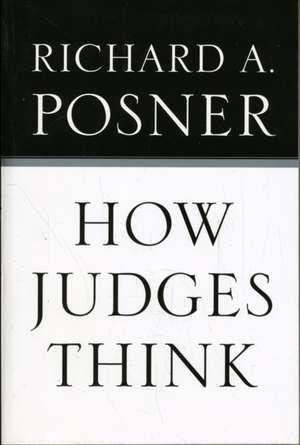
How Judges Think (OISC)
Autor Richard Allen Posneren Limba Engleză Paperback – mai 2010
Richard A. Posner, cel mai citat cercetător juridic al secolului XX, pornește de la o premisă care demontează mitul judecătorului ca simplu „automat” de aplicat legi: în cazurile complexe, materialele legale convenționale se epuizează, lăsând magistratul să navigheze mări neexplorate folosind doar experiența, emoțiile și propriile convingeri inconștiente. Găsim în această carte o analiză tăioasă a modului în care funcționează realitatea din spatele robei, acolo unde raționamentul legalist lasă locul pragmatismului juridic. Ne-a atras atenția modul în care Richard A. Posner definește acest pragmatism nu ca pe o metodă juridică specială, ci ca pe o formă de raționament practic ordinar, orientat spre consecințe politice și sociale pe termen lung. Reținem argumentul său central: în zona deciziilor „deschise”, judecătorii devin legislatori ocazionali, influențați de un set de constrângeri interne și externe, precum etica profesională sau opiniile colegilor. Abordarea diferă de The Judicial Process de E. W. Thomas prin faptul că este mai puțin abstractă și mult mai aplicabilă; în timp ce Thomas deplânge „măcinarea” sistemului sub teorii învechite, Posner oferă o perspectivă realistă, aproape chirurgicală, asupra modului în care puterea este exercitată de facto. Spre deosebire de Legal Reasoning and Political Conflict de Cass R. Sunstein, care propune ca instanțele să evite conflictele abstracte, How Judges Think acceptă natura politică a Curții Supreme ca pe o realitate inevitabilă. Această lucrare se plasează strategic în continuarea operei sale, rafinând temele din The Problems of Jurisprudence și oferind un contra-argument practic la prăpastia academică descrisă în Divergent Paths – The Academy and the Judiciary. Este o lectură despre mecanismele puterii, scrisă de un om care a petrecut peste trei decenii în interiorul sistemului de apel federal.
Preț: 182.41 lei
Carte disponibilă
Livrare economică 16-30 noiembrie
Livrare express 31 octombrie-06 noiembrie pentru 31.61 lei
Specificații
ISBN-10: 0674048067
Pagini: 400
Dimensiuni: 156 x 235 x 29 mm
Greutate: 0.46 kg
Editura: Harvard University Press
Locul publicării:Cambridge, United States
V-ar putea interesa
-
 The Concept of State Aid Under EU Law: From internal market to competition and beyondJuan Jorge Piernas López-31%Preț: 810.62 lei1167.59 lei
 -
 Bounded Rationality and Industrial OrganizationRan Spiegler-11%Preț: 326.73 lei368.85 lei
 -
 EU Competition Law and EconomicsDamien Geradin-14%Preț: 1741.99 lei2025.57 lei
 -
 EU Merger Control: A Legal and Economic AnalysisIoannis Kokkoris-31%Preț: 2302.16 lei3318.96 lei
 -
 The Oxford Handbook of Bayesian EconometricsJohn Geweke-18%Preț: 344.41 lei422.29 lei
 -
 Toward a Theory of Economic GrowthSimon KuznetsPreț: 97.96 lei
 -
 Behavioral Game Theory – Experiments in Strategic InteractionColin F. Camerer-23%Preț: 707.60 lei918.96 lei
 -
 Advances in Behavioral EconomicsColin F. Camerer-19%Preț: 578.39 lei714.06 lei
 -
 The Theory of Corporate FinanceJean Tirole-16%Preț: 723.48 lei861.28 lei
 -
 -23%Preț: 989.37 lei1284.89 lei
 -
 Preț: 212.45 lei
 -
 Analyzing Modern Business CyclesPhilip A KleinPreț: 250.32 lei
 -
 -22%Preț: 271.08 lei346.35 lei
 -
 The Psychology of Intelligence AnalysisRichard J. HeuerPreț: 151.38 lei
 -
 -16%Preț: 515.66 lei615.97 leiRecomandat
De ce să citești această carte
Această carte este esențială pentru profesioniștii din drept și științe politice care doresc să înțeleagă procesul decizional dincolo de litera legii. Cititorul va câștiga o perspectivă demistificată asupra justiției, învățând cum factorii psihologici și politici influențează sentințele în cazurile de mare importanță. Este un instrument critic pentru a evalua legitimitatea puterii judiciare într-o democrație modernă.
Despre autor
Richard A. Posner (n. 1939) este una dintre cele mai influente figuri ale gândirii juridice contemporane, servind ca judecător federal de apel în SUA între 1981 și 2017. Profesor la University of Chicago Law School, el este pionierul analizei economice a dreptului. Cu o operă vastă de aproape 40 de cărți, Posner a explorat intersecția dintre drept și domenii precum economia, filosofia morală sau biologia. Deși tradițional asociat cu conservatorismul juridic, lucrările sale recente, inclusiv analizele asupra crizei financiare din 2008, reflectă o disponibilitate rară de a-și chestiona propriile modele teoretice în fața realității pragmatice.
Descriere
A distinguished and experienced appellate court judge, Richard A. Posner offers in this new book a unique and, to orthodox legal thinkers, a startling perspective on how judges and justices decide cases. When conventional legal materials enable judges to ascertain the true facts of a case and apply clear pre-existing legal rules to them, Posner argues, they do so straightforwardly; that is the domain of legalist reasoning.
However, in non-routine cases, the conventional materials run out and judges are on their own, navigating uncharted seas with equipment consisting of experience, emotions, and often unconscious beliefs. In doing so, they take on a legislative role, though one that is confined by internal and external constraints, such as professional ethics, opinions of respected colleagues, and limitations imposed by other branches of government on freewheeling judicial discretion. Occasional legislators, judges are motivated by political considerations in a broad and sometimes a narrow sense of that term.
In that open area, most American judges are legal pragmatists. Legal pragmatism is forward-looking and policy-based. It focuses on the consequences of a decision in both the short and the long term, rather than on its antecedent logic.
Legal pragmatism so understood is really just a form of ordinary practical reasoning, rather than some special kind of legal reasoning. Supreme Court justices are uniquely free from the constraints on ordinary judges and uniquely tempted to engage in legislative forms of adjudication. More than any other court, the Supreme Court is best understood as a political court.