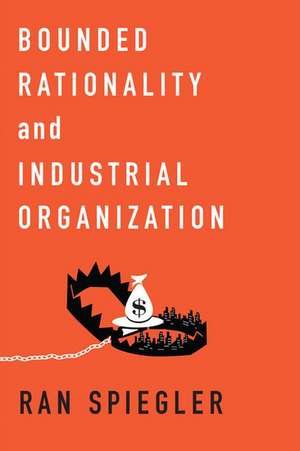
Bounded Rationality and Industrial Organization
Autor Ran Spiegleren Limba Engleză Paperback – 27 feb 2014
Preț: 326.73 lei
Preț vechi: 368.85 lei
-11%
Puncte Express: 490
Carte tipărită la comandă
Livrare economică 04-15 decembrie
Livrare prin curier în România Termenul estimat este afișat lângă disponibilitate.
Transport gratuit de la 400.00 lei Plată online sau ramburs, în funcție de opțiunile comenzii.
Retur gratuit în 14 zile Comandă securizată și suport în română.
Specificații
ISBN-13: 9780199334261
ISBN-10: 0199334269
Pagini: 240
Dimensiuni: 155 x 231 x 15 mm
Greutate: 0.34 kg
Editura: Oxford University Press
Colecția OUP USA
Locul publicării:New York, United States
ISBN-10: 0199334269
Pagini: 240
Dimensiuni: 155 x 231 x 15 mm
Greutate: 0.34 kg
Editura: Oxford University Press
Colecția OUP USA
Locul publicării:New York, United States
V-ar putea interesa
-
 The Concept of State Aid Under EU Law: From internal market to competition and beyondJuan Jorge Piernas López-31%Preț: 810.62 lei1167.59 lei
 -
 EU Competition Law and EconomicsDamien Geradin-14%Preț: 1741.99 lei2025.57 lei
 -
 EU Merger Control: A Legal and Economic AnalysisIoannis Kokkoris-31%Preț: 2302.16 lei3318.96 lei
 -
 The Oxford Handbook of Bayesian EconometricsJohn Geweke-18%Preț: 344.41 lei422.29 lei
 -
 Toward a Theory of Economic GrowthSimon KuznetsPreț: 97.96 lei
 -
 How Judges Think (OISC)Richard Allen PosnerPreț: 182.41 lei
 -
 Behavioral Game Theory – Experiments in Strategic InteractionColin F. Camerer-23%Preț: 707.60 lei918.96 lei
 -
 Advances in Behavioral EconomicsColin F. Camerer-19%Preț: 578.39 lei714.06 lei
 -
 The Theory of Corporate FinanceJean Tirole-16%Preț: 723.48 lei861.28 lei
 -
 -23%Preț: 989.37 lei1284.89 lei
 -
 Preț: 212.45 lei
 -
 Analyzing Modern Business CyclesPhilip A KleinPreț: 250.32 lei
 -
 -22%Preț: 271.08 lei346.35 lei
 -
 The Psychology of Intelligence AnalysisRichard J. HeuerPreț: 150.37 lei
 -
 -16%Preț: 515.66 lei615.97 leiRecomandat
Recenzii
Nobody thinks like Adam Smith when buying a toothbrush, but this is the assumption of consumer behavior offered in traditional economics textbooks. Marketing experts used to laugh at such naivety, but they will have to take economic theory more seriously from now on. Ran Spiegler's book takes on the challenge of rewriting the theory of industrial organization without the classical assumption that economic agents are all rational supermen. This is an important book that nobody working on industrial organization will wish to be without.
Spiegler's Bounded Rationality and Industrial Organization is a beautifully written book. He makes a compelling case that understanding what happens when boundedly rational consumers meet sophisticated firms is both intellectually interesting and practically important. He has a wonderful feel for using rigorous models to clarify arguments and develops insights from a number of branches of the emerging literature in a parsimonious way. It is a must read book.
Spiegler's Bounded Rationality and Industrial Organization is a beautifully written book. He makes a compelling case that understanding what happens when boundedly rational consumers meet sophisticated firms is both intellectually interesting and practically important. He has a wonderful feel for using rigorous models to clarify arguments and develops insights from a number of branches of the emerging literature in a parsimonious way. It is a must read book.
Notă biografică
Professor of Economics at Tel Aviv University and University College London
Cuprins
- 1 Introduction
- 1.1 Bibliographic Notes
- I Anticipating Future Preferences
- 2 Dynamically Inconsistent Preferences I: Unconstrained Contracting
- 2.1 The Multi-Selves Model
- 2.1.1 Naivety
- 2.2 Monopoly Pricing
- 2.2.1 Optimal Price Schemes for Sophisticated Consumers
- 2.2.2 Optimal Price Schemes for Naive Consumers
- 2.2.3 Screening the Consumer's Type
- 2.3 Competitive Pricing
- 2.4 Welfare Analysis
- 2.5 Educating Naive Consumers
- 2.6 The Interpretation of Naivety
- 2.7 Two Applications
- 2.8 Other Topics
- 2.8.1 The (?, ?) Model
- 2.8.2 Preference Heterogeneity
- 2.9 Summary
- 2.10 Bibliographic Notes
- 3 Dynamically Inconsistent Preferences II: Constrained Contracting
- 3.1 Two-Part Tariffs
- 3.1.1 Departure from Marginal-Cost Pricing
- 3.1.2 Welfare Analysis
- 3.2 Destabilization of Commitment Devices: Renegotiation and Spot Market
- Competition
- 3.3 Self-Control
- 3.3.1 Implications for Monopoly Pricing
- 3.3.2 Do Self-Control Costs Hamper Competition?
- 3.4 Summary
- 3.5 Bibliographic Notes
- 4 Dynamically Inconsistent Preferences III: Partial Naivety
- 4.1 Magnitude Naivety
- 4.1.1 Monopoly Pricing
- 4.1.2 Are More Sophisticated Consumers Always Better Off?
- 4.2 Frequency Naivety
- 4.2.1 First-Best Monopoly Pricing
- 4.2.2 Second-Best Monopoly Pricing
- 4.2.3 Does Competition Curb Exploitation?
- 4.3 Summary
- 4.4 Bibliographic Notes
- 5 Biased Beliefs without Dynamic Inconsistency
- 5.1 Monopoly Pricing with Over-Optimistic Consumers
- 5.1.1 Comparison with Related Models
- 5.2 Overconfidence: Three-Part Tariffs
- 5.3 Unforeseen Contingencies: Add-On Pricing
- 5.4 A Summary Exercise: Insurance Markets with Biased Consumers
- 5.4.1 Equilibrium Analysis when Subjective Beliefs are Observable
- 5.4.2 Equilibrium Analysis when Subjective Beliefs are Private Information
- 5.5 Summary
- 5.6 Bibliographic notes
- A Appendix to Part I: A Decision-Theoretic Perspective
- A.1 The Multi-Selves Model
- A.2 Self-Control Preferences
- A.3 The Relation between Self-Control Preferences and the Multi-Selves Model
- A.4 Other Classes of Temptation-Driven Preferences
- A.5 Bibliographic Notes
- II Responding to Market Complexity
- 6 Sampling-Based Reasoning: Price Competition and Product Differentiation
- 6.1 A Sampling-Based Choice Procedure
- 6.2 Price Competition and Technology Adoption
- 6.2.1 Nash Equilibrium
- 6.2.2 Welfare Analysis
- 6.3 Spurious Product Differentiation
- 6.3.1 Nash Equilibrium
- 6.3.2 Product Complexity as a Differentiation Device
- 6.4 Can the Market Educate Consumers?
- 6.5 Summary
- 6.6 Bibliographic Notes
- 7 Sampling-Based Reasoning: Obfuscation
- 7.1 A Model of Competitive Obfuscation
- 7.1.1 Nash Equilibrium
- 7.1.2 Welfare Analysis
- 7.2 Production Inefficiencies
- 7.3 Multi-Dimensional Prices
- 7.4 A Market Intervention: Introducing \Simple" Options
- 7.5 Summary
- 7.6 Bibliographic Notes
- 8 Coarse Reasoning
- 8.1 A Modeling Framework
- 8.2 Complex Price Patterns as a Discrimination Device
- 8.2.1 "DeBruijn" Price Sequences
- 8.2.2 Conditions for Profitability of Complex Price Patterns
- 8.3 Limited Understanding of Adverse Selection
- 8.3.1 A Buyer-Seller Example
- 8.3.2 A Benchmark: A Bayesian-Rational Buyer
- 8.3.3 A \Coarse" Buyer
- 8.3.4 Action-Dependent Feedback
- 8.4 Summary
- 8.5 Bibliographic Notes
- III Reference Dependence
- 9 Loss Aversion
- 9.1 Expected Price as a Reference Point: Monopoly Pricing
- 9.1.1 Reduced Price Variability
- 9.1.2 Impact on Expected Prices
- 9.2 Price Uniformity in a Duopoly Setting: \Kinked" Demand
- 9.3 Expected Consumption as a Reference Point: An \Attachment Effect"
- 9.3.1 Personal Equilibrium
- 9.3.2 Price Randomization
- 9.4 Discussion
- 9.4.1 Actual Prices as Reference Points
- 9.4.2 Pleasant Surprises
- 9.5 Summary
- 9.6 Bibliographic Notes
- 10 Inertia I: Price Competition
- 10.1 Price Competition under Consumer Inertia
- 10.2 Price-Frame Competition
- 10.2.1 Nash Equilibrium
- 10.2.2 Equilibrium Properties
- 10.2.3 Two Market Interventions
- 10.3 Consumer Switching
- 10.4 Asymmetric Default Assignment
- 10.5 A Few General Remarks
- 10.5.1 More than Two Frames
- 10.5.2 Revealed Preferences
- 10.6 Summary
- 10.7 Bibliographic Notes
- 11 Inertia II: Costly Marketing 261
- 11.1 A Model of Competitive Marketing
- 11.2 Nash Equilibrium
- 11.3 The Effective Marketing Property
- 11.4 Discussion
- 11.5 Summary
- 11.6 Bibliographic Notes
- IV Discussion
- 12 Recurring Themes
- 12.1 Complex Pricing Strategies
- 12.2 Spurious Variety
- 12.3 Market Transactions as a Form of Speculative Trade
- 12.4 How Effective are Competition and Consumer Protection Policies?
- 12.5 Externalities between Rational and Boundedly Rational Consumers
- 12.6 Conclusion
- 13 But Can't we Get the Same Thing with a Standard Model?
- 13.1 Rationalization via Modified Information
- 13.2 Rationalization via Modified Preferences
- 13.3 Rationalization via Endogenization
- 13.4 Discussion
- 13.5 Epilogue
- 13.6 Bibliographic Notes
- Bibliography
- Index