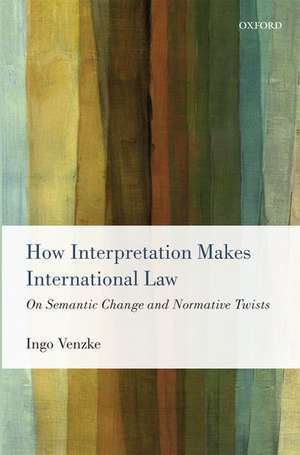
How Interpretation Makes International Law: On Semantic Change and Normative Twists
Autor Ingo Venzkeen Limba Engleză Hardback – 6 sep 2012
Preț: 712.45 lei
Preț vechi: 1032.04 lei
-31%
Puncte Express: 1069
Carte tipărită la comandă
Livrare economică 20 noiembrie-01 decembrie
Livrare prin curier în România Termenul estimat este afișat lângă disponibilitate.
Transport gratuit pentru acest produs Plată online sau ramburs, în funcție de opțiunile comenzii.
Retur gratuit în 14 zile Comandă securizată și suport în română.
Specificații
ISBN-13: 9780199657674
ISBN-10: 019965767X
Pagini: 338
Dimensiuni: 163 x 235 x 25 mm
Greutate: 0.67 kg
Editura: OUP OXFORD
Colecția OUP Oxford
Locul publicării:Oxford, United Kingdom
ISBN-10: 019965767X
Pagini: 338
Dimensiuni: 163 x 235 x 25 mm
Greutate: 0.67 kg
Editura: OUP OXFORD
Colecția OUP Oxford
Locul publicării:Oxford, United Kingdom
V-ar putea interesa
-
 Representing Time: An Essay on Temporality as ModalityKasia M. Jaszczolt-21%Preț: 300.97 lei379.69 lei
 -
 -21%Preț: 403.67 lei509.93 lei
 -
 Semantic Analysis: A Practical IntroductionCliff Goddard-10%Preț: 392.52 lei436.76 lei
 -
 Donald Davidson's Truth-Theoretic SemanticsErnest Lepore-21%Preț: 512.81 lei651.87 lei
 -
 Interfaces in Linguistics: New Research PerspectivesRaffaella Folli-22%Preț: 450.76 lei578.68 lei
 -
 Negative IndefinitesDoris Penka-23%Preț: 503.75 lei651.56 lei
 -
 The Semantics of Clause Linking: A Cross-Linguistic TypologyR. M. W. Dixon-21%Preț: 377.69 lei476.35 lei
 -
 -23%Preț: 942.31 lei1223.79 lei
 -
 PragmaticsSiobhan Chapman-24%Preț: 267.09 lei353.41 lei
 -
 Language and StyleDan McIntyrePreț: 347.51 lei
 -
 SemanticsKate Kearns-23%Preț: 258.55 lei337.21 lei
 -
 Discourse StudiesTeun A. van Dijk-8%Preț: 525.49 lei571.18 lei
Recenzii
It is an impressive and thought-provoking book for scholars and practitioners alike, as it addresses key issues of interpretation in a way that, until now, has remained more or less unexplored ... Readers of Venzke's book will find it the work of a talented writer and lawyer - a truly enjoyable read, and this being backed by solid research and well-structured arguments, the whole is a brilliantly executed piece of work. Last not least, Venzke also succeeds in building a bridge between legal theory and what is sometimes too pedestrian - the practitioner's perspective; both kinds of reader can benefit from reading this book.
Venzke's philosophically and dogmatically thoughtful work provides a sophisticated translation of critical linguistic arguments into concrete conclusions for the law.
Who does not read it [the book] will spend a lot of time with unnecessary problems.
Ingo Venzke's insightful work on the changing of international norms by way of interpretation comes at an opportune moment ... Its main achievement lies in its critical approach to exposing where authority and power really lie.
well worth reading ... a welcome contribution to international law
Ingo Venzke's book How Interpretation Makes International Law: On Semantic Change and Normative Twists tells a number of tortoise and hare tales with respect to the creation of international law. In these tales the hare is represented by a number of different concepts and actors: formalism, states, sovereignty and sources-centred theoretical accounts of international law and the classic understanding of pacta sunt servanda as the ultimate maxim of how international law comes into existence ... the tortoises in Venzke's thesis are portrayed by the theory of communicative action, jurisgenerative practice and the interpretive acts of international administrations and other participants in international legal relations. Venzke's book is a significant step in providing a concrete theoretical framework for the analysis of how tortoises run. They run in many ways, but a very significant one is interpretation.
Readers of Venzke's book will find it the work of a talented writer and lawyer-a truly enjoyable read, and this being backed by solid research and well-structured arguments, the whole is a brilliantly executed piece of work.
Venzke's philosophically and dogmatically thoughtful work provides a sophisticated translation of critical linguistic arguments into concrete conclusions for the law.
Who does not read it [the book] will spend a lot of time with unnecessary problems.
Ingo Venzke's insightful work on the changing of international norms by way of interpretation comes at an opportune moment ... Its main achievement lies in its critical approach to exposing where authority and power really lie.
well worth reading ... a welcome contribution to international law
Ingo Venzke's book How Interpretation Makes International Law: On Semantic Change and Normative Twists tells a number of tortoise and hare tales with respect to the creation of international law. In these tales the hare is represented by a number of different concepts and actors: formalism, states, sovereignty and sources-centred theoretical accounts of international law and the classic understanding of pacta sunt servanda as the ultimate maxim of how international law comes into existence ... the tortoises in Venzke's thesis are portrayed by the theory of communicative action, jurisgenerative practice and the interpretive acts of international administrations and other participants in international legal relations. Venzke's book is a significant step in providing a concrete theoretical framework for the analysis of how tortoises run. They run in many ways, but a very significant one is interpretation.
Readers of Venzke's book will find it the work of a talented writer and lawyer-a truly enjoyable read, and this being backed by solid research and well-structured arguments, the whole is a brilliantly executed piece of work.
Notă biografică
Ingo Venzke is a Research Fellow and Lecturer at the Amsterdam Center for International Law, University of Amsterdam. He completed his doctorate in law at the University of Frankfurt while working at the Max Planck Institute for Comparative Public Law and International Law in Heidelberg where he co-directed a research project on the exercise of public authority by international courts. Ingo was a Hauser Research Scholar at New York University and a Visiting Scholar at the Cegla Center for the Interdisciplinary Research of the Law, Tel Aviv University. He received his LL.M. from the University of London and his B.A. in International Relations from the University of Dresden.
Cuprins
- 1: In the Beginning was the Deed
- 2: The Practice of Interpretation: A Theoretical Perspective
- 3: UNHCR and the Making of Refugee Law
- 4: Adjudication in the GATT/WTO: Making General Exceptions in Trade Law
- 5: Creative Interpretations: Normative Twists
- 6: Epilogue: In the End there is Eternity