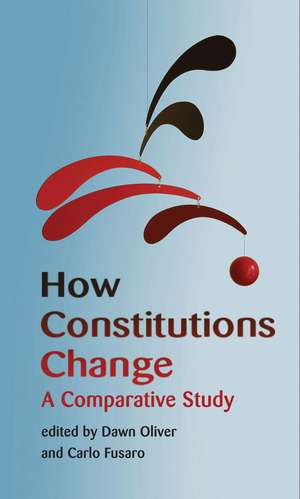
How Constitutions Change: A Comparative Study
Editat de Professor Dawn Oliver, Carlo Fusaroen Limba Engleză Hardback – 9 aug 2011
The countries in this study include, from the EU, a common law country, a Nordic one, a former communist state, several civil law systems, parliamentary systems and a hybrid one (France). Chapters on non EU countries include two on developing countries (India and South Africa), two on common law countries without entrenched written constitutions (Israel and New Zealand), a presidential system (the USA) and three federal ones (Switzerland, the USA and Canada). In the last two chapters the editors conduct a detailed comparative analysis of the jurisdiction-based chapters and explore the question whether any overarching theory or theories about constitutional change in liberal democracies emerge from the study.
Preț: 622.74 lei
Preț vechi: 916.18 lei
-32%
Puncte Express: 934
Carte tipărită la comandă
Livrare economică 23 noiembrie-07 decembrie
Livrare prin curier în România Termenul estimat este afișat lângă disponibilitate.
Transport gratuit pentru acest produs Plată online sau ramburs, în funcție de opțiunile comenzii.
Retur gratuit în 14 zile Comandă securizată și suport în română.
Specificații
ISBN-13: 9781849460941
ISBN-10: 1849460949
Pagini: 514
Dimensiuni: 171 x 244 x 25 mm
Greutate: 0.93 kg
Ediția:New.
Editura: Bloomsbury Publishing
Colecția Hart Publishing
Locul publicării:London, United Kingdom
ISBN-10: 1849460949
Pagini: 514
Dimensiuni: 171 x 244 x 25 mm
Greutate: 0.93 kg
Ediția:New.
Editura: Bloomsbury Publishing
Colecția Hart Publishing
Locul publicării:London, United Kingdom
V-ar putea interesa
-
 -15%Preț: 111.83 lei131.00 lei
 -
 -28%Preț: 488.98 lei680.19 lei
 -
 -31%Preț: 563.79 lei816.98 lei
 -
 Foreign Affairs and the United States ConstitutionLouis Henkin-31%Preț: 686.26 lei988.97 lei
 -
 An Introduction to Constitutional LawEric Barendt-29%Preț: 396.51 lei555.87 lei
 -
 Interpreting Constitutions: A Comparative StudyJeffrey Goldsworthy-21%Preț: 428.39 lei542.77 lei
 -
 The Sovereignty of Parliament: History and PhilosophyJeffrey Goldsworthy-22%Preț: 395.72 lei509.16 lei
 -
 Public LawAdam Tomkins-23%Preț: 404.83 lei523.80 lei
 -
 -31%Preț: 900.07 lei1308.72 lei
 -
 Employment LawHugh Collins-31%Preț: 740.04 lei1075.91 lei
 -
 Key Cases: Constitutional and Administrative LawJoanne ColesPreț: 372.46 lei
 -
 Law of European UnionPenelope Kent-13%Preț: 422.00 lei485.06 lei
 -
 The Safest Shield: Lectures, Speeches and EssaysLord Igor Judge-29%Preț: 378.93 lei534.92 lei
 -
 -33%Preț: 720.35 lei1070.02 lei
 -
 Debating Social RightsProfessor Conor Gearty-17%Preț: 190.99 lei230.11 lei
 -
 -23%Preț: 235.01 lei306.97 lei
 -
 Commonwealth Caribbean Public LawAlbert Fiadjoe-15%Preț: 578.15 lei680.19 lei
 -
 Jus Post BellumCarsten StahnPreț: 391.16 lei
Cuprins
Part I
1. Changing Constitutions
Carlo Fusaro and Dawn Oliver
Part II
2. Canada
Tsvi Kahana
3. The Czech Republic
Maxim Tomoszek
4. The European Union
Renaud Dehousse
5. Finland
Markku Suksi
6. France
Sophie Boyron
7. Germany
Jens Woelk
8. India
Mahendra Pal Singh
9. Israel
Suzie Navot
10. Italy
Carlo Fusaro
11. New Zealand
Paul Rishworth
12. Republic of South Africa
Hugh Corder
13. Spain
Ascensión Elvira
14. Switzerland
Giovanni Biaggini
15. The United Kingdom
Dawn Oliver
16. The United States of America
Stephen M Griffin
Part III
17. Changing Constitutions: Comparative Analysis
Dawn Oliver and Carlo Fusaro
18. Towards a Theory of Constitutional Change
Carlo Fusaro and Dawn Oliver
Annex: Jurisdiction-based Chart
1. Changing Constitutions
Carlo Fusaro and Dawn Oliver
Part II
2. Canada
Tsvi Kahana
3. The Czech Republic
Maxim Tomoszek
4. The European Union
Renaud Dehousse
5. Finland
Markku Suksi
6. France
Sophie Boyron
7. Germany
Jens Woelk
8. India
Mahendra Pal Singh
9. Israel
Suzie Navot
10. Italy
Carlo Fusaro
11. New Zealand
Paul Rishworth
12. Republic of South Africa
Hugh Corder
13. Spain
Ascensión Elvira
14. Switzerland
Giovanni Biaggini
15. The United Kingdom
Dawn Oliver
16. The United States of America
Stephen M Griffin
Part III
17. Changing Constitutions: Comparative Analysis
Dawn Oliver and Carlo Fusaro
18. Towards a Theory of Constitutional Change
Carlo Fusaro and Dawn Oliver
Annex: Jurisdiction-based Chart
Recenzii
The volume undoubtedly assembles a considerable amount of useful and interesting material relating to the individual countries studied. In this way, it provides a valuable compendium, making information on a number of less known constitutional systems available in English.
...comparative public lawyers will no doubt value the information on how constitutions change in the various legal systems assembled and represented in the volume.
Due to the broad approach adopted in this book, a lively picture is drawn of the different constitutional cultures including historic, political, legal or social aspects.
How Constitutions Change contains many exciting and surprising details about constitutions all over the world...as the editors suggest, this book has to be seen as first approach to a theory of constitutional change. In this regard, the study offers viable opportunity to get familiar with the many aspects of this topic.
This collection of essays [on How Constitutions Change] provides authoritative academic commentary and reflections on the evolution of contemporary democratic principles. The collection is rich in insights which should encourage researchers to pursue comparative research, and suggests a uniquely effective approach to the task.
The Authors note that a constitution totally unsuited for change sooner or later is doomed to become an instrument incapable of serving its purpose, bound therefore to be superseded. In the end, they believe that constitutional patriotism is best served by ensuring that a given set of constitutional arrangements can be adapted and incrementally changed rather than making out of it a petrified object of devotion. And I would agree with them.
...comparative public lawyers will no doubt value the information on how constitutions change in the various legal systems assembled and represented in the volume.
Due to the broad approach adopted in this book, a lively picture is drawn of the different constitutional cultures including historic, political, legal or social aspects.
How Constitutions Change contains many exciting and surprising details about constitutions all over the world...as the editors suggest, this book has to be seen as first approach to a theory of constitutional change. In this regard, the study offers viable opportunity to get familiar with the many aspects of this topic.
This collection of essays [on How Constitutions Change] provides authoritative academic commentary and reflections on the evolution of contemporary democratic principles. The collection is rich in insights which should encourage researchers to pursue comparative research, and suggests a uniquely effective approach to the task.
The Authors note that a constitution totally unsuited for change sooner or later is doomed to become an instrument incapable of serving its purpose, bound therefore to be superseded. In the end, they believe that constitutional patriotism is best served by ensuring that a given set of constitutional arrangements can be adapted and incrementally changed rather than making out of it a petrified object of devotion. And I would agree with them.