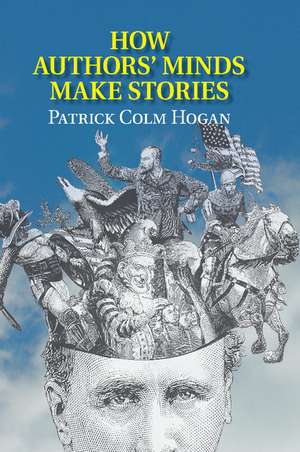
How Authors' Minds Make Stories
Autor Patrick Colm Hoganen Limba Engleză Paperback – aug 2014
Preț: 299.96 lei
Puncte Express: 450
Carte tipărită la comandă
Livrare economică 02-16 decembrie
Livrare prin curier în România Termenul estimat este afișat lângă disponibilitate.
Transport gratuit de la 400.00 lei Plată online sau ramburs, în funcție de opțiunile comenzii.
Retur gratuit în 14 zile Comandă securizată și suport în română.
Specificații
ISBN-13: 9781107475892
ISBN-10: 1107475899
Pagini: 250
Dimensiuni: 152 x 229 x 15 mm
Greutate: 0.41 kg
Editura: Cambridge University Press
Locul publicării:New York, United States
ISBN-10: 1107475899
Pagini: 250
Dimensiuni: 152 x 229 x 15 mm
Greutate: 0.41 kg
Editura: Cambridge University Press
Locul publicării:New York, United States
V-ar putea interesa
-
 The Mind and Its StoriesPatrick Colm HoganPreț: 366.14 lei
 -
 Figurative LanguageBarbara DancygierPreț: 389.43 lei
 -
 The Psychology of Visual ArtGeorge MatherPreț: 432.22 lei
 -
 Understanding Autobiographical MemoryDorthe BerntsenPreț: 399.86 lei
 -
 Cognition and MotivationShulamith Kreitler-11%Preț: 628.66 lei706.36 lei
 -
 Preț: 355.76 lei
 -
 Face Value: The Irresistible Influence of First ImpressionsAlexander TodorovPreț: 304.08 lei
 -
 Are We Getting Smarter?James R. FlynnPreț: 196.98 lei
 -
 Extraordinary BeliefsPeter LamontPreț: 284.05 lei
 -
 Does Your Family Make You Smarter?James R. FlynnPreț: 193.35 lei
 -
 Judgment Decision MakingDavid HardmanPreț: 389.57 lei
 -
 The Learning BrainSarah-Jayne BlakemorePreț: 270.32 lei
 -
 The Little Mindfulness WorkbookGary Hennessey-28%Preț: 50.64 lei70.22 lei
 -
 New Developments in Expressive Arts Therapy: The Play of PoiesisStephen K. Levine-28%Preț: 233.20 lei324.84 lei
Cuprins
Introduction: from the universal to the particular; 1. Simulation: imagining fictional worlds in Faulkner and Austen; 2. Story development, literary evaluation, and the place of character; 3. A narrative idiolect: Shakespeare's heroic stories; 4. Principles and parameters of storytelling: the trajectory of Racine's romantic tragedies; 5. Argument and metaphor in Brecht and Kafka; 6. Emplotment: selection, organization, and construal in Hamlet; Afterword: if on a winter's night a narrator ….
Recenzii
“From his groundbreaking work on how the mind’s stories resonate with themes that occur all around the world, Patrick Hogan takes on the question of how minds make stories. His answer is that it is by the same sort of imagination that we humans use to know each other. Hogan ranges cogently through examples from William Shakespeare’s Hamlet and Jane Austen’s Emma to Franz Kafka’s Metamorphosis. He ends with an afterword, inspired by Italo Calvino, of a kind you won’t find in any other academic book. Marvelous.”
– Keith Oatley, University of Toronto
“Patrick Hogan’s provocative discussion of the role of simulation in literary composition demystifies literary narration by relating it to familiar mechanisms of reasoning and simulation. More important, he makes explicit cognitivist attempts at explanation so that we can try to evaluate how far cognitive approaches to narrative just provide an alternative vocabulary, and how far they offer additional explanatory power. As Hogan models the processes that underlie the creation of literary works, he outlines of a valuable program for poetics.”
– Jonathan Culler, Cornell University
"...This engaging and thoughtful written account, [however], goes beyond traditional approaches of literary criticism.... Drawing on recent work in neurophysiology, primed memories, childhood experiences, and theories of mind, Hogan makes a significant contribution to both cognitive and literary studies.... sheds light on the uniquely human mental faculty of authors to entertain counterfactual situations and render them in well-crafted, descriptively precise word.... Highly recommended..."
--R.M. Davis, emeritus, Albion College, CHOICE
– Keith Oatley, University of Toronto
“Patrick Hogan’s provocative discussion of the role of simulation in literary composition demystifies literary narration by relating it to familiar mechanisms of reasoning and simulation. More important, he makes explicit cognitivist attempts at explanation so that we can try to evaluate how far cognitive approaches to narrative just provide an alternative vocabulary, and how far they offer additional explanatory power. As Hogan models the processes that underlie the creation of literary works, he outlines of a valuable program for poetics.”
– Jonathan Culler, Cornell University
"...This engaging and thoughtful written account, [however], goes beyond traditional approaches of literary criticism.... Drawing on recent work in neurophysiology, primed memories, childhood experiences, and theories of mind, Hogan makes a significant contribution to both cognitive and literary studies.... sheds light on the uniquely human mental faculty of authors to entertain counterfactual situations and render them in well-crafted, descriptively precise word.... Highly recommended..."
--R.M. Davis, emeritus, Albion College, CHOICE
Descriere
This book explores how the creations of great authors result from the same cognitive processes as our everyday counterfactual and hypothetical imaginations.