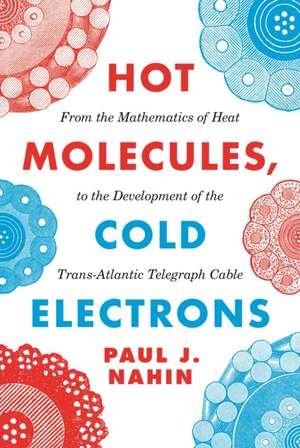
Hot Molecules, Cold Electrons
Autor Paul J. Nahinen Limba Engleză Hardback – 17 mar 2020
În ecosistemul istoriei științei și ingineriei aplicate, Hot Molecules, Cold Electrons ocupă un loc central, analizând fundamentele matematice ale ecuației căldurii și impactul acesteia asupra tehnologiei comunicațiilor. Remarcăm modul în care Paul Nahin reușește să demonstreze că un concept abstract de termodinamică a devenit pilonul central în realizarea cablului telegrafic transatlantic, o provocare tehnică monumentală a secolului al XIX-lea. Suntem de părere că această lucrare continuă tradiția autorului de a transforma problemele dificile în narațiuni accesibile, similar abordării sale din Number–Crunching, unde investiga depanarea cablurilor submarine prin calcule matematice riguroase. Dacă în Duelling Idiots and Other Probability Puzzlers se concentra pe enigme de probabilitate, aici Paul Nahin își îndreaptă atenția către fizica matematică și aplicațiile sale industriale. Ca și Jeremy Gray în Change and Variations, autorul distilează experiență reală în principii acționabile, oferind o perspectivă istorică asupra ecuațiilor diferențiale. Lucrarea face referire directă la fundamentul pus de Jean Baptiste Joseph Fourier în The Analytical Theory of Heat, explicând cum seriile matematice infinite au permis analizarea conducției termice în solide. Prin acest volum, Paul Nahin reușește să poziționeze ecuația căldurii nu doar ca un instrument de laborator, ci ca o forță motrice a progresului tehnologic global.
Preț: 160.23 lei
Carte disponibilă
Livrare economică 14-28 septembrie
Livrare express 28 august-03 septembrie pentru 35.15 lei
Specificații
ISBN-10: 0691191727
Pagini: 232
Dimensiuni: 166 x 249 x 25 mm
Greutate: 0.55 kg
Editura: Princeton University Press
V-ar putea interesa
-
 The Mathematical Theory of CommunicationClaude E ShannonPreț: 168.53 lei
 -
 Preț: 393.75 lei
 -
 Number-CrunchingPaul J. NahinPreț: 254.46 lei
 -
 Will You Be Alive 10 Years from Now?Paul J NahinPreț: 107.27 lei
 -
 When Least Is BestPaul J NahinPreț: 106.93 lei
 -
 How to Fall Slower Than GravityPaul J NahinPreț: 135.44 lei
 -
 Brunel's BritainDerrick BeckettPreț: 132.91 lei
 -
 Preț: 130.27 lei
 -
 -18%Preț: 1003.44 lei1223.71 lei
 -
 Small Things ConsideredHenry PetroskiPreț: 113.64 lei
 -
 The Wireless OperatorDavid TuchPreț: 141.97 lei
 -
 Inside Interesting IntegralsPaul J. NahinPreț: 395.40 lei
 -
 Simulazione CFD del flusso di fluidi attraverso tubi con giunzione a T, Y e yAllaboina V. Ramana RaoPreț: 260.63 lei
 -
 Preț: 128.68 lei
 -
 Preț: 128.48 lei
 -
 -8%Preț: 410.84 lei446.56 lei
 -
 -8%Preț: 410.49 lei446.19 lei
 -
 -8%Preț: 410.49 lei446.19 lei
 -
 Preț: 231.32 lei
De ce să citești această carte
Recomandăm această carte pasionaților de inginerie și istoria științei care doresc să înțeleagă legătura dintre matematica teoretică și marile realizări tehnice. Cititorul va câștiga o perspectivă clară asupra modului în care ecuația căldurii a influențat dezvoltarea telegrafiei moderne. Este o lectură esențială pentru cei care apreciază rigoarea matematică aplicată în rezolvarea problemelor complexe de infrastructură mondială.
Notă biografică
Descriere scurtă
An entertaining mathematical exploration of the heat equation and its role in the triumphant development of the trans-Atlantic telegraph cable
Heat, like gravity, shapes nearly every aspect of our world and universe, from how milk dissolves in coffee to how molten planets cool. The heat equation, a cornerstone of modern physics, demystifies such processes, painting a mathematical picture of the way heat diffuses through matter. Presenting the mathematics and history behind the heat equation, Hot Molecules, Cold Electrons tells the remarkable story of how this foundational idea brought about one of the greatest technological advancements of the modern era. Paul Nahin vividly recounts the heat equation's tremendous influence on society, showing how French mathematical physicist Joseph Fourier discovered, derived, and solved the equation in the early nineteenth century. Nahin then follows Scottish physicist William Thomson, whose further analysis of Fourier's explorations led to the pioneering trans-Atlantic telegraph cable. This feat of engineering reduced the time it took to send a message across the ocean from weeks to minutes. Readers also learn that Thomson used Fourier's solutions to calculate the age of the earth, and, in a bit of colorful lore, that writer Charles Dickens relied on the trans-Atlantic cable to save himself from a career-damaging scandal. The book's mathematical and scientific explorations can be easily understood by anyone with a basic knowledge of high school calculus and physics, and MATLAB code is included to aid readers who would like to solve the heat equation themselves. A testament to the intricate links between mathematics and physics, Hot Molecules, Cold Electrons offers a fascinating glimpse into the relationship between a formative equation and one of the most important developments in the history of human communication.