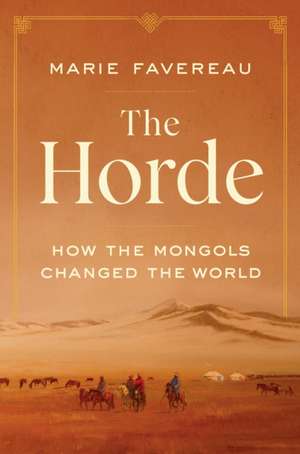
Horde
Autor Marie Favereauen Limba Engleză Hardback – apr 2021
Remarcăm, încă de la primele hărți și analize de caz incluse în acest volum, o schimbare radicală de perspectivă: Marie Favereau propune o examinare a Hoardei nu ca forță distructivă, ci ca un sistem administrativ sofisticat. Analiza se concentrează pe modul în care acest regim politic unic, bazat pe partajarea puterii între han și aristocrație, a creat un ordin economic mobil și inovator. Descoperim cum, de la capitala de pe cursul inferior al Volgăi, mongolii au influențat structurile statale din spațiul rus și islamic, introducând concepte avansate de toleranță religioasă și diplomație comercială. Din punct de vedere vizual, cele 15 hărți și 21 de fotografii incluse în ediția de față sunt esențiale pentru a înțelege rutele de integrare care au conectat civilizații anterior izolate. Reținem că această lucrare nu este doar o cronică militară, ci un studiu despre reziliență și adaptabilitate instituțională. Lucrarea The Horde completează perspectiva oferită de The Mongols de Morris Rossabi, adăugând o profunzime necesară asupra mecanismelor economice și administrative specifice Hoardei de Aur, depășind simpla cronologie a cuceririlor prezentată în introducerile generale. Față de abordările clasice, Marie Favereau demonstrează că lumea modernă a fost modelată de aceste structuri nomade, oferind un aparat critic riguros ce transformă percepția asupra istoriei Eurasiei.
Preț: 212.12 lei
Carte disponibilă
Livrare economică 19 octombrie-02 noiembrie
Specificații
ISBN-10: 0674244214
Pagini: 384
Dimensiuni: 170 x 244 x 40 mm
Greutate: 0.73 kg
Editura: Harvard University Press
V-ar putea interesa
-
 -20%Preț: 16.39 lei20.60 lei
 -
 The Mexican Pet (Paper)Jh BrunvandPreț: 109.10 lei
 -
 Wind in the Ash TreeJ McmullenPreț: 110.38 lei
 -
 Baby BoomersPaul Charles LightPreț: 134.08 lei
 -
 Technological Risk (Paper)Harold Warren LewisPreț: 136.39 lei
 -
 The Latin DeliJudith Ortiz CoferPreț: 83.71 lei
 -
 Going Higher with God in PrayerA. W. TozerPreț: 90.75 lei
 -
 Embracing TrustJoanna WeaverPreț: 99.36 lei
 -
 From Trauma to TransformationDebra LaaserPreț: 102.13 lei
 -
 Preț: 91.92 lei
 -
 Strategic Disciple MakingAubrey MalphursPreț: 118.83 lei
 -
 Preț: 91.76 lei
 -
 Saving Your Church from ItselfChris SonksenPreț: 113.61 lei
 -
 Soul Care to Save Your LifeManda CarpenterPreț: 92.67 lei
 -
 Strangers and ScapegoatsMatthew S VosPreț: 134.93 lei
 -
 A Christian Theology of SciencePaul TysonPreț: 133.28 lei
 -
 Preț: 100.28 lei
 -
 Preț: 295.85 lei
 -
 English Victorian ChurchesJames Stevens Curl-19%Preț: 463.24 lei571.89 lei
 -
 The Pastoral EpistlesOsvaldo PadillaPreț: 127.93 lei
 -
 The Pastoral Care of Women in Late Medieval EnglandBeth Alison BarrPreț: 212.90 lei
 -
 The Illumination CodexMichael James GarberPreț: 282.13 lei
 -
 The Metamorphosis of PurposeMarcia E. RhoePreț: 81.80 lei
De ce să citești această carte
Această carte este esențială pentru cititorii pasionați de istorie geopolitică și economie mondială. Veți câștiga o înțelegere clară a modului în care un imperiu nomad a pus bazele globalizării timpurii. Este o lectură necesară pentru a demonta prejudecățile despre „barbari” și pentru a observa cum toleranța religioasă și inovația administrativă pot susține un imperiu timp de secole.
Despre autor
Marie Favereau este un istoric francez specializat în Imperiul Mongol și Hoarda de Aur. Activitatea sa academică se concentrează pe intersecția dintre istoria politică și cea economică a Eurasiei. Prin lucrarea de față, publicată de Belknap Press, ea a obținut recunoaștere internațională, fiind finalistă la prestigiosul Premiu Cundill. Expertiza sa este recunoscută pentru modul în care reușește să integreze surse rusești, persane și mongole pentru a reconstrui o imagine fidelă a structurilor de putere nomade, oferind o voce nouă și documentată într-un domeniu adesea marcat de interpretări unilaterale.
Descriere scurtă
A Financial Times Best Book of the Year
A Spectator Best Book of the Year
A Five Books Best Book of the Year
"Outstanding, original, and revolutionary. Favereau subjects the Mongols to a much-needed re-evaluation, showing how they were able not only to conquer but to control a vast empire. A remarkable book."
-Peter Frankopan, author of The Silk Roads
The Mongols are widely known for one thing: conquest. In the first comprehensive history of the Horde, the western portion of the Mongol empire that arose after the death of Chinggis Khan, Marie Favereau shows that the accomplishments of the Mongols extended far beyond war. For three hundred years, the Horde was no less a force in global development than Rome had been. It left behind a profound legacy in Europe, Russia, Central Asia, and the Middle East, palpable to this day.
Favereau takes us inside one of the most powerful sources of cross-border integration in world history. The Horde was the central node in the Eurasian commercial boom of the thirteenth and fourteenth centuries and was a conduit for exchanges across thousands of miles. Its unique political regime-a complex power-sharing arrangement among the khan and the nobility-rewarded skillful administrators and diplomats and fostered an economic order that was mobile, organized, and innovative. From its capital at Sarai on the lower Volga River, the Horde provided a governance model for Russia, influenced social practice and state structure across Islamic cultures, disseminated sophisticated theories about the natural world, and introduced novel ideas of religious tolerance.
The Horde is the eloquent, ambitious, and definitive portrait of an empire little understood and too readily dismissed. Challenging conceptions of nomads as peripheral to history, Favereau makes clear that we live in a world inherited from the Mongol moment.
Descriere
Cundill Prize Finalist A Financial Times Book of the Year A Spectator Book of the Year A Five Books Book of the Year The Mongols are known for one thing: conquest. But in this first comprehensive history of the Horde, the western portion of the Mongol empire that arose after the death of Chinggis Khan, Marie Favereau takes us inside one of the most powerful engines of economic integration in world history to show that their accomplishments extended far beyond the battlefield. Central to the extraordinary commercial boom that brought distant civilizations in contact for the first time, the Horde had a unique political regime—a complex power-sharing arrangement between the khan and nobility—that rewarded skillful administrators and fostered a mobile, innovative economic order. From their capital on the lower Volga River, the Mongols influenced state structures in Russia and across the Islamic world, disseminated sophisticated theories about the natural world, and introduced new ideas of religious tolerance. An eloquent, ambitious, and definitive portrait of an empire that has long been too little understood, The Horde challenges our assumptions that nomads are peripheral to history and makes it clear that we live in a world shaped by Mongols. “The Mongols have been ill-served by history, the victims of an unfortunate mixture of prejudice and perplexity...The Horde flourished, in Favereau’s fresh, persuasive telling, precisely because it was not the one-trick homicidal rabble of legend.” —Wall Street Journal “Fascinating...The Mongols were a sophisticated people with an impressive talent for government and a sensitive relationship with the natural world...An impressively researched and intelligently reasoned book.” —The Times