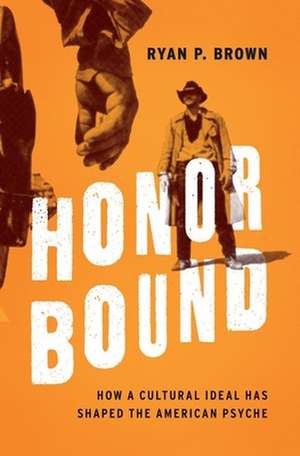
Honor Bound: How a Cultural Ideal Has Shaped the American Psyche
Autor Ryan P. Brownen Limba Engleză Hardback – 30 iun 2016
While most human societies throughout history can be described as "honor cultures," the United States is particularly well known for having a deeply rooted culture of honor, especially in the American South and West. In Honor Bound, social psychologist Ryan P. Brown integrates social science research, current events, and personal stories to explore and explain how honor underpins nearly every aspect of our lives, from spontaneous bar fights to organized acts of terrorism, romantic relationships, mental health and well-being, unsportsmanlike conduct in football, the commission of suicide, foreign policy decisions by political leaders, and even how parents name their babies.
Sometimes the effects of living in an honor culture are subtle and easily missed-there are fewer nursing homes in the American south, as more parents live with their children as they age-and sometimes the effects are more dramatic, as in the fact that there are more school shootings in honor states, but they are always relevant. By illuminating a surprising and pervasive thread that has endured in our culture for centuries, Brown's narrative will captivate those raised in these types of honor cultures who wish to understand themselves, and those who wish to better understand their neighbors.
| Toate formatele și edițiile | Preț | Express |
|---|---|---|
| Paperback (1) | 169.21 lei 41-52 zile | |
| Oxford University Press – 22 mar 2018 | 169.21 lei 41-52 zile | |
| Hardback (1) | 215.55 lei 3-5 săpt. | |
| Oxford University Press – 30 iun 2016 | 215.55 lei 3-5 săpt. |
Preț: 215.55 lei
Puncte Express: 323
Preț estimativ în valută:
38.12€ • 44.25$ • 33.18£
38.12€ • 44.25$ • 33.18£
Carte disponibilă
Livrare economică 28 martie-11 aprilie
Specificații
ISBN-13: 9780199399864
ISBN-10: 0199399867
Pagini: 232
Dimensiuni: 156 x 235 x 25 mm
Greutate: 0.45 kg
Editura: Oxford University Press
Colecția OUP USA
Locul publicării:New York, United States
ISBN-10: 0199399867
Pagini: 232
Dimensiuni: 156 x 235 x 25 mm
Greutate: 0.45 kg
Editura: Oxford University Press
Colecția OUP USA
Locul publicării:New York, United States
V-ar putea interesa
-
 The 33 Strategies of WarRobert GreenePreț: 159.53 lei
 -
 Adaptive Thinking: Rationality in the Real WorldGerd Gigerenzer-11%Preț: 406.35 lei456.58 lei
 -
 A Life Worth Living: Contributions to positive psychologyMihaly Csikszentmihalyi-21%Preț: 520.72 lei660.78 lei
 -
 The Psychology of Terrorism FearsSamuel Justin Sinclair-31%Preț: 370.91 lei541.01 lei
 -
 The Musical Temperament: Psychology and Personality of MusiciansAnthony E. Kemp-34%Preț: 644.04 lei978.51 lei
 -
 The Social Psychology of MusicDavid J. Hargreaves-24%Preț: 387.41 lei510.51 lei
 -
 -29%Preț: 512.04 lei717.29 lei
 -
 -24%Preț: 270.78 lei358.59 lei
 -
 Social IntelligenceDaniel GolemanPreț: 104.04 lei
 -
 Identities, Groups and Social IssuesMichel ForséPreț: 462.79 lei
 -
 Doing Social PsychologyDorothy E MiellPreț: 440.58 lei
 -
 Culture of Fear RevisitedFrank Furedi-42%Preț: 126.26 lei216.38 lei
 -
 Human RelationshipsSteve Duck-23%Preț: 481.81 lei625.72 lei
 -
 The SAGE Handbook of IdentitiesMargaret Wetherell-27%Preț: 1070.38 lei1466.28 lei
Descriere
In Honor Bound, social psychologist Ryan Brown explores a cultural narrative pervading the hearts and minds of the global community: the ideology of honor - a strong sense of pride rooted in personal and political identity - and how it shapes the psyche of U.S. citizens today, particularly in the American south and west.Honor Bound expertly explains the surprising and somewhat paradoxical dynamics of honor ideology through personal stories, current events, and social science research by focusing on the role of honor in the lives of contemporary Americans. Further, Brown makes the case that those who embrace this specific ideology are subsequently vigilant to honor threats, perceiving them everywhere in the form of bar brawls, romantic relationships gone awry, and terrorist attacks against their homeland. Sometimes, the effects of honor syndrome are subtle and easily missed, and sometimes they are much more dramatic, playing out on the global stage for the world to witness.Ryan Brown presents a fascinating story about how a particular cultural trait present in half of the United States and in other parts of the world underpins relationships, politics and policy, sports culture, and nearly every other aspect of our lives. By illuminating a surprising and pervasive thread that has endured in our culture for centuries, Brown's narrative will captivate those raised in honor cultures who wish to understand themselves, those who wish to better understand theirneighbors, or by those who wish to understand the pivotal role this contentious ideology tends to take in world affairs.
Notă biografică
Ryan P. Brown, Ph.D., is the Managing Director for Measurement at the Doerr Institute for New Leaders, Rice University. He has been conducting research on how people think, feel, and behave for over 20 years, first at The University of Texas at Austin, then briefly at Amherst College in Massachusetts before going to Oklahoma, where he taught and conducted research on honor culture. He graduated cum laude with a B.A. in psychology from Rice University in Houston, TX. Having grown up in Alabama of Scotch-Irish descent, he has spent almost all of his life in "honor states."
Recenzii
Deep, wise, meticulously researched and beautifully written, Honor Bound shows how one strange and powerful concern has shaped the American mind.
Honor Bound gives lie to the notion that Big Box stores, the Internet, and the other homogenizing influences of the modern world have turned America into a bland monoculture. Far from it, here Ryan Brown shows that the people of the United States continue to vary dramatically in their fundamental orientations to the concept of honor, which influences virtually everything we do with each other, for each other, and to each other. Thorough, imaginative, and winsomely written.
Around the world, honor is one of the great motivating forces behind human behavior. Here in the U.S., it plays an important, though often unacknowledged role. In Honor Bound, Ryan Brown offers a panoramic tour of honor's influence on many areas of American life, including homicides, naming practices, football, foreign policy, and mental health to name a few. Brown is one of the top psychologists studying honor, and his book offers an excellent and highly accessible introduction to this powerful cultural ideal.
One of the best things about this book is the far-ranging implications of the culture of honor that Brown and others have investigated. Their work spans individual consequences of the honor ideal (mental health, suicide rates, risk-taking) and social consequences (e.g., state spending on mental health, rates of bomb scares in schools, stand your ground laws, and domestic violence rates). It presents a convincing case that the honor ideal is pervasive and central to the psyche of American Southerners and Westerners. The fact that it is written by a Southerner who has experience in different parts of the South and Southwest is also a plus. Count me a fan. This book will have an important place on my shelf and in my classes.
In most regional cultures, including those in the U.S., people work hard to earn honor-by protecting community values, for example, or defending a family member's reputation. Superficially, this is a good thing; it encourages people to behave appropriately. But there is a downside, argues social psychologist Ryan P. Brown in his new book, Honor Bound: How a Cultural Ideal Has Shaped the American Psyche. Research suggests that if a society is overly concerned with honor, its members can become hypersensitive to insults. Consider the question 'What did you just call me?' writes Brown, which is often a 'prelude to potential violence.' Or the statistics, he adds, that show a correlation between certain honor obsessed areas of the South and higher rates of domestic violence and school shootings. Ironically, Brown concludes, putting a premium on honor is "the primary force that makes honor cultures so often not honorable.'
Honor Bound, a new book by social psychologist Ryan Brown, lists US states by how concerned residents are about their reputation and their desire to retaliate against perceived slights. The top 10 are South Carolina, North Carolina, Alabama, Georgia, Arkansas, Mississippi, West Virginia, Virginia, Tennessee and Texas. Trump was victorious in all of these except for Virginia." -Chris Simms, NEW SCIENTIST
We've heard a lot about honor, bravery, and trust during the 2016 election. Though these words often conjure up images of power and chivalry, social scientists who study honor cultures in America see things differently. They say the desire to defend one's honor is more likely to have negative consequences than positive ones. Regionally, states in the southern and western parts of the United States are more likely to have cultures who exhibit 'honor syndrome,' and the strain to live up to reputation leads to higher incidents of violence, risk taking, and suicide. Here to explain is Ryan Brown, is professor of social psychology at the University of Oklahoma and is author of Honor Bound: How a Cultural Ideal Has Shaped the American Psyche." -WNYC Public Radio
Most social scientists would say majority of societies in history have been 'honor cultures' or cultures that put effort into making sure their community and family reputations are defended and maintained. Our guest tells us how American society has deep roots in honor culture and how that impacts everything from public policy to whether or not to put elderly relatives in nursing homes." -Wisconsin Public Radio
How do ideas about personal honor and/or reputation shape our lives and relationships? How do they affect American society as a whole? And how have they helped to shape our history as a nation? On this edition of our show, we speak with Ryan P. Brown, a professor of social psychology at The University of Oklahoma. Brown has been conducting research on how people think, feel, and behave for over 20 years, and he speaks with us about his new book, just out from Oxford University Press, which is called Honor Bound: How a Cultural Ideal Has Shaped the American Psyche. As is noted of this book at the OUP website: 'While most human societies throughout history can be described as 'honor cultures,' the United States is particularly well-known for having a deeply rooted culture of honor, especially in the American South and West." -Public Radio Tulsa
Honor Bound gives lie to the notion that Big Box stores, the Internet, and the other homogenizing influences of the modern world have turned America into a bland monoculture. Far from it, here Ryan Brown shows that the people of the United States continue to vary dramatically in their fundamental orientations to the concept of honor, which influences virtually everything we do with each other, for each other, and to each other. Thorough, imaginative, and winsomely written.
Around the world, honor is one of the great motivating forces behind human behavior. Here in the U.S., it plays an important, though often unacknowledged role. In Honor Bound, Ryan Brown offers a panoramic tour of honor's influence on many areas of American life, including homicides, naming practices, football, foreign policy, and mental health to name a few. Brown is one of the top psychologists studying honor, and his book offers an excellent and highly accessible introduction to this powerful cultural ideal.
One of the best things about this book is the far-ranging implications of the culture of honor that Brown and others have investigated. Their work spans individual consequences of the honor ideal (mental health, suicide rates, risk-taking) and social consequences (e.g., state spending on mental health, rates of bomb scares in schools, stand your ground laws, and domestic violence rates). It presents a convincing case that the honor ideal is pervasive and central to the psyche of American Southerners and Westerners. The fact that it is written by a Southerner who has experience in different parts of the South and Southwest is also a plus. Count me a fan. This book will have an important place on my shelf and in my classes.
In most regional cultures, including those in the U.S., people work hard to earn honor-by protecting community values, for example, or defending a family member's reputation. Superficially, this is a good thing; it encourages people to behave appropriately. But there is a downside, argues social psychologist Ryan P. Brown in his new book, Honor Bound: How a Cultural Ideal Has Shaped the American Psyche. Research suggests that if a society is overly concerned with honor, its members can become hypersensitive to insults. Consider the question 'What did you just call me?' writes Brown, which is often a 'prelude to potential violence.' Or the statistics, he adds, that show a correlation between certain honor obsessed areas of the South and higher rates of domestic violence and school shootings. Ironically, Brown concludes, putting a premium on honor is "the primary force that makes honor cultures so often not honorable.'
Honor Bound, a new book by social psychologist Ryan Brown, lists US states by how concerned residents are about their reputation and their desire to retaliate against perceived slights. The top 10 are South Carolina, North Carolina, Alabama, Georgia, Arkansas, Mississippi, West Virginia, Virginia, Tennessee and Texas. Trump was victorious in all of these except for Virginia." -Chris Simms, NEW SCIENTIST
We've heard a lot about honor, bravery, and trust during the 2016 election. Though these words often conjure up images of power and chivalry, social scientists who study honor cultures in America see things differently. They say the desire to defend one's honor is more likely to have negative consequences than positive ones. Regionally, states in the southern and western parts of the United States are more likely to have cultures who exhibit 'honor syndrome,' and the strain to live up to reputation leads to higher incidents of violence, risk taking, and suicide. Here to explain is Ryan Brown, is professor of social psychology at the University of Oklahoma and is author of Honor Bound: How a Cultural Ideal Has Shaped the American Psyche." -WNYC Public Radio
Most social scientists would say majority of societies in history have been 'honor cultures' or cultures that put effort into making sure their community and family reputations are defended and maintained. Our guest tells us how American society has deep roots in honor culture and how that impacts everything from public policy to whether or not to put elderly relatives in nursing homes." -Wisconsin Public Radio
How do ideas about personal honor and/or reputation shape our lives and relationships? How do they affect American society as a whole? And how have they helped to shape our history as a nation? On this edition of our show, we speak with Ryan P. Brown, a professor of social psychology at The University of Oklahoma. Brown has been conducting research on how people think, feel, and behave for over 20 years, and he speaks with us about his new book, just out from Oxford University Press, which is called Honor Bound: How a Cultural Ideal Has Shaped the American Psyche. As is noted of this book at the OUP website: 'While most human societies throughout history can be described as 'honor cultures,' the United States is particularly well-known for having a deeply rooted culture of honor, especially in the American South and West." -Public Radio Tulsa