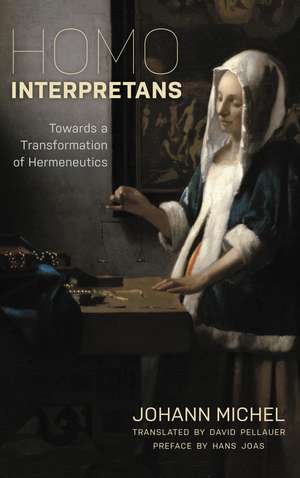
Homo Interpretans: Towards a Transformation of Hermeneutics
Autor Johann Michel Traducere de David Pellauer Prefață de Hans Joasen Limba Engleză Hardback – 8 apr 2019
Preț: 792.48 lei
Preț vechi: 1149.98 lei
-31%
Puncte Express: 1189
Carte tipărită la comandă
Livrare economică 27 noiembrie-11 decembrie
Livrare prin curier în România Termenul estimat este afișat lângă disponibilitate.
Transport gratuit pentru acest produs Plată online sau ramburs, în funcție de opțiunile comenzii.
Retur gratuit în 14 zile Comandă securizată și suport în română.
Specificații
ISBN-13: 9781786608826
ISBN-10: 1786608820
Pagini: 384
Dimensiuni: 163 x 229 x 29 mm
Greutate: 0.64 kg
Editura: Bloomsbury Publishing
Colecția Rowman & Littlefield
Locul publicării:New York, United States
ISBN-10: 1786608820
Pagini: 384
Dimensiuni: 163 x 229 x 29 mm
Greutate: 0.64 kg
Editura: Bloomsbury Publishing
Colecția Rowman & Littlefield
Locul publicării:New York, United States
Cuprins
Acknowledgements / Introduction / Part I: The Ordinary Disclosure of the World / 1. The Problem of Meaning and the Opening to the World / 2. The Lifeworld and the Mirror of Meaning / 3. The Production of Meaning and the Transformation of the World / Part II: The Scholarly Deciphering of Signs / 4. The Infinite and the Relative / 5. Being and Method / 6. The Text and Action / Index
Recenzii
Homo Interpretans is a most significant contribution to the theory of interpretation that at the same time rather uniquely demonstrates this theory's practical contemporary import and ongoing implications for daily life. The emphases that interpretation is not individual but social and also creative and enabling are additional signal assets. The book deserves separate commendation for its interdisciplinarity.
This book is the most ambitious and most comprehensive new approach in the area of hermeneutics.
This well-researched and carefully argued book provides an ambitiously comprehensive and multi-leveled account of interpretation. Drawing on a wide variety of philosophical sources and on multiple disciplines of the natural and social sciences, Johann Michel renews the hermeneutic tradition by showing its relevance to an impressive range of contemporary practices.
This book courageously defends a philosophical anthropology that heralds the specificity of the human condition in its multifaceted capacity of interpretation and thus renews for the 21st century the universal scope of hermeneutics.
Johann Michel makes an ambitious bid to claim interpretation as a fundamental competence of being itself, pushing the scope of interpretation beyond Western, beyond textual, beyond even human perspectives into interpretive regions not yet accounted for. Although anchored in an anthropological perspective, Michel opens wide the trans- and interdisciplinary frontiers to bring hermeneutic inquiry into the era of postlinguistic, posthumanist learning. Although known primarily for his work on Paul Ricoeur, Michel makes a case for the universality of interpretation beyond textual hermeneutics. This is not a work of secondary scholarship, but a paradigm argument, a programmatic case for interpretation as one of the basic competencies of organic life and a primary approach for the human sciences. David Pellauer's English translation is, as usual, graceful, vigorous, and clear.
This book revives the hermeneutical question through the impressive mobilization of both its history and positive knowledge by developing an authentic interpretive anthropology. Man, placed in a world that surprises him, interprets because he seeks to know him, to give him meaning and to act within interpreting communities. An original synthesis and an opening on an authentic philosophy of interpretation.
It is important to emphasize that this book is a genuine and rich treasure trove of discussions in anthropology and the sciences in which interpretation and meta-interpretation are assigned their proper place. At many places in the book, the reader is confronted with illuminating and insightful ideas that call for further
reflection.
This book is the most ambitious and most comprehensive new approach in the area of hermeneutics.
This well-researched and carefully argued book provides an ambitiously comprehensive and multi-leveled account of interpretation. Drawing on a wide variety of philosophical sources and on multiple disciplines of the natural and social sciences, Johann Michel renews the hermeneutic tradition by showing its relevance to an impressive range of contemporary practices.
This book courageously defends a philosophical anthropology that heralds the specificity of the human condition in its multifaceted capacity of interpretation and thus renews for the 21st century the universal scope of hermeneutics.
Johann Michel makes an ambitious bid to claim interpretation as a fundamental competence of being itself, pushing the scope of interpretation beyond Western, beyond textual, beyond even human perspectives into interpretive regions not yet accounted for. Although anchored in an anthropological perspective, Michel opens wide the trans- and interdisciplinary frontiers to bring hermeneutic inquiry into the era of postlinguistic, posthumanist learning. Although known primarily for his work on Paul Ricoeur, Michel makes a case for the universality of interpretation beyond textual hermeneutics. This is not a work of secondary scholarship, but a paradigm argument, a programmatic case for interpretation as one of the basic competencies of organic life and a primary approach for the human sciences. David Pellauer's English translation is, as usual, graceful, vigorous, and clear.
This book revives the hermeneutical question through the impressive mobilization of both its history and positive knowledge by developing an authentic interpretive anthropology. Man, placed in a world that surprises him, interprets because he seeks to know him, to give him meaning and to act within interpreting communities. An original synthesis and an opening on an authentic philosophy of interpretation.
It is important to emphasize that this book is a genuine and rich treasure trove of discussions in anthropology and the sciences in which interpretation and meta-interpretation are assigned their proper place. At many places in the book, the reader is confronted with illuminating and insightful ideas that call for further
reflection.