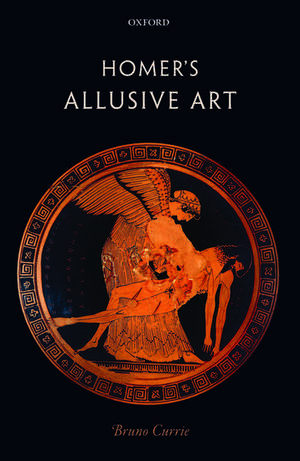
Homer's Allusive Art
Autor Bruno Currieen Limba Engleză Hardback – 13 oct 2016
Ne-a atras atenția în mod deosebit felul în care Homer's Allusive Art reușește să recalibreze dezbaterea academică despre natura poeziei homerice, propunând o perspectivă care depășește dihotomia clasică dintre tradiția orală și compoziția literară conștientă. Bruno Currie aduce un suflu nou în literatura de specialitate prin contestarea ideii că o poezie derivată dintr-o tradiție orală multiseculară ar fi incompatibilă cu tehnicile sofisticate de aluzie specifice textelor scrise.
Notăm cu interes rigoarea cu care autorul explorează posibilitatea unei continuități metodologice ce leagă tabletele cuneiforme mesopotamiene de papirusurile grecești și, ulterior, de poezia latină. Volumul este structurat în jurul unor studii de caz interconectate, investigând cum Iliada sau Odiseea fac trimiteri nu doar la propriul univers epic, ci și la figuri precum Memnon sau la tradiții mitologice din Orientul Apropiat, pre-eminent Epopeea lui Ghilgameș.
Comparabil cu The Homeric Simile in Comparative Perspectives de Jonathan L. Ready în ceea ce privește utilizarea perspectivelor comparative, volumul de față se distinge prin faptul că mută accentul de la funcția stilistică a similitudinii către mecanismele profunde ale intertextualității și istoriei literare. Dacă Ready se concentrează pe tradiții orale moderne, Currie ancorează studiul în tehnici literare sofisticate, similare celor din perioada augustană. În contextul operei sale, această lucrare extinde interesul autorului pentru dimensiunea culturală și religioasă a Greciei arhaice, temă centrală și în Pindar and the Cult of Heroes, însă aici accentul cade pe arhitectura aluzivă a textului.
Preț: 742.53 lei
Preț vechi: 1021.43 lei
-27%
Carte tipărită la comandă
Livrare economică 05-16 iunie
Specificații
ISBN-10: 0198768826
Pagini: 358
Dimensiuni: 164 x 240 x 25 mm
Greutate: 0.66 kg
Editura: OUP OXFORD
Colecția OUP Oxford
Locul publicării:Oxford, United Kingdom
V-ar putea interesa
-
 Sophoclea: Studies on the Text of SophoclesHugh Lloyd-Jones-37%Preț: 530.72 lei844.17 lei
 -
 -34%Preț: 600.90 lei908.67 lei
 -
 -12%Preț: 224.51 lei256.45 lei
 -
 Venantius Fortunatus: A Latin Poet in Merovingian GaulJudith W. George-34%Preț: 628.80 lei959.02 lei
 -
 Lancelot and the Grail: A Study of the Prose `Lancelot'Elspeth Kennedy-23%Preț: 351.19 lei453.26 lei
 -
 The IliadHomer-23%Preț: 148.66 lei192.65 lei
 -
 Pindar and the Cult of HeroesBruno Currie-23%Preț: 483.35 lei624.03 lei
 -
 -35%Preț: 405.18 lei620.80 lei
 -
 Gender, Violence, and the Past in Edda and SagaDavid Clark-28%Preț: 702.83 lei973.61 lei
 -
 -22%Preț: 387.56 lei494.96 lei
 -
 Romance and the Gentry in Late Medieval EnglandMichael Johnston-34%Preț: 735.69 lei1111.86 lei
 -
 Love and Providence: Recognition in the Ancient NovelSilvia Montiglio-14%Preț: 629.98 lei732.53 lei
 -
 The Elegiac Passion: Jealousy in Roman Love ElegyRuth Rothaus Caston-14%Preț: 628.24 lei730.51 lei
 -
 Medievalisms: Making the Past in the PresentTison PughPreț: 372.50 lei
 -
 Claudian and the Roman Epic TraditionCatherine Ware-14%Preț: 682.78 lei793.94 lei
 -
 Euripides: Iphigeneia at AulisHolly EckhardtPreț: 139.09 lei
De ce să citești această carte
Această lucrare este esențială pentru cercetătorii și studenții la filologie clasică care doresc să înțeleagă cum funcționează memoria poetică în Antichitate. Cititorul câștigă o perspectivă integrată asupra modului în care textele homerice comunică cu tradițiile anterioare și posterioare, depășind limitările teoriei oralității pure. Este un argument solid pentru complexitatea intelectuală a poeziei arhaice, tratată aici cu o erudiție remarcabilă.
Despre autor
Bruno Currie este membru (Fellow) și tutor în limbi și literatură greacă și latină la Oriel College, în cadrul Universității Oxford. Expertiza sa se concentrează pe poezia greacă arhaică și pe intersecția dintre literatură, religie și mitologie. În lucrările sale anterioare, precum Pindar and the Cult of Heroes, a explorat modul în care cultele religioase și figurile eroice din secolul al V-lea î.Hr. sunt reflectate în poezia epiniciană. Prin cercetările sale, Currie contribuie la o înțelegere mai nuanțată a continuității culturale în spațiul mediteranean antic.
Descriere
Recenzii
This is a book to be enjoyed slowly and thoughtfully -- it is unusually user-friendly in its system of cross-referencing and in its overall readability, packed full of information and full supporting secondary and primary sources but always keeping the wood visible above the trees. The death of Martin West had left a gaping hole in this area of study -- I think that MLW now has a worthy successor to his crown.
Bruno Currie's book delves into this most significant debate in a systematic and thoughtful manner. It represents a major contribution and indispensable reading for all those interested in Homer and archaic Greek poetry at large ... a rewarding and thought-provoking book. Currie is commended for his sound methodology, his step-by-step unravelling of his thought as he directs his reader with admirable precision and help through labyrinthine turns of arguments difficult to grasp: a true sine qua non for all scholars interested in early Greek hexameter poetry.