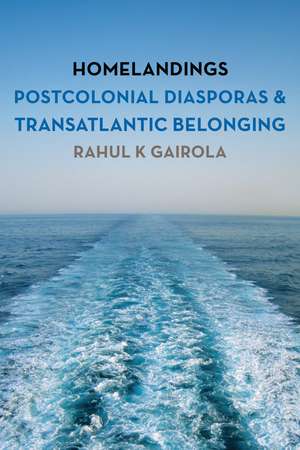
Homelandings: Postcolonial Diasporas and Transatlantic Belonging
Autor Rahul K. Gairolaen Limba Engleză Hardback – 21 sep 2016
Preț: 818.01 lei
Preț vechi: 1185.87 lei
-31%
Puncte Express: 1227
Carte tipărită la comandă
Livrare economică 23 noiembrie-07 decembrie
Livrare prin curier în România Termenul estimat este afișat lângă disponibilitate.
Transport gratuit pentru acest produs Plată online sau ramburs, în funcție de opțiunile comenzii.
Retur gratuit în 14 zile Comandă securizată și suport în română.
Specificații
ISBN-13: 9781783489725
ISBN-10: 1783489723
Pagini: 240
Dimensiuni: 152 x 232 x 22 mm
Greutate: 0.48 kg
Editura: Bloomsbury Publishing
Colecția Rowman & Littlefield
Locul publicării:New York, United States
ISBN-10: 1783489723
Pagini: 240
Dimensiuni: 152 x 232 x 22 mm
Greutate: 0.48 kg
Editura: Bloomsbury Publishing
Colecția Rowman & Littlefield
Locul publicării:New York, United States
Cuprins
Dedication / Acknowledgements / Prologue: History as Home Base / 1. Home, Queer Home: Postcolonial Belonging in the Transatlantic Anglosphere / 2. Between Homes: Western Education and Transgressions of Disciplinary Gender Roles in Michelle Cliff's Abeng / 3. Capitalist Houses, Queer Homes: Sexuality & Belonging in Hanif Kureishi's and Stephen Frears's My Beautiful Launderette and Sammy and Rosie Get Laid / 4. Homesick for Future Revolution: Heteronormative Lifestyles and Queer Heterotopias in Jessica Hagedorn's Dogeaters / 5. Home is Where the Heart Writes: Race, Media, Masculinity, and the Market in Jackie Kay's Trumpet / Epilogue: Broken Homes and Insecure Homelands / Index
Recenzii
Homelandings is an intersectional study of postcolonial film and fiction emerging from the USA and UK during the Reaganite and Thatcherite period. It addresses the work of Michelle Cliff, Hanif Kureishi, Jessica Hagedorn, and Jackie Kay. Through a sustained analysis of the interaction of racism, sexism, classism and queerphobia in marking the experience and strategies of resistance of queer agents of colour, it provides a penetrating critique of received notions of home and belonging. A timely contribution to our understanding of what Gairola calls a ' situated genealogy of "home"'. Essential reading for anyone interested in innovative interdisciplinary analysis.
Homelandings offers a compelling challenge to received conceptions of home and national belonging by exposing the ways in which these are always already constituted by racism, classism, misogyny, and queerphobia in neoliberal governmental societies. Gairola accomplishes this through a brilliant analysis of transnational strategies of cultural resistance that have produced alternative modes of living and embodiments of home by queer diasporic agents of colour in work by Michelle Cliff, Hanif Kureishi, Jessica Hagedorn, and Jackie Kay. A timely book that stretches the intersectional matrices and transdisciplinary breadth of queer theorising in innovative ways.
Through thoughtful readings of postcolonial film and fiction as well as criticism, Rahul K. Gairola offers a sobering account of how racism, classism, sexism, and queerphobia together make up the "home economics" of neoliberal biopolitical governmentality. Although many of the texts he examines first appeared in an earlier historical moment, this book is a timely contribution to our understanding of Brexit.
The insightful, comparative readings of postcolonial fiction and films in Homelandings expose how elements of racism, class distinctions, sexism, and queerphobia are built into the neoliberal ideology of home economics and biopolitical governmentality. Gairola's brilliant analysis of the strategies of resistance provides an alternative to state-sponsored heteronormative assumptions/ principles regarding home and belonging. His timely choice of texts dating from 1984 to 2001 is, it appears, a deliberate genealogy. They provide a historical and ideological road map of how we have gone from the rise of the neoliberal values of Thatcherism and Reagonomics to the global crisis of Brexit and Trumpism today. Truly, Gairola's book warrants accolades for bringing searing, fresh insights and transnational breadth to postcolonial, migration, and queer studies. I wonder if the ancient Indian adage "Vasudhaiva Kutumbakam" (from the Maha Upanishad), which means that the world is one family, could be relevant here.
Rahul K. Gairola's work is a rich addition to the repertoire of scholarship that throws light upon (the representations of) the experiences of black and brown queer diasporic figures in the West, a category of migrants under-represented in diasporic studies. The book, on the one hand, challenges a dominant trend in diaspora studies that views the diasporic subject as heterosexual, and, on the other hand, exposes the white-biases in queer studies and invites us to look at the latter discipline from the point of view queer of colour (migrant) subjects in the West.
Homelandings: Postcolonial Diasporas & Transatlantic Belonging by Rahul K. Gairola is an important addition to the field of postcolonial queer studies...This book is compulsory reading for those interested in the intersections of postcolonialism, race, gender, and cultural studies.
Rahul K. Gairola's book breaks the paradigm of postcolonial and diasporic studies centred on 'home'. It departs from the theoretical abstractions of postcolonial theory that originated from an overreliance on the psychic and behavioural aspects of the diasporic subjects, and instead focuses on the sociological, political and pathological grounds of subject formations around the concept of 'home' responsible for such behaviour. The methodological novelty of the book lies in its use of Foucauldian notions of 'governmentality' and 'biopower' and Gramscian concept of 'articulation' to investigate how the lives of diasporic subjects in these postcolonial but neoliberal temporal locations are regulated by the state power, even as the marginalized identities of divergent racial, sexual and class orientation may articulate cultural identities of solidarity and common resistance. ... This book is a very useful source for interdisciplinary discourses on Postcolonial Diasporas.
Writing now in the wake of the emergence of COVID 19 as a health, social, and economic crisis-as well as the world-wide Black Lives Matter (BLM) Movement-a critical re-theorization of home across the multiple registers of race, sexuality, gender, ethnicity, class, and disability is more urgently needed than ever. [...] Homelandings provides an index for how interventions in the regulation of the neoliberal home offers countervailing practices and narratives, ways of rewiring our relations and communities, and initiating new socio-cultural linkages of belonging in a transnational context.
Homelandings offers a compelling challenge to received conceptions of home and national belonging by exposing the ways in which these are always already constituted by racism, classism, misogyny, and queerphobia in neoliberal governmental societies. Gairola accomplishes this through a brilliant analysis of transnational strategies of cultural resistance that have produced alternative modes of living and embodiments of home by queer diasporic agents of colour in work by Michelle Cliff, Hanif Kureishi, Jessica Hagedorn, and Jackie Kay. A timely book that stretches the intersectional matrices and transdisciplinary breadth of queer theorising in innovative ways.
Through thoughtful readings of postcolonial film and fiction as well as criticism, Rahul K. Gairola offers a sobering account of how racism, classism, sexism, and queerphobia together make up the "home economics" of neoliberal biopolitical governmentality. Although many of the texts he examines first appeared in an earlier historical moment, this book is a timely contribution to our understanding of Brexit.
The insightful, comparative readings of postcolonial fiction and films in Homelandings expose how elements of racism, class distinctions, sexism, and queerphobia are built into the neoliberal ideology of home economics and biopolitical governmentality. Gairola's brilliant analysis of the strategies of resistance provides an alternative to state-sponsored heteronormative assumptions/ principles regarding home and belonging. His timely choice of texts dating from 1984 to 2001 is, it appears, a deliberate genealogy. They provide a historical and ideological road map of how we have gone from the rise of the neoliberal values of Thatcherism and Reagonomics to the global crisis of Brexit and Trumpism today. Truly, Gairola's book warrants accolades for bringing searing, fresh insights and transnational breadth to postcolonial, migration, and queer studies. I wonder if the ancient Indian adage "Vasudhaiva Kutumbakam" (from the Maha Upanishad), which means that the world is one family, could be relevant here.
Rahul K. Gairola's work is a rich addition to the repertoire of scholarship that throws light upon (the representations of) the experiences of black and brown queer diasporic figures in the West, a category of migrants under-represented in diasporic studies. The book, on the one hand, challenges a dominant trend in diaspora studies that views the diasporic subject as heterosexual, and, on the other hand, exposes the white-biases in queer studies and invites us to look at the latter discipline from the point of view queer of colour (migrant) subjects in the West.
Homelandings: Postcolonial Diasporas & Transatlantic Belonging by Rahul K. Gairola is an important addition to the field of postcolonial queer studies...This book is compulsory reading for those interested in the intersections of postcolonialism, race, gender, and cultural studies.
Rahul K. Gairola's book breaks the paradigm of postcolonial and diasporic studies centred on 'home'. It departs from the theoretical abstractions of postcolonial theory that originated from an overreliance on the psychic and behavioural aspects of the diasporic subjects, and instead focuses on the sociological, political and pathological grounds of subject formations around the concept of 'home' responsible for such behaviour. The methodological novelty of the book lies in its use of Foucauldian notions of 'governmentality' and 'biopower' and Gramscian concept of 'articulation' to investigate how the lives of diasporic subjects in these postcolonial but neoliberal temporal locations are regulated by the state power, even as the marginalized identities of divergent racial, sexual and class orientation may articulate cultural identities of solidarity and common resistance. ... This book is a very useful source for interdisciplinary discourses on Postcolonial Diasporas.
Writing now in the wake of the emergence of COVID 19 as a health, social, and economic crisis-as well as the world-wide Black Lives Matter (BLM) Movement-a critical re-theorization of home across the multiple registers of race, sexuality, gender, ethnicity, class, and disability is more urgently needed than ever. [...] Homelandings provides an index for how interventions in the regulation of the neoliberal home offers countervailing practices and narratives, ways of rewiring our relations and communities, and initiating new socio-cultural linkages of belonging in a transnational context.