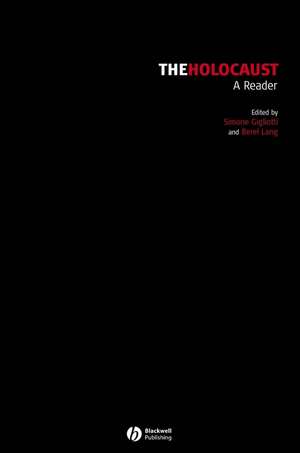
Holocaust
Autor Gigliotti, Langen Limba Engleză Hardback – 17 ian 2005
- Interdisciplinary content encourages students to engage with philosophical, political, cultural and literary debate as well as historiographical issues.
- Integrates oral histories and testimonies from both victims and perpetrators, including Jewish council leaders, victims of ghettos and camps, SS officials and German soldiers.
- Subsections can be used as the basis for oral or written exercises.
- Whole articles or substantial extracts are included wherever possible.
Preț: 1029.45 lei
Preț vechi: 1410.20 lei
-27%
Puncte Express: 1544
Carte tipărită la comandă
Livrare economică 20 noiembrie-04 decembrie
Livrare prin curier în România Termenul estimat este afișat lângă disponibilitate.
Transport gratuit pentru acest produs Plată online sau ramburs, în funcție de opțiunile comenzii.
Retur gratuit în 14 zile Comandă securizată și suport în română.
Specificații
ISBN-13: 9781405113991
ISBN-10: 1405113995
Pagini: 486
Dimensiuni: 157 x 235 x 31 mm
Greutate: 0.85 kg
Ediția:New.
Editura: Wiley
Locul publicării:Chichester, United Kingdom
ISBN-10: 1405113995
Pagini: 486
Dimensiuni: 157 x 235 x 31 mm
Greutate: 0.85 kg
Ediția:New.
Editura: Wiley
Locul publicării:Chichester, United Kingdom
Public țintă
scholars and students of the Holocaust in departments of history, Jewish studies, literature, religion, philosophy, sociology, politics and film studiesNotă biografică
Simone Gigliotti is a lecturer in the History Program at Victoria University of Wellington, New Zealand, and a Fellow in the Department of History at the University of Melbourne, Australia. Previously, she taught at the University of the West Indies, Jamaica, and was a visiting scholar at the Center for Advanced Holocaust Studies, US Holocaust Memorial Museum, Washington DC.
Berel Lang is Professor of Humanities at Trinity College, Hartford, Connecticut. His many books include The Future of the Holocaust: Between History and Memory (1999) and Act and Idea in the Nazi Genocide (1990). His forthcoming book is Post-Holocaust: Interpretation, Misinterpretation, and the Claims of History.
Berel Lang is Professor of Humanities at Trinity College, Hartford, Connecticut. His many books include The Future of the Holocaust: Between History and Memory (1999) and Act and Idea in the Nazi Genocide (1990). His forthcoming book is Post-Holocaust: Interpretation, Misinterpretation, and the Claims of History.
Cuprins
List of Maps. Acknowledgments.
Chronology.
Glossary.
Introduction: Simone Gigliotti and Berel Lang.
Part I Preconditions: Nazism and the Turn from Anti-Judaism to Antisemitism.
Introduction.
1 Anti-Semites: Bernard Lewis.
2 From Weimar to Hitler: Robert S. Wistrich.
3 Nation and Race: Adolf Hitler.
4 Nuremberg Law for the Protection of the German Blood and of the German Honour of 15 September 1935.
Part II A Racial Europe: Nazi Population and Resettlement Policy.
Introduction.
5 The Setting: Henry Friedlander.
6 Ghetto Formation: Raul Hilberg.
7 From "Ethnic Cleansing" to Genocide to the "Final Solution": The Evolution of Nazi Jewish Policy, 1939-1941: Christopher R. Browning.
8 Some Thoughts on the Treatment of the Alien Population in the East: Heinrich Himmler.
Part III War and the Turn to Genocide.
Introduction.
9 The "Commissar Decree," June 6, 1941.
10 Affidavit of SS Grueppenfuehrer Otto Ohlendorf.
11 Operation Barbarossa as a War of Conquest and Annihilation: Jürgen Förster.
12 From Mass Murder to the "Final Solution:" The Shooting of Jewish Civilians during the first months of the Eastern Campaign within the context of the Nazi Jewish Genocide: Peter Longerich.
13 Savage War: German Warfare and Moral Choices in World War II: Omer Bartov.
Part IV Whose "Final Solution"? Revisted Intentionalism and Functionalism.
Introduction.
14 Hitler's Reichstag Speech, January 30, 1939 : Adolf Hitler.
15 Minutes of the Wannsee Conference, January 20, 1942.
16Intentions and the "Final Solution:" Berel Lang.
17 A Controversy about the Historicization of National Socialism: Martin Broszat and Saul Friedlaender.
18 Justice Jackson's Report to the President on Atrocities and War Crimes, June 6, 1945: Robert H. Jackson.
Part V Response and Testimony: At the Center of the Whirlwind.
Introduction.
19 Inside the Ghetto: Emmanuel Ringelblum.
20 Notebook H: Oskar Rosenfeld.
21 The Second Winter: October 29, 1942--March 18, 1943: Herman Kruk.
22 Letters from Westerbork: Etty Hillesum.
Part VI Genocide and the Holocaust.
Introduction.
23 UnitedNations Convention on the Prevention and Punishment of the Crime of Genocide, December 9, 1948..
24 Defining Genocide as a Sociological Concept: Helen Fein.
25 Is the Holocaust Simply Another Example of Genocide? Mark Levene.
26 Conceptual Blockages and Definitional Dilemmas in the "Racial Century:" Genocides of Indigenous Peoples and the Holocaust: A. Dirk Moses
Chronology.
Glossary.
Introduction: Simone Gigliotti and Berel Lang.
Part I Preconditions: Nazism and the Turn from Anti-Judaism to Antisemitism.
Introduction.
1 Anti-Semites: Bernard Lewis.
2 From Weimar to Hitler: Robert S. Wistrich.
3 Nation and Race: Adolf Hitler.
4 Nuremberg Law for the Protection of the German Blood and of the German Honour of 15 September 1935.
Part II A Racial Europe: Nazi Population and Resettlement Policy.
Introduction.
5 The Setting: Henry Friedlander.
6 Ghetto Formation: Raul Hilberg.
7 From "Ethnic Cleansing" to Genocide to the "Final Solution": The Evolution of Nazi Jewish Policy, 1939-1941: Christopher R. Browning.
8 Some Thoughts on the Treatment of the Alien Population in the East: Heinrich Himmler.
Part III War and the Turn to Genocide.
Introduction.
9 The "Commissar Decree," June 6, 1941.
10 Affidavit of SS Grueppenfuehrer Otto Ohlendorf.
11 Operation Barbarossa as a War of Conquest and Annihilation: Jürgen Förster.
12 From Mass Murder to the "Final Solution:" The Shooting of Jewish Civilians during the first months of the Eastern Campaign within the context of the Nazi Jewish Genocide: Peter Longerich.
13 Savage War: German Warfare and Moral Choices in World War II: Omer Bartov.
Part IV Whose "Final Solution"? Revisted Intentionalism and Functionalism.
Introduction.
14 Hitler's Reichstag Speech, January 30, 1939 : Adolf Hitler.
15 Minutes of the Wannsee Conference, January 20, 1942.
16Intentions and the "Final Solution:" Berel Lang.
17 A Controversy about the Historicization of National Socialism: Martin Broszat and Saul Friedlaender.
18 Justice Jackson's Report to the President on Atrocities and War Crimes, June 6, 1945: Robert H. Jackson.
Part V Response and Testimony: At the Center of the Whirlwind.
Introduction.
19 Inside the Ghetto: Emmanuel Ringelblum.
20 Notebook H: Oskar Rosenfeld.
21 The Second Winter: October 29, 1942--March 18, 1943: Herman Kruk.
22 Letters from Westerbork: Etty Hillesum.
Part VI Genocide and the Holocaust.
Introduction.
23 UnitedNations Convention on the Prevention and Punishment of the Crime of Genocide, December 9, 1948..
24 Defining Genocide as a Sociological Concept: Helen Fein.
25 Is the Holocaust Simply Another Example of Genocide? Mark Levene.
26 Conceptual Blockages and Definitional Dilemmas in the "Racial Century:" Genocides of Indigenous Peoples and the Holocaust: A. Dirk Moses
Descriere
A collection of primary and secondary readings that encourages scholars and students to engage critically with debates about the origins, implementation and postwar interpretation of the Holocaust. It encourages students to engage with philosophical, political, cultural and literary debate as well as historiographical issues.