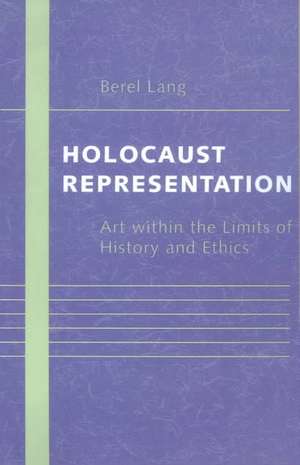
Holocaust Representation
Autor Berel Langen Limba Engleză Paperback – 15 sep 2003
The dynamics between artistic form and content generally hold even more intensely, Lang argues, when art's subject has the moral weight of an event like the Holocaust. As authors reach beyond the standard conventions for more adequate means of representation, Holocaust writings frequently display a blurring of genres. The same impulse manifests itself in repeated claims of historical as well as artistic authenticity. Informing Lang's discussion are the recent conflicts about the truth-status of Benjamin Wilkomirski's memoir Fragments and the comic fantasy of Roberto Benigni's film Life Is Beautiful. Lang views Holocaust representation as limited by a combination of ethical and historical constraints. As art that violates such constraints often lapses into sentimentality or melodrama, clich or kitsch, this becomes all the more objectionable when its subject is moral enormity. At an extreme, all Holocaust representation must face the test of whether its referent would not be more authentically expressed by silence--that is, by the absence of representation.
Preț: 263.94 lei
Puncte Express: 396
Carte tipărită la comandă
Livrare economică 24 noiembrie-08 decembrie
Livrare prin curier în România Termenul estimat este afișat lângă disponibilitate.
Transport gratuit de la 400.00 lei Plată online sau ramburs, în funcție de opțiunile comenzii.
Retur gratuit în 14 zile Comandă securizată și suport în română.
Specificații
ISBN-13: 9780801877452
ISBN-10: 0801877458
Pagini: 192
Dimensiuni: 140 x 216 x 11 mm
Greutate: 0.26 kg
Ediția:Revised edition
Editura: Johns Hopkins University Press
Locul publicării:Baltimore, United States
ISBN-10: 0801877458
Pagini: 192
Dimensiuni: 140 x 216 x 11 mm
Greutate: 0.26 kg
Ediția:Revised edition
Editura: Johns Hopkins University Press
Locul publicării:Baltimore, United States
V-ar putea interesa
-
 Religious LiteracyStephen ProtheroPreț: 118.36 lei
 -
 -19%Preț: 375.83 lei464.72 lei
 -
 Awakening and Insight: Zen Buddhism and PsychotherapyPolly Young-EisendrathPreț: 394.29 lei
 -
 Psychology for Christian MinistryRebecca NyePreț: 433.69 lei
 -
 -18%Preț: 1255.17 lei1530.69 lei
 -
 Branching Streams Flow in the DarknessShunryû SuzukiPreț: 178.99 lei
 -
 Religion For DummiesMarc GellmanPreț: 140.24 lei
 -
 Talmudic StoriesRubensteinPreț: 321.78 lei
 -
 In Praise of the GoddessDevadatta KaliPreț: 140.50 lei
 -
 -23%Preț: 1066.07 lei1384.50 lei
Notă biografică
Berel Lang is a professor of humanities at Trinity College. His many books include Writing and the Moral Self, Mind's Bodies: Thought in the Act, Heidegger's Silence, and Act and Idea in the Nazi Genocide.