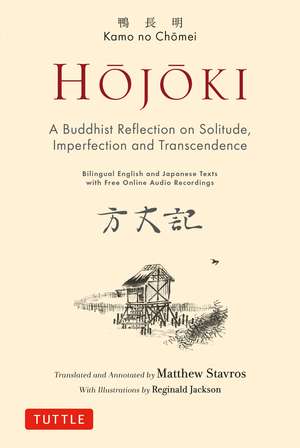
Hojoki: A Buddhist Reflection on Solitude: Imperfection and Transcendence - Bilingual English and Japanese Texts with Free Online Audio Recordings
Autor Kamo no Chomei Traducere de Matthew Stavros Ilustrat de Reginald Jacksonen Limba Engleză Hardback – 7 mai 2024
Hojoki is an introspective poem written in the 13th century by the enigmatic Japanese hermit Kamo no Chomei, who as a young man served in the capital as official court poet but later in life withdrew from society.
Composed in a time of devastating fires, floods, earthquakes, droughts and famines, Chomei's masterpiece reflects on the impermanence of things, expressing life's mysterious beauty and the profound wisdom to be found in nature.
Chomei paints a vivid picture of the chaos and suffering of the human condition. Amidst this turmoil, he discovers an oasis of calm in a simple mountain hut, where he contemplates the virtues of nature and the wabi sabi beauty of imperfection in all things.
In their friends,
People like to find affluence and a ready smile.
Compassion and honesty,
Not so much.
So why not make friends with music and nature instead:
The moon; the flowers?
********
I know my needs,
And I know the world.
I want for nothing,
And do not labor to acquire things.
Quietude is all I desire:
To be free from worry is happiness enough.
This new translation by Matthew Stavros, presented alongside the original Classical Japanese, perfectly captures the profound serenity of Chomei's writings. His poignant verses serve as timely reminders that amidst the uncertainty of this world, true contentment can often be found in the simple life, in embracing fleeting moments, and in seeking solace in nature's beauty.
Preț: 92.29 lei
Nou
Puncte Express: 138
Preț estimativ în valută:
16.33€ • 19.15$ • 14.34£
16.33€ • 19.15$ • 14.34£
Carte disponibilă
Livrare economică 21 ianuarie-04 februarie 26
Preluare comenzi: 021 569.72.76
Specificații
ISBN-13: 9784805318003
ISBN-10: 4805318007
Pagini: 192
Ilustrații: with 30 photos and illustrations
Dimensiuni: 127 x 191 x 28 mm
Greutate: 0.34 kg
Editura: Tuttle Publishing
Colecția Tuttle Publishing
ISBN-10: 4805318007
Pagini: 192
Ilustrații: with 30 photos and illustrations
Dimensiuni: 127 x 191 x 28 mm
Greutate: 0.34 kg
Editura: Tuttle Publishing
Colecția Tuttle Publishing
Recenzii
"This new translation is marked by the literary quality of Stavros's English. Choosing to render Chomei's prose into verse, the English is lyrical and sounds beautiful when read aloud…The text is complemented by beautiful photographs taken by the author around Kyoto." — Asian Review of Books
"The impermanence of the world is a thread that weaves its way through Hojoki. Three other Buddhist themes are used to group the 14 short chapters in Matthew's translation: Suffering, Detachment and Transcendence." —John Dougill: "Writers in Kyoto," author of Zen Gardens and Temples of Kyoto, Japan's World Heritage Sites, and more.
"Chomei's original text follows Stavros' translation to create a fully bilingual edition, and the book includes maps of the ancient capital so that the full scope of the tragedies Chomei records — pestilence, fire, earthquakes, raging winds — can be appreciated by readers, especially those who will draw parallels to their own experiences living amid a global pandemic." —The Japan Times, "Hojoki': The paradox of desire and detachment in recluse literature"
"The impermanence of the world is a thread that weaves its way through Hojoki. Three other Buddhist themes are used to group the 14 short chapters in Matthew's translation: Suffering, Detachment and Transcendence." —John Dougill: "Writers in Kyoto," author of Zen Gardens and Temples of Kyoto, Japan's World Heritage Sites, and more.
"Chomei's original text follows Stavros' translation to create a fully bilingual edition, and the book includes maps of the ancient capital so that the full scope of the tragedies Chomei records — pestilence, fire, earthquakes, raging winds — can be appreciated by readers, especially those who will draw parallels to their own experiences living amid a global pandemic." —The Japan Times, "Hojoki': The paradox of desire and detachment in recluse literature"
Notă biografică
Kamo no Chomei was a Japanese poet, Buddhist thinker, and musician. After being passed over for a prestigious promotion in Kyoto, he became a recluse, moving to Mount Hiei outside the city and then to Hino where he built a tiny hut and spent the rest of his life writing and contemplating. He died in 1216.
Matthew Stavros has a PhD from Princeton University and is senior lecturer in Japanese and Asian Studies at the University of Sydney and former director of the Kyoto Consortium for Japanese Studies. He is the author of Kyoto: An Urban History of Japan's Premodern Capital and In Praise of Solitude: Two Japanese Classics on Reclusion. He teaches courses on Japanese history, modern and classical Japanese, and the histories of East and Southeast Asia.
Reginald Jackson is an artist and associate professor of pre-modern Japanese literature and performance at the University of Michigan. He is the author of Textures of Mourning: Calligraphy, Mortality, and the Tale of Genji Scrolls and A Proximate Remove: Queering Intimacy and Loss in The Tale of Genji.
Matthew Stavros has a PhD from Princeton University and is senior lecturer in Japanese and Asian Studies at the University of Sydney and former director of the Kyoto Consortium for Japanese Studies. He is the author of Kyoto: An Urban History of Japan's Premodern Capital and In Praise of Solitude: Two Japanese Classics on Reclusion. He teaches courses on Japanese history, modern and classical Japanese, and the histories of East and Southeast Asia.
Reginald Jackson is an artist and associate professor of pre-modern Japanese literature and performance at the University of Michigan. He is the author of Textures of Mourning: Calligraphy, Mortality, and the Tale of Genji Scrolls and A Proximate Remove: Queering Intimacy and Loss in The Tale of Genji.