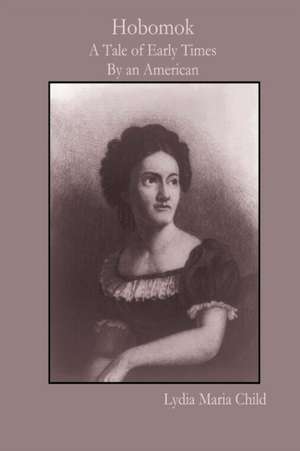
Hobomok
Autor Lydia Maria Childen Limba Engleză Paperback – 21 aug 2019
Preț: 80.39 lei
Puncte Express: 121
Carte tipărită la comandă
Livrare economică 02-16 decembrie
Livrare prin curier în România Termenul estimat este afișat lângă disponibilitate.
Transport gratuit de la 400.00 lei Plată online sau ramburs, în funcție de opțiunile comenzii.
Retur gratuit în 14 zile Comandă securizată și suport în română.
Specificații
ISBN-13: 9780359868377
ISBN-10: 0359868371
Pagini: 144
Dimensiuni: 152 x 229 x 9 mm
Greutate: 0.22 kg
Editura: Lulu.Com
ISBN-10: 0359868371
Pagini: 144
Dimensiuni: 152 x 229 x 9 mm
Greutate: 0.22 kg
Editura: Lulu.Com
Notă biografică
Mrs. Lydia Maria Child (1802-1880) was widely read and extremely well informed. She was the successful and popular author of a novel (Hobomok) and several how-to books (The Frugal Housewife, The Mother's Book, The Girl's Own Book), and editor of the Juvenile Miscellany. She was also a former educator and a member of the learned and reform-minded intellectual circles in Boston, both in her own right and as the younger sister of Convers Francis (1795-1863), a Unitarian minister, Harvard professor, and member of the Transcendental Club. In 1828 she married David Lee Child (1794-1874), another Harvard graduate, schoolmaster, diplomat, and lawyer. Their association with William Lloyd Garrison prompted Mrs. Child to publish this Appeal, for which she paid the price of alienating a significant portion of her previous audience. She did not waver but went on to edit the National Anti-Slavery Standard in New York City (1840-1844) and continued to write in support of emancipation, women's rights, and native rights as well.
Descriere
Descriere de la o altă ediție sau format:
Hobomok, a Tale of Early Times launched the career of one of nineteenth-century America’s most influential writers and activists. Set during the first years of Puritan settlement, Lydia Maria Child’s debut novel centers the experiences of women under the strain of transatlantic migration, dramatizes the religious disputes that roiled the early colonies, and mythologizes settler-Indigenous relations—especially with its depiction of a marriage between its Wampanoag title character and the fictional English colonist Mary Conant, a plotline that astonished readers in 1824. Today, Hobomok commands interest both as a crucial contribution to the project of national mythmaking in early nineteenth-century American literature, and as the first work by a major but still often underappreciated nineteenth-century woman writer. This first new edition of Hobomok in nearly four decades includes an annotated text, a robust introduction to Child and her novel, and a rich array of contextual materials.
Hobomok, a Tale of Early Times launched the career of one of nineteenth-century America’s most influential writers and activists. Set during the first years of Puritan settlement, Lydia Maria Child’s debut novel centers the experiences of women under the strain of transatlantic migration, dramatizes the religious disputes that roiled the early colonies, and mythologizes settler-Indigenous relations—especially with its depiction of a marriage between its Wampanoag title character and the fictional English colonist Mary Conant, a plotline that astonished readers in 1824. Today, Hobomok commands interest both as a crucial contribution to the project of national mythmaking in early nineteenth-century American literature, and as the first work by a major but still often underappreciated nineteenth-century woman writer. This first new edition of Hobomok in nearly four decades includes an annotated text, a robust introduction to Child and her novel, and a rich array of contextual materials.
Recenzii
Hobomok, a Tale of Early Times launched the career of one of nineteenth-century America’s most influential writers and activists. Set during the first years of Puritan settlement, Lydia Maria Child’s debut novel centers the experiences of women under the strain of transatlantic migration, dramatizes the religious disputes that roiled the early colonies, and mythologizes settler-Indigenous relations—especially with its depiction of a marriage between its Wampanoag title character and the fictional English colonist Mary Conant, a plotline that astonished readers in 1824. Today, Hobomok commands interest both as a crucial contribution to the project of national mythmaking in early nineteenth-century American literature, and as the first work by a major but still often underappreciated nineteenth-century woman writer. This first new edition of Hobomok in nearly four decades includes an annotated text, a robust introduction to Child and her novel, and a rich array of contextual materials.
“Hobomok is a fascinating read, both visionary and problematic in its depiction of the explosive effects of European settlement on Indigenous peoples of North America. Tiffany Potter’s new edition provides reviews, maps, historical documents, and—crucially—Indigenous perspectives that enable readers to appreciate the novel’s significance and moral complexity. It confirms Child as one of the foremost intellectuals of her generation, seen here at the beginning of her lifetime of political engagement. A wonderful resource for a captivating book.” — Lydia L. Moland, Colby College
“Nearly 40 years after Carolyn Karcher’s groundbreaking recovery of Hobomok, this new scholarly edition of Child’s fascinating and important novel is very long overdue. Editor Tiffany Potter strikes just the right balance in providing in-depth scholarly explanations of the relevant historical contexts but in a concise, streamlined form that will be of great use to students in the classroom, and to scholars and general readers as well” — James Salazar, Temple University
“Tiffany Potter’s edition [of Hobomok] renders this still under-studied and complex novel more thoroughly comprehensible and accessible. Potter’s clear introductory framing offers a frank discussion of Child’s literary and activist career, acknowledging both her radicality for her time and her severe shortcomings as a would-be ally to Indigenous people. … This edition of Hobomok will serve new and familiar readers of Child’s novel for years to come” — Brigitte Fielder, University of Wisconsin-Madison
“Hobomok is a fascinating read, both visionary and problematic in its depiction of the explosive effects of European settlement on Indigenous peoples of North America. Tiffany Potter’s new edition provides reviews, maps, historical documents, and—crucially—Indigenous perspectives that enable readers to appreciate the novel’s significance and moral complexity. It confirms Child as one of the foremost intellectuals of her generation, seen here at the beginning of her lifetime of political engagement. A wonderful resource for a captivating book.” — Lydia L. Moland, Colby College
“Nearly 40 years after Carolyn Karcher’s groundbreaking recovery of Hobomok, this new scholarly edition of Child’s fascinating and important novel is very long overdue. Editor Tiffany Potter strikes just the right balance in providing in-depth scholarly explanations of the relevant historical contexts but in a concise, streamlined form that will be of great use to students in the classroom, and to scholars and general readers as well” — James Salazar, Temple University
“Tiffany Potter’s edition [of Hobomok] renders this still under-studied and complex novel more thoroughly comprehensible and accessible. Potter’s clear introductory framing offers a frank discussion of Child’s literary and activist career, acknowledging both her radicality for her time and her severe shortcomings as a would-be ally to Indigenous people. … This edition of Hobomok will serve new and familiar readers of Child’s novel for years to come” — Brigitte Fielder, University of Wisconsin-Madison
Cuprins
List of Illustrations
Introduction
- Lydia Maria Child
- Hobomok
Hobomok, a Tale of Early Times. By an American.
In Context
Hobomok: Inspiration, Creation, and Reception
- from John Gorham Palfrey, “Yamoyden, a Tale of the Wars of King Philip, in Six Cantos,” The North American Review (April 1821)
Letters
- from Lydia Maria Child to Convers Francis, 5 June 1817 and 3 February 1819
- from Lydia Maria Child to Rufus Wilmot Griswold, undated, c. 1846
Reviews
- from The North American Review (July 1824)
- from The Boston Weekly Magazine, Devoted to Polite Literature, Useful Science, Biography and Dramatic Criticism (18 September 1824)
- from The National Gazette and Literary Register (23 April 1825)
- from The North American Review (July 1825)
Colonial Accounts of the Plymouth Colony at Patuxet
- from Edward Winslow and William Bradford, A Relation or Journal of the Beginning and Proceedings of the English Plantation Settled at Plymouth in New England (1622)
- from Edward Winslow, Good News from New-England (1624)
- from Susanna Bell, Legacy of a Dying Mother (1673)
Indigenous Historical Accounts of the Dawnland
- from David Cusick, Sketches of Ancient History of the Six Nations (1828)
- from William Apess, Eulogy on King Philip (1836)
- from William Apess, “The Experience of Sally George,” The Experiences of Five Christian Indians of the Pequod Tribe, or the Indian’s Looking-Glass for the White Man (1833)
Indigenous Voices and Fictions of Indigeneity in Child’s Literary Moment
Indigenous Literary Voices of the 1820s
- Bamewawagezhikaquay (Jane Johnston Schoolcraft), “Invocation: To my Maternal Grandfather on Hearing his Descent from Chippewa Ancestors Misrepresented” (1827, written c. 1823)
- Bamewawagezhikaquay (Jane Johnston Schoolcraft), “On Leaving my Children John and Jane at School, in the Atlantic States, and Preparing to Return to the Interior” (1839, 1851, 2007)
- Henry Schoolcraft, “Free Translation” of “On Leaving my Children”
- William Walker Jr., “Oh, Give Me Back My Bended Bow” (1882, written 1820s)
Narratives of Indigeneity in the 1820s
- from James E. Seaver, A Narrative of the Life of Mrs. Mary Jemison (1824)
- from Catharine Maria Sedgwick, Hope Leslie, or Early Times in Massachusetts (1827)
Child’s Activism
- from Lydia Maria Child, The First Settlers of New-England; or, Conquest of the Pequods, Narragansets and Pokanokets. As Related by a Mother to Her Children (1829)
- from Lydia Maria Child, An Appeal for the Indians (1868)
- from Lydia Maria Child, An Appeal in Favor of That Class of Americans Called Africans (1833)
- from Lydia Maria Child, The Duty of Disobedience to the Fugitive Slave Act: An Appeal to the Legislators of Massachusetts (1860)
- from Lydia Maria Child, “Woman’s Rights,” Letters from New-York, Letter 34 (1843)