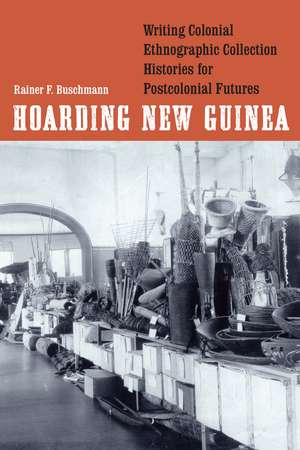
Hoarding New Guinea: Writing Colonial Ethnographic Collection Histories for Postcolonial Futures: Critical Studies in the History of Anthropology
Autor Rainer F. Buschmannen Limba Engleză Hardback – iul 2023
Buschmann moves beyond the easy definition of artifacts as trophies of colonial defeat or religious conversion, instead employing the term hoarding to describe the irrational amassing of Indigenous artifacts by European colonial residents. Buschmann also highlights Indigenous material culture as a bargaining chip for its producers to engage with the imposed colonial regime. In addition, by centering an area of collection rather than an institution, he opens new areas of investigation that include non-professional ethnographic collectors and a sustained rather than superficial consideration of Indigenous peoples as producers behind the material culture. Hoarding New Guinea answers the call for a more significant historical focus on colonial ethnographic collections in European museums.
Din seria Critical Studies in the History of Anthropology
- 19%
 Preț: 421.76 lei
 -
 Preț: 138.86 lei
 -
 Preț: 208.99 lei
 -
 Preț: 449.85 lei
 -
 Preț: 310.62 lei
 -
 Preț: 354.15 lei
 -
 Preț: 234.08 lei
 -
 Preț: 311.17 lei
 -
 Preț: 285.89 lei
 -
 Preț: 223.82 lei
 -
 Preț: 219.29 lei
 - 15%
 Preț: 496.35 lei
 -
 Preț: 208.21 lei
 - 15%
 Preț: 470.17 lei
 -
 Preț: 206.84 lei
 - 15%
 Preț: 435.02 lei
 -
 Preț: 451.68 lei
 -
 Preț: 246.42 lei
 -
 Preț: 271.96 lei
 -
 Preț: 446.71 lei
 -
 Preț: 361.53 lei
 - 23%
 Preț: 501.72 lei
 - 15%
 Preț: 438.81 lei
 - 23%
 Preț: 438.72 lei
 -
 Preț: 417.02 lei
 -
 Preț: 304.77 lei
 -
 Preț: 247.00 lei
 -
 Preț: 212.85 lei
 -
 Preț: 392.12 lei
 -
 Preț: 211.43 lei
 -
 Preț: 410.17 lei
 -
 Preț: 209.60 lei
 -
 Preț: 347.66 lei
 -
 Preț: 200.57 lei
 -
 Preț: 489.24 lei
 - 15%
 Preț: 446.83 lei
 -
 Preț: 212.13 lei
 -
 Preț: 379.76 lei
Preț: 432.02 lei
Preț vechi: 561.07 lei
-23%
Puncte Express: 648
Preț estimativ în valută:
76.46€ • 89.36$ • 66.38£
76.46€ • 89.36$ • 66.38£
Carte tipărită la comandă
Livrare economică 19 februarie-05 martie
Preluare comenzi: 021 569.72.76
Specificații
ISBN-13: 9781496234643
ISBN-10: 1496234642
Pagini: 284
Ilustrații: 24 photographs, 2 illustrations, 5 maps, 3 graphs, 1 appendix, index
Dimensiuni: 152 x 229 x 26 mm
Greutate: 0.59 kg
Editura: Nebraska
Colecția University of Nebraska Press
Seria Critical Studies in the History of Anthropology
Locul publicării:United States
ISBN-10: 1496234642
Pagini: 284
Ilustrații: 24 photographs, 2 illustrations, 5 maps, 3 graphs, 1 appendix, index
Dimensiuni: 152 x 229 x 26 mm
Greutate: 0.59 kg
Editura: Nebraska
Colecția University of Nebraska Press
Seria Critical Studies in the History of Anthropology
Locul publicării:United States
Notă biografică
Rainer F. Buschmann is program chair and a professor of history at California State University, Channel Islands. He is the author of several books, including Iberian Visions of the Pacific Ocean, 1507–1899 and Anthropology’s Global Histories: The Ethnographic Frontier in German New Guinea, 1870–1935.
Cuprins
List of Illustrations
Series Editors’ Introduction
Acknowledgments
Introduction
1. The Itinerant Yet Stubbornly Stable European Value of Material Culture, Circa 1870–1920
2. Ethnographic Resident Collection Networks in German New Guinea
3. Contested Indigenous Borderlands
4. Artifact Exchanges along the Ethnographic Borderlands
Conclusion
Appendix: Three Ways of Estimating Artifact Extraction from German New Guinea
Notes
Bibliography
Index
Series Editors’ Introduction
Acknowledgments
Introduction
1. The Itinerant Yet Stubbornly Stable European Value of Material Culture, Circa 1870–1920
2. Ethnographic Resident Collection Networks in German New Guinea
3. Contested Indigenous Borderlands
4. Artifact Exchanges along the Ethnographic Borderlands
Conclusion
Appendix: Three Ways of Estimating Artifact Extraction from German New Guinea
Notes
Bibliography
Index
Recenzii
“Indeed, there is much to be learned from the author’s use of broad, comparative analysis to craft nuanced histories of collecting from angles that can otherwise shrink into obscurity within conventional, museum-based provenance methods. By widening our focus, we deepen our understanding of material exchange practices from multiple viewpoints. . . . The success of Hoarding New Guinea at introducing such an inventive methodological approach to collections research is itself a feat. Readers of this journal will be drawn to sections of the book that foreground the role of material exchange networks in shaping the field of ethnology, such as the drawing of ethnographic borderlands in chapter 3. . . . Museum scholars and others interested in the dynamics of collecting will value Buschmann’s disruption of colonial authority and his commitment to locating Indigenous agency within this unique history of material exchange. That Buschmann adds to contemporary discourse on museums and their need for redress means that it may also be of interest to broad and diverse nonspecialist audiences.”—Pascale Boucicaut, American Ethnologist
“Objects have taken on new significance in recent years in Anthropology. Buschmann’s fascinating, nuanced and multi-leveled narrative offers a rich, new perspective on the role played by artefacts in early Pacific colonialism, one in which both “collectors and producers” are given roles and voices. This is a useful, vigorously researched, and clearly composed book . . . which has quite a bit to offer students of material culture, the social relations of collecting, the relationship of colonialism to ethnographic museums and, not least, to the history of German New Guinea.”—David Lipset, Journal de la société des océanistes
“Objects have taken on new significance in recent years in Anthropology. Buschmann’s fascinating, nuanced and multi-leveled narrative offers a rich, new perspective on the role played by artefacts in early Pacific colonialism, one in which both “collectors and producers” are given roles and voices. This is a useful, vigorously researched, and clearly composed book . . . which has quite a bit to offer students of material culture, the social relations of collecting, the relationship of colonialism to ethnographic museums and, not least, to the history of German New Guinea.”—David Lipset, Journal de la société des océanistes
"Hoarding New Guinea illustrates a complicated relationship between Indigenous people and their material productions and the European anthropologists, missionaries, and officials who sought to collect, traffic, and hoard Indigenous ethnographica. . . . The framing of movement/trafficking of Indigenous belongings and ancestors from German New Guinea to Europe as hoarding has proven to be a novel and fruitful contribution to the discussion of provenance, collections, and Indigenous histories. All in all, this monograph is well written, well researched, and engaging for the specialist and non-specialists alike, and will serve to be important for anyone interested in the study of colonialism and its institutions."—Brian Yang, Museum Worlds: Advances in Research
"In Hoarding New Guinea, Buschmann provides a complex account how various collectors, Indigenous traders, and museum curators interacted over time and determined what was collected. This book is particularly convincing in its depiction of the dynamics of collecting. . . . By 1914 across German ethnography museums, a near paralysis in documentation, theorizing, and displaying had taken hold. The sorcerer's apprentice had truly run riot, as Buschmann has so cogently and dramatically documented."—Nick Stanley, Journal of Anthropological Research
"Hoarding New Guinea significantly contributes to the discussion about colonial collections and their future. It challenges museum experts and scholars to critically reflect on their role in dealing with the colonial past and to contribute actively to a more just future. This is an indispensable work for all those concerned with post-colonialism, anthropology and museum practice."—Katharina Nowak, Zeitschrift für Ethnologie
"This book will fascinate scholars in museum studies, postcolonial studies, memory studies, cultural geography, and anyone interested in tracing the history of material culture. Beyond the case study and geographic focus, this scholarship will also inform explorations into local colonial collections in other parts of the world, from Africa to Canada. By making space for Indigenous actions and reactions, the study will become a model for the decentering of historical studies on colonial artifacts."—Hélène B. Ducros, EuropeNow
“Hoarding New Guinea manages to be both historically grounded and also attuned to contemporary recognitions of Indigenous agency. The book’s findings and conclusions are sobering, surprising, and illuminating in equal measure, and a refreshing corrective to much superficial postcolonial writing that simplifies and flattens the complexities of the colonial encounter.”—Conal McCarthy, author of Museums and Māori: Heritage Professionals, Indigenous Collections, Current Practice
“This book establishes its topical focus—the hoarding of New Guinea—in a sound analysis of colonial ethnographic collection histories, thus grounding the critique of the present and potential reimagination of the future in a nuanced understanding of the past. Such careful and detailed work is much needed, long overdue, and highly important. It will be of interest to museum scholars as well as professionals and students.”—Philipp Schorch, author of Refocusing Ethnographic Museums through Oceanic Lenses
Descriere
Hoarding New Guinea provides a new cultural history of colonialism that pays close attention to the millions of artifacts that continue to serve as witnesses to Europe’s colonial past in ethnographic museums.