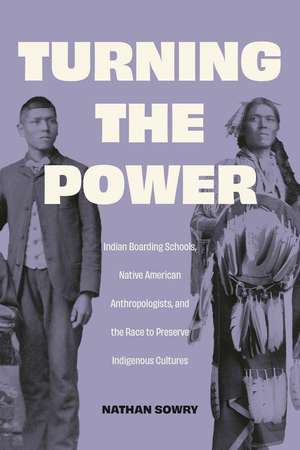
Turning the Power: Indian Boarding Schools, Native American Anthropologists, and the Race to Preserve Indigenous Cultures: Critical Studies in the History of Anthropology
Autor Dr. Nathan Sowryen Limba Engleză Hardback – apr 2025
In Turning the Power Nathan Sowry examines how some Native American students from the boarding school system, with its forced assimilationist education, became key cultural informants for anthropologists conducting fieldwork during the late nineteenth and early twentieth centuries. Salvage anthropologists of this era relied on Native informants to accomplish their mission of “saving” Native American cultures and ultimately turned many informants into anthropologists after years of fieldwork experience.
Sowry investigates ten relatively unknown Native American anthropologists and collaborators who, from 1878 to 1930, attended a religiously affiliated mission school, a federal Indian boarding school, or both. He tells the stories of Native anthropologists Tichkematse, William Jones, and James R. Murie, who were alumni of the Hampton Institute in Virginia. Richard Davis and Cleaver Warden were among the first and second classes to attend the Carlisle Indian Industrial School in Pennsylvania. Amos Oneroad graduated from the Haskell Indian Industrial Training School in Lawrence, Kansas, after attending mission and boarding schools in South Dakota. D. C. Duvall, John V. Satterlee, and Florence and Louis Shotridge attended smaller boarding and mission schools in Montana, Wisconsin, and Alaska Territory, respectively.
Turning the Power follows the forced indoctrination of Native American students and then details how each of them “turned the power,” using their English knowledge and work experience in the anthropological field to embrace, document, and preserve their Native cultures rather than abandoning their heritage.
Din seria Critical Studies in the History of Anthropology
-
 Preț: 138.86 lei
 -
 Preț: 449.85 lei
 -
 Preț: 354.15 lei
 -
 Preț: 208.99 lei
 -
 Preț: 310.40 lei
 -
 Preț: 417.02 lei
 -
 Preț: 451.68 lei
 -
 Preț: 361.53 lei
 -
 Preț: 212.85 lei
 - 15%
 Preț: 496.35 lei
 -
 Preț: 347.66 lei
 -
 Preț: 246.42 lei
 -
 Preț: 379.76 lei
 - 15%
 Preț: 438.81 lei
 - 15%
 Preț: 470.17 lei
 -
 Preț: 304.77 lei
 - 23%
 Preț: 501.72 lei
 - 23%
 Preț: 438.72 lei
 -
 Preț: 247.00 lei
 -
 Preț: 285.89 lei
 -
 Preț: 212.13 lei
 - 23%
 Preț: 432.02 lei
 -
 Preț: 233.89 lei
 -
 Preț: 225.97 lei
 -
 Preț: 219.29 lei
 -
 Preț: 211.43 lei
 -
 Preț: 208.21 lei
 -
 Preț: 209.60 lei
 -
 Preț: 206.99 lei
 -
 Preț: 200.57 lei
 - 15%
 Preț: 435.02 lei
 -
 Preț: 489.24 lei
 -
 Preț: 271.96 lei
 - 19%
 Preț: 421.43 lei
 -
 Preț: 360.17 lei
 - nou
 Preț: 422.90 lei
Preț: 446.71 lei
Puncte Express: 670
Preț estimativ în valută:
78.100€ • 92.70$ • 68.52£
78.100€ • 92.70$ • 68.52£
Carte tipărită la comandă
Livrare economică 09-23 martie
Specificații
ISBN-13: 9781496241924
ISBN-10: 1496241924
Pagini: 358
Ilustrații: 13 photographs, index
Dimensiuni: 152 x 229 mm
Greutate: 0.65 kg
Editura: Nebraska
Colecția University of Nebraska Press
Seria Critical Studies in the History of Anthropology
Locul publicării:United States
ISBN-10: 1496241924
Pagini: 358
Ilustrații: 13 photographs, index
Dimensiuni: 152 x 229 mm
Greutate: 0.65 kg
Editura: Nebraska
Colecția University of Nebraska Press
Seria Critical Studies in the History of Anthropology
Locul publicării:United States
Notă biografică
Nathan Sowry is a reference archivist at the National Museum of the American Indian, Smithsonian Institution.
Cuprins
List of Illustrations
Acknowledgments
Introduction: What Happened Before (Bellevue, Nebraska Territory, 1862)
1. A Great Favorite at the Smithsonian: Tichkematse (Zuni, New Mexico Territory, 1881)
2. One Who Clearly Understands the Thoughts and Ideas of the Indians: William Jones (Cambridge, Massachusetts, 1897)
3. We as a Race Cannot Be Wiped Out in a Short Time: Richard Davis (Colony, Oklahoma Territory, 1905)
4. All the Information There Is to Be Got: D. C. Duvall (Browning, Montana, 1911)
5. We Can Get Fine Work Out—Better Than Any That’s Been Out on Indians: James R. Murie (Pawnee, Oklahoma, 1911)
6. Making a Great Collection of Relics for My People: John V. Satterlee (Keshena, Wisconsin, 1911)
7. A True Indian Is Someone Who Helps Their Race: Cleaver Warden (Washington DC, 1918)
8. Both an Experienced Field Man and a Missionary among His People: Amos Oneroad (Tokio, North Dakota, 1925)
9. Civilized Indians Exploring the Wilds of Alaska: Florence and Louis Shotridge (Sitka, Alaska Territory, 1929)
Conclusion: What Happened After (Hoonah, Alaska, 2017)
Notes
Bibliography
Index
Acknowledgments
Introduction: What Happened Before (Bellevue, Nebraska Territory, 1862)
1. A Great Favorite at the Smithsonian: Tichkematse (Zuni, New Mexico Territory, 1881)
2. One Who Clearly Understands the Thoughts and Ideas of the Indians: William Jones (Cambridge, Massachusetts, 1897)
3. We as a Race Cannot Be Wiped Out in a Short Time: Richard Davis (Colony, Oklahoma Territory, 1905)
4. All the Information There Is to Be Got: D. C. Duvall (Browning, Montana, 1911)
5. We Can Get Fine Work Out—Better Than Any That’s Been Out on Indians: James R. Murie (Pawnee, Oklahoma, 1911)
6. Making a Great Collection of Relics for My People: John V. Satterlee (Keshena, Wisconsin, 1911)
7. A True Indian Is Someone Who Helps Their Race: Cleaver Warden (Washington DC, 1918)
8. Both an Experienced Field Man and a Missionary among His People: Amos Oneroad (Tokio, North Dakota, 1925)
9. Civilized Indians Exploring the Wilds of Alaska: Florence and Louis Shotridge (Sitka, Alaska Territory, 1929)
Conclusion: What Happened After (Hoonah, Alaska, 2017)
Notes
Bibliography
Index
Recenzii
“Through this examination of these Native Americans' personal and professional lives, readers gain insights into how they navigated a society determined to permanently alter them and their central roles in shaping the anthropological discipline.”—G. R. Campbell, Choice
“Turning the Power brings to historical consciousness a series of Native individuals who have rarely been recognized and whose roles in early ethnographic fieldwork were significant. Of even greater importance, though, are the issues surrounding ethnic identity and the central importance of individual decisions (agency). The essays are fascinating to read, individually and collectively.”—Curtis M. Hinsley, coeditor of Coming of Age in Chicago: The 1893 World’s Fair and the Coalescence of American Anthropology
“Nathan Sowry’s research utilizes a vast array of archival and secondary sources. He has done a wonderful job of weaving the narratives of important characters in each chapter. It will serve well anyone interested in the history of American anthropology and American Indians.”—Benjamin R. Kracht, editor of Autobiography of a Kiowa Indian
Descriere
Nathan Sowry examines how Native American students from the boarding school system, with its forced assimilated education, became key cultural informants for anthropologists conducting field work during the late nineteenth and early twentieth centuries.