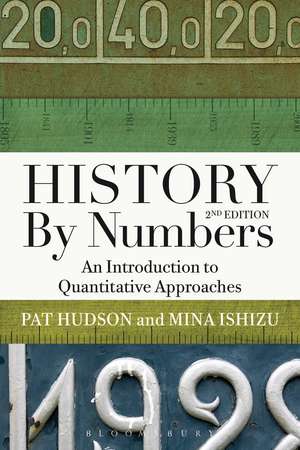
History by Numbers: An Introduction to Quantitative Approaches
Autor Prof. Pat Hudson, Mina Ishizuen Limba Engleză Paperback – 17 noi 2016
Notăm cu interes capitolul dedicat seriilor temporale și indicilor, un punct critic în analiza evoluției fenomenelor sociale, care face din History by Numbers un instrument de lucru indispensabil în mediul academic. Această a doua ediție, semnată de Prof. Pat Hudson și Mina Ishizu, rafinează abordarea pedagogică a metodelor cantitative, transformând statistica dintr-o barieră tehnică într-o resursă interpretativă accesibilă chiar și cercetătorilor mai puțin familiarizați cu matematica. Credem că forța acestui manual rezidă în utilizarea exclusivă a seturilor de date istorice autentice, permițând cititorului să parcurgă drumul de la colectarea brută a informației până la momentul descoperirii narative.
Din punct de vedere al conținutului, volumul urmează o progresie logică: începe cu fundamentele gândirii cantitative, trece prin organizarea și sumarizarea datelor prin medii și distribuții, și culminează cu modelarea istorică și utilizarea noilor tehnologii. Merită menționat că această ediție extinde cadrul propus de Making History Count de Charles H. Feinstein, integrând o secțiune vitală despre computere și internet în cercetarea istorică, adaptându-se astfel peisajului digital contemporan. În timp ce An Introduction to Quantitative Methods for Historians de Roderick Floud pune accent pe tehnici de analiză a dovezilor măsurabile, lucrarea de față reușește să contextualizeze aceste metode prin prisma experienței vaste a lui Prof. Pat Hudson. Aceasta din urmă, cunoscută pentru analiza integrată a aspectelor economice și sociale în The Industrial Revolution, aduce în noul manual aceeași rigoare în interpretarea schimbărilor structurale, oferind studenților nu doar formule, ci o metodologie de investigare a trecutului.
Preț: 218.64 lei
Preț vechi: 270.73 lei
-19%
Carte disponibilă
Livrare economică 29 octombrie-12 noiembrie
Livrare express 14-20 octombrie pentru 82.49 lei
Specificații
ISBN-10: 1849665370
Pagini: 360
Dimensiuni: 152 x 230 x 26 mm
Greutate: 0.59 kg
Ediția:2nd edition
Editura: Bloomsbury Publishing
Colecția Bloomsbury Academic
Locul publicării:London, United Kingdom
V-ar putea interesa
-
 The Principles of History: And Other Writings in Philosophy of HistoryR. G. Collingwood-28%Preț: 465.01 lei649.83 lei
 -
 A Concise Companion to HistoryUlinka Rublack-12%Preț: 267.08 lei303.06 lei
 -
 Futures Past - On the Semantics of Historical TimeReinhart KoselleckPreț: 255.90 lei
 -
 On HistoryEric Hobsbawm-27%Preț: 72.54 lei98.93 lei
 -
 Altered Pasts: Counterfactuals in HistorySir Richard J. Evans, FBA, FRSL, FRHistS-27%Preț: 67.10 lei92.55 lei
 -
 History Skills: A Student's HandbookMary AbbottPreț: 376.18 lei
 -
 A History of HistoryAlun MunslowPreț: 410.01 lei
 -
 The Past is a Foreign Country - RevisitedDavid LowenthalPreț: 293.12 lei
 -
 The Look of the PastLudmilla JordanovaPreț: 449.94 lei
 -
 The Practice of Conceptual History: Timing History, Spacing ConceptsReinhart KoselleckPreț: 232.31 lei
 -
 Preț: 292.98 lei
 -
 Thousand Years of Nonlinear HistoryManuel De LandaPreț: 193.82 lei
 -
 Being a Historian: An Introduction to the Professional World of HistoryJames M. Banner, Jr.Preț: 239.45 lei
 -
 The Lessons of HistoryWill Durant-14%Preț: 60.73 lei70.93 lei
 -
 The Uses and Abuses of HistoryProfessor Margaret MacMillan-20%Preț: 50.78 lei63.46 lei
De ce să citești această carte
Recomandăm această lucrare studenților și cercetătorilor care doresc să stăpânească analiza datelor fără a fi experți în matematică. Cartea oferă o introducere aplicată în metodele cantitative, explicând clar originea și limitele fiecărei tehnici. Este un ghid esențial pentru oricine dorește să utilizeze surse istorice complexe pentru a construi argumente solide, sprijinite de dovezi statistice corect interpretate.
Descriere
History by Numbers stands alone as the only textbook on quantitative methods suitable for students of history encountering the field for the first time. It is an exceptional book - even the numerically challenged will find inspiration.
Cuprins
1. The Prospects and Pitfalls of History by Numbers
2. The Origins and Nature of Quantitative Thinking
3. Arranging, Rearranging and Displaying Data
4. Summarising Data: Averages and Distributions
5. Time Series and Indices
6. Relationships Between Variables
7. Sampling and Significance Testing
8. Modelling History
9. Computing, the Internet and History
Glossary
Index
Recenzii
History by Numbers is a perfect introduction to those unfamiliar with, or uncertain about, quantitative approaches to the study of the past. Written in an accessible and engaging style, even those who lack confidence with numbers, graphs and statistics will find themselves enlightened as the authors carefully guide them through a variety of quantitative historical methodologies, describe how they have been used, and what their advantages and shortcomings might be for historical researchers.
Scared of numbers no more! In a world in which we are constantly asked to make sense of data in the form of graphs and tables, how can we address history without much sense of magnitude, scale and trends over time? In History by Numbers Hudson and Ishizu guide the reader step by step into the world of quantities, and percentages, as well as the mysteries of sampling and causation. Without numerical literacy, it is impossible to tackle key issues such as migration, consumption, urbanisation and indeed cultural and political change.
This is the text book for the next generation of quantitative historians. The brilliantly crafted new edition is written for those who are knowledgeable in history but still skip over the graphs and tables. Chapters convey the evolving need for quantitative study, then lead readers smoothly through all the key quantitative principles. Early chapters show how to read and assess quantitative history; concluding chapters provide effective guidelines on conducting quantitative research. The images and tables, updated and beautifully documented, illustrate concretely the principles. Hudson and Ishizu have overcome the mechanical approaches of their competitors: at every step, a lively historiographical discussion accompanies their clear statement of quantitative principles, emphasizing the balance of technique and critical historical review of the past. Students will be elevated as well as informed; senior scholars will read this book with profit as a review of principles and as a guide to teaching.
Ever wondered about that Gini they talk about? If you have scratched your head over debates about income inequality, puzzled over long-run trends, or perhaps pondered on what son-preference in India did to men's chances of marrying, then History by Numbers is for you. This book gently teaches how to think with statistics, using wide-ranging examples from recent historical literature. Statistical concepts are crystal clear. The authors also examine why historians want to quantify, and how research is changing in the digital age. Big Data means everyone needs to understand numbers. Hudson and Ishizu offer an at once practical and engaging introductory text.
This is the best English handbook on quantitative methods for history students.
This is a great introduction to quantitative history. It is clear and accessible and makes the topic appealing to students.