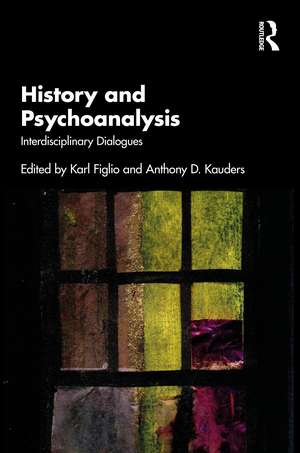
History and Psychoanalysis: Interdisciplinary Dialogues
Editat de Karl Figlio, Anthony D. Kaudersen Limba Engleză Paperback – 24 mar 2027
With a methodological focus, each chapter captures a live dialogue between a psychoanalyst and a historian, enriched by discussion and further refinement. Chapters relate the subjectivity of clinical psychoanalysis to the structuring of social and national groups. Topics range across politics, international conflicts, class and the effects of trauma on the individual and the group.
With insights on a wide range of historical and contemporary social and political topics and many aspects of human experience, this is key reading for psychoanalysts, historians, social scientists and anyone wanting a deeper understanding of human nature and experience.
Preț: 276.13 lei
Preț vechi: 326.68 lei
-15% Precomandă
Puncte Express: 414
Carte nepublicată încă
Livrare prin curier în România Precomanda se expediază când titlul devine disponibil.
Transport gratuit de la 400.00 lei Plată online sau ramburs, în funcție de opțiunile comenzii.
Retur gratuit în 14 zile Comandă securizată și suport în română.
Doresc să fiu notificat când acest titlu va fi disponibil:
Se trimite...
Specificații
ISBN-13: 9781041249788
ISBN-10: 1041249780
Pagini: 272
Ilustrații: 52
Dimensiuni: 156 x 234 mm
Ediția:1
Editura: Taylor & Francis
Colecția Routledge
Locul publicării:Oxford, United Kingdom
ISBN-10: 1041249780
Pagini: 272
Ilustrații: 52
Dimensiuni: 156 x 234 mm
Ediția:1
Editura: Taylor & Francis
Colecția Routledge
Locul publicării:Oxford, United Kingdom
Public țintă
Postgraduate and Professional Practice & DevelopmentCuprins
1. Wrestling With Subjectivity: Historical and Psychoanalytic Perspectives 2. Psychiatric Diagnoses: An Embodiment of Socio-Cultural Transformation 3. The Ethos of the Welfare State in Britain in the 1940s: Historical Analysis and the Unconscious 4. State and Character in Germany: From 1946 to the Present 5. Psychodynamics of Hitler and Nazism 6. Climbing the Kiliansturm: A methodological dialogue between historiography and psychoanalysis on searching for the traces of the historical trauma of the German Peasants’ War 7. Trauma, Psychology, and Racism in Frantz Fanon’s Black Skin, White Masks (1952) 8. Material culture in psychoanalysis and history 9. History in Trauma 10. Reinstating History in Trauma 11. Observing Dialogue: Interdisciplinarity in Theory and Practice
Recenzii
'Psychoanalysis is “in” again – and this volume showcases a highly productive experiment in putting analysts and historians in conversation with each other. Not least as the terrible vagaries of the global present – novel pressures and seductions, spiraling fears and ambivalences – force us to question long-held certainties especially about the attractions of fascism and the moral compromises humans are willing to make and to rationalize to themselves, this anthology could not come at a better moment. Every reader will find gems of provocative insight.'
Dagmar Herzog, Distinguished Professor, CUNY Graduate Center, author of The Question of Unworthy Life.
'This outstanding and original collection opens a genuinely creative dialogue between history and psychoanalysis, not by collapsing one discipline into the other, but by allowing each to illuminate the limits, possibilities, and blind spots of the other. The essays are intellectually adventurous, methodologically sophisticated, and emotionally resonant. Together they offer a rich exploration of trauma, memory, subjectivity, and historical experience, demonstrating how psychoanalytic thinking can deepen historical understanding and historical inquiry can sharpen psychoanalytic reflection. A major and timely contribution to interdisciplinary scholarship.'
Professor Peter Fonagy, CBE FMedSci FBA FAcSS, Head of Division, Psychology and Language Sciences, UCL, Professor, Contemporary Psychoanalysis and Developmental Science, National Clinical Adviser Children’s Mental Health, NHSE
'A thoughtful and probing set of dialogues. These vivid encounters between clinicians, historians and theorists illuminate opportunities, challenges and potential pitfalls in applying Freudian thought in the study of history, politics and contemporary life.'
Daniel Pick, Professor emeritus Birkbeck College; Training analyst, British Psychoanalytical Society
'This is a unique book, which brings together the contributions of renowned clinicians and scholars from different fields on the complex issue of 'history'. Under the editorship of Karl Figlio and Anthony Kauders, this interdisciplinary approach not only deepens our understanding of the 'past'. It leads right into the heart of the riddle of time: the role of remembering and forgetting, trauma and reparation, forgiveness and, finally, the emergence of the future. An indispensable reading for all those who are concerned with the challenges of historical understanding.'
Professor Heinz Weiss, Senior Scientist, Sigmund Freud Institute, Frankfurt, Chair of the Education Section, the International Journal of Psychoanalysis.
Dagmar Herzog, Distinguished Professor, CUNY Graduate Center, author of The Question of Unworthy Life.
'This outstanding and original collection opens a genuinely creative dialogue between history and psychoanalysis, not by collapsing one discipline into the other, but by allowing each to illuminate the limits, possibilities, and blind spots of the other. The essays are intellectually adventurous, methodologically sophisticated, and emotionally resonant. Together they offer a rich exploration of trauma, memory, subjectivity, and historical experience, demonstrating how psychoanalytic thinking can deepen historical understanding and historical inquiry can sharpen psychoanalytic reflection. A major and timely contribution to interdisciplinary scholarship.'
Professor Peter Fonagy, CBE FMedSci FBA FAcSS, Head of Division, Psychology and Language Sciences, UCL, Professor, Contemporary Psychoanalysis and Developmental Science, National Clinical Adviser Children’s Mental Health, NHSE
'A thoughtful and probing set of dialogues. These vivid encounters between clinicians, historians and theorists illuminate opportunities, challenges and potential pitfalls in applying Freudian thought in the study of history, politics and contemporary life.'
Daniel Pick, Professor emeritus Birkbeck College; Training analyst, British Psychoanalytical Society
'This is a unique book, which brings together the contributions of renowned clinicians and scholars from different fields on the complex issue of 'history'. Under the editorship of Karl Figlio and Anthony Kauders, this interdisciplinary approach not only deepens our understanding of the 'past'. It leads right into the heart of the riddle of time: the role of remembering and forgetting, trauma and reparation, forgiveness and, finally, the emergence of the future. An indispensable reading for all those who are concerned with the challenges of historical understanding.'
Professor Heinz Weiss, Senior Scientist, Sigmund Freud Institute, Frankfurt, Chair of the Education Section, the International Journal of Psychoanalysis.
Notă biografică
Karl Figlio is Professor Emeritus, Department of Psychosocial and Psychoanalytic Studies, University of Essex; Clinical Associate, British Psychoanalytical Society and Senior Member, Psychoanalytic Psychotherapy Association, British Psychotherapy Society. Books include Remembering as Reparation: Psychoanalysis and Historical Memory (2017), Rethinking the Psychoanalysis of Masculinity: From Toxic to Seminal (2024).
Anthony D. Kauders is Professor Emeritus of Modern History, Keele University. He has published in German-Jewish history, antisemitism and the history of psychology, including Der Freud-Komplex. Eine Geschichte der Psychoanalyse in Deutschland (Berlin, 2014). He is currently using social psychological concepts to understand modern antisemitism. Recent work has appeared in Antisemitism Studies, Jahrbuch für Antisemitismusforschung, Geschichte und Gesellschaft and Holocaust and Genocide Studies.
Anthony D. Kauders is Professor Emeritus of Modern History, Keele University. He has published in German-Jewish history, antisemitism and the history of psychology, including Der Freud-Komplex. Eine Geschichte der Psychoanalyse in Deutschland (Berlin, 2014). He is currently using social psychological concepts to understand modern antisemitism. Recent work has appeared in Antisemitism Studies, Jahrbuch für Antisemitismusforschung, Geschichte und Gesellschaft and Holocaust and Genocide Studies.
Descriere
This book explores the conviction that psychoanalysis and history can, through active dialogue, learn from each other, to understand ourselves better as individuals and societies.