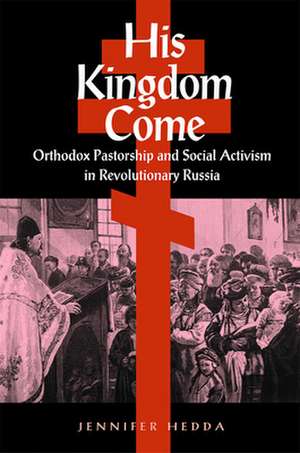
His Kingdom Come: Orthodox Pastorship and Social Activism in Revolutionary Russia
Autor Jennifer Heddaen Limba Engleză Paperback – aug 2011
Jennifer Hedda analyzes the ideas and activities of the parish clergy serving in St. Petersburg, the capital of imperial Russia, in order to discover how the Russian Orthodox Church responded theologically and pastorally to the profound social, economic, and cultural changes that transformed Russia during the 19th and early 20th centuries. The challenges of modernity forced the Orthodox clergy, like other members of educated society, to re-examine their interpretation of the Church’s earthly mission and their own role in fulfilling it. During the mid-19th century, Orthodox theologians began to argue that the church had a responsibility to society as well as to individuals, and to assert that its mission was to lead believers in building a society that manifested the gospel principles of love, mercy, charity, and justice.
The idea of creating “the kingdom of God” on earth inspired many clergymen, who dramatically increased their social outreach work in the last two decades of the 19th century: preaching during church services, teaching outside their churches, organizing charities, establishing temperance societies, and engaging in a host of other activities that involved them in the daily lives of their parishioners. The clergy’s work culminated in 1905, when a workers’ organization established by an Orthodox priest became a mass political movement whose activities sparked a revolution.
His Kingdom Come challenges many common assumptions about the Orthodox Church as a weak and passive institution that did not respond to the demands of the modern world—demonstrating that it played an active and creative role in late imperial society, albeit on its own terms rather than those of its secular critics. This book will be of particular interest to those who study the politics and society of Russia in the imperial period, the history of the Russian Orthodox Church in the modern era, the relationship of religious institutions to society and culture, and the history of religious-social thought in other post-Enlightenment societies.
The idea of creating “the kingdom of God” on earth inspired many clergymen, who dramatically increased their social outreach work in the last two decades of the 19th century: preaching during church services, teaching outside their churches, organizing charities, establishing temperance societies, and engaging in a host of other activities that involved them in the daily lives of their parishioners. The clergy’s work culminated in 1905, when a workers’ organization established by an Orthodox priest became a mass political movement whose activities sparked a revolution.
His Kingdom Come challenges many common assumptions about the Orthodox Church as a weak and passive institution that did not respond to the demands of the modern world—demonstrating that it played an active and creative role in late imperial society, albeit on its own terms rather than those of its secular critics. This book will be of particular interest to those who study the politics and society of Russia in the imperial period, the history of the Russian Orthodox Church in the modern era, the relationship of religious institutions to society and culture, and the history of religious-social thought in other post-Enlightenment societies.
Preț: 409.25 lei
Puncte Express: 614
Carte tipărită la comandă
Livrare economică 08-22 decembrie
Livrare prin curier în România Termenul estimat este afișat lângă disponibilitate.
Transport gratuit pentru acest produs Plată online sau ramburs, în funcție de opțiunile comenzii.
Retur gratuit în 14 zile Comandă securizată și suport în română.
Specificații
ISBN-13: 9780875806648
ISBN-10: 0875806643
Pagini: 382
Dimensiuni: 152 x 228 x 25 mm
Greutate: 0.45 kg
Ediția:1
Editura: Northern Illinois University Press
Colecția Northern Illinois University Press
ISBN-10: 0875806643
Pagini: 382
Dimensiuni: 152 x 228 x 25 mm
Greutate: 0.45 kg
Ediția:1
Editura: Northern Illinois University Press
Colecția Northern Illinois University Press
Recenzii
“Remarkable. Highly recommended.” —Choice
“Contributes to the growing body of American scholarship and Russian scholarship. Hedda has illuminated a neglected corner of Russian history and her book is a useful and welcome addition.”—The Russian Review
“Valuable and stimulating. Hedda focuses on the passion with which many clergy ... embraced the idea of the Kingdom of God on earth and worked courageously for social reforms necessary to that end.”—Times Literary Supplement
“Valuable and stimulating. Hedda focuses on the passion with which many clergy ... embraced the idea of the Kingdom of God on earth and worked courageously for social reforms necessary to that end.”—Times Literary Supplement
Notă biografică
Jennifer Hedda received a Ph.D. in History from Harvard University and now lives in Virginia with her husband and her three sons.
Cuprins
Table of Contents
Preface
Introduction
1: Foundations of the Modern Russian Orthodox Church
2: Bridging the Great Divide: The St. Petersburg Ecclesiastical Academy and the Church’s Mission to Society
3: Good Shepherds: Preaching and Pastoral Care in St. Petersburg
4: Church Charity and the Search for Christian Community
5: Teaching, Temperance, and the Expansion of the Church's Mission
6: In the Footsteps of Christ: The Work of Father Grigorii Petrov
7: From Religion to Politics: Father Gapon and the Assembly of Russian Workers
8: Renewing the Church: The Renovationists and Church Reform
9: The Decade of Despair: 1907–1917
Conclusion
Appendix: The Union of Zealots for Church Renovation, 1906
Notes
Works Cited
Index
Introduction
1: Foundations of the Modern Russian Orthodox Church
2: Bridging the Great Divide: The St. Petersburg Ecclesiastical Academy and the Church’s Mission to Society
3: Good Shepherds: Preaching and Pastoral Care in St. Petersburg
4: Church Charity and the Search for Christian Community
5: Teaching, Temperance, and the Expansion of the Church's Mission
6: In the Footsteps of Christ: The Work of Father Grigorii Petrov
7: From Religion to Politics: Father Gapon and the Assembly of Russian Workers
8: Renewing the Church: The Renovationists and Church Reform
9: The Decade of Despair: 1907–1917
Conclusion
Appendix: The Union of Zealots for Church Renovation, 1906
Notes
Works Cited
Index
Descriere
Jennifer Hedda analyzes the ideas and activities of the parish clergy serving in St. Petersburg, the capital of imperial Russia, in order to discover how the Russian Orthodox Church responded theologically and pastorally to the profound social, economic, and cultural changes that transformed Russia during the 19th and early 20th centuries. The challenges of modernity forced the Orthodox clergy, like other members of educated society, to re-examine their interpretation of the Church’s earthly mission and their own role in fulfilling it. During the mid-19th century, Orthodox theologians began to argue that the church had a responsibility to society as well as to individuals, and to assert that its mission was to lead believers in building a society that manifested the gospel principles of love, mercy, charity, and justice.
The idea of creating “the kingdom of God” on earth inspired many clergymen, who dramatically increased their social outreach work in the last two decades of the 19th century: preaching during church services, teaching outside their churches, organizing charities, establishing temperance societies, and engaging in a host of other activities that involved them in the daily lives of their parishioners. The clergy’s work culminated in 1905, when a workers’ organization established by an Orthodox priest became a mass political movement whose activities sparked a revolution.
His Kingdom Come challenges many common assumptions about the Orthodox Church as a weak and passive institution that did not respond to the demands of the modern world—demonstrating that it played an active and creative role in late imperial society, albeit on its own terms rather than those of its secular critics. This book will be of particular interest to those who study the politics and society of Russia in the imperial period, the history of the Russian Orthodox Church in the modern era, the relationship of religious institutions to society and culture, and the history of religious-social thought in other post-Enlightenment societies.
The idea of creating “the kingdom of God” on earth inspired many clergymen, who dramatically increased their social outreach work in the last two decades of the 19th century: preaching during church services, teaching outside their churches, organizing charities, establishing temperance societies, and engaging in a host of other activities that involved them in the daily lives of their parishioners. The clergy’s work culminated in 1905, when a workers’ organization established by an Orthodox priest became a mass political movement whose activities sparked a revolution.
His Kingdom Come challenges many common assumptions about the Orthodox Church as a weak and passive institution that did not respond to the demands of the modern world—demonstrating that it played an active and creative role in late imperial society, albeit on its own terms rather than those of its secular critics. This book will be of particular interest to those who study the politics and society of Russia in the imperial period, the history of the Russian Orthodox Church in the modern era, the relationship of religious institutions to society and culture, and the history of religious-social thought in other post-Enlightenment societies.