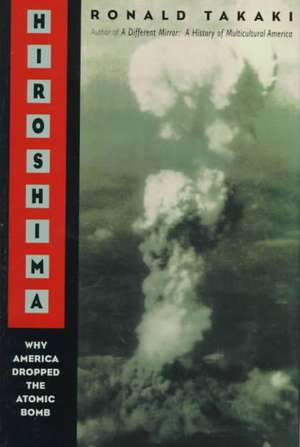
Hiroshima
Autor Ronald Takakien Limba Engleză Hardback – aug 1995
Preț: 244.50 lei
Puncte Express: 367
Carte tipărită la comandă
Livrare economică 30 decembrie 26 - 13 ianuarie 27
Livrare prin curier în România Termenul estimat este afișat lângă disponibilitate.
Transport gratuit de la 400.00 lei Plată online sau ramburs, în funcție de opțiunile comenzii.
Retur gratuit în 14 zile Comandă securizată și suport în română.
Specificații
ISBN-13: 9780316831222
ISBN-10: 0316831220
Pagini: 208
Dimensiuni: 146 x 223 x 25 mm
Greutate: 0.39 kg
Ediția:American edition
Editura: Little, Brown and Company
ISBN-10: 0316831220
Pagini: 208
Dimensiuni: 146 x 223 x 25 mm
Greutate: 0.39 kg
Ediția:American edition
Editura: Little, Brown and Company
V-ar putea interesa
-
 1939 the Second World War in PhotographsJohn ChristopherPreț: 164.97 lei
-
 1940 the Second World War in PhotographsJohn ChristopherPreț: 165.43 lei
-
 1940 the Second World War at Sea in PhotographsPhil CarradicePreț: 136.03 lei
-
 An Illustrated Introduction to the Second World WarHenry BucktonPreț: 49.78 lei
-
 Kampfgruppe Peiper: The Race for the MeuseDavid CookePreț: 108.69 lei
-
 KüstenfliegerAdam Thompson-9%Preț: 112.09 lei123.49 lei
-
 Monty S Northern Legions: Moray's Regular Revolution 1760 1840Patrick Delaforce-12%Preț: 104.43 lei118.44 lei
-
 Life and Death in ChangiThomas Kitching-19%Preț: 147.62 lei181.93 lei
Descriere
Descriere de la o altă ediție sau format:
The bombing of Hiroshima was one of the pivotal events of the twentieth century, yet this controversial question remains unresolved. At the time, General Dwight Eisenhower, General Douglas MacArthur, and chief of staff Admiral William Leahy all agreed that an atomic attack on Japanese cities was unnecessary. All of them believed that Japan had already been beaten and that the war would soon end. Was the bomb dropped to end the war more quickly? Or did it herald the start of the Cold War? In his probing new study, prizewinning historian Ronald Takaki explores these factors and more. He considers the cultural context of race - the ways in which stereotypes of the Japanese influenced public opinion and policymakers - and also probes the human dimension. Relying on top secret military reports, diaries, and personal letters, Takaki relates international policies to the individuals involved: Los Alamos director J. Robert Oppenheimer, Secretary of State James Byrnes, Secretary of War Henry L. Stimson, and others... but above all, Harry Truman.
The bombing of Hiroshima was one of the pivotal events of the twentieth century, yet this controversial question remains unresolved. At the time, General Dwight Eisenhower, General Douglas MacArthur, and chief of staff Admiral William Leahy all agreed that an atomic attack on Japanese cities was unnecessary. All of them believed that Japan had already been beaten and that the war would soon end. Was the bomb dropped to end the war more quickly? Or did it herald the start of the Cold War? In his probing new study, prizewinning historian Ronald Takaki explores these factors and more. He considers the cultural context of race - the ways in which stereotypes of the Japanese influenced public opinion and policymakers - and also probes the human dimension. Relying on top secret military reports, diaries, and personal letters, Takaki relates international policies to the individuals involved: Los Alamos director J. Robert Oppenheimer, Secretary of State James Byrnes, Secretary of War Henry L. Stimson, and others... but above all, Harry Truman.