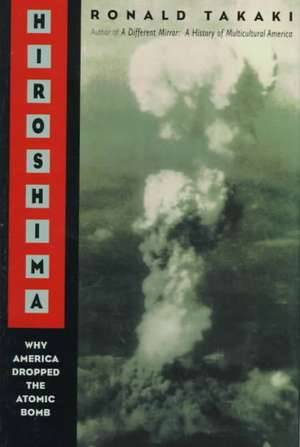
Hiroshima: Why America Dropped the Atomic Bomb
Autor Ronald Takakien Limba Engleză Hardback – 31 iul 1995
| Toate formatele și edițiile | Preț | Express |
|---|---|---|
| Paperback (1) | 137.60 lei 6-8 săpt. | +22.24 lei 7-13 zile |
| Little Brown – sep 1996 | 137.60 lei 6-8 săpt. | +22.24 lei 7-13 zile |
| Hardback (1) | 224.41 lei 6-8 săpt. | |
| Little, Brown and Company – 31 iul 1995 | 224.41 lei 6-8 săpt. |
Preț: 224.41 lei
Puncte Express: 337
Preț estimativ în valută:
39.65€ • 45.56$ • 34.35£
39.65€ • 45.56$ • 34.35£
Carte tipărită la comandă
Livrare economică 06-20 mai
Specificații
ISBN-13: 9780316831222
ISBN-10: 0316831220
Pagini: 208
Dimensiuni: 148 x 218 x 20 mm
Greutate: 0.34 kg
Ediția:American
Editura: Little, Brown and Company
Colecția Little Brown and Company
ISBN-10: 0316831220
Pagini: 208
Dimensiuni: 148 x 218 x 20 mm
Greutate: 0.34 kg
Ediția:American
Editura: Little, Brown and Company
Colecția Little Brown and Company
V-ar putea interesa
-
 Preț: 156.94 lei
 -
 1940 the Second World War in PhotographsJohn ChristopherPreț: 157.58 lei
 -
 1940 the Second World War at Sea in PhotographsPhil CarradicePreț: 129.50 lei
 -
 Preț: 129.83 lei
 -
 An Illustrated Introduction to the Second World WarHenry BucktonPreț: 47.30 lei
 -
 Kampfgruppe PeiperDavid CookePreț: 103.52 lei
 -
 KüstenfliegerAdam Thompson-12%Preț: 103.47 lei117.60 lei
 -
 Monty S Northern Legions: Moray's Regular Revolution 1760 1840Patrick Delaforce-12%Preț: 104.43 lei118.44 lei
 -
 Leaders of the Storm TroopsMichael Miller-8%Preț: 407.73 lei443.18 lei
 -
 Life and Death in ChangiThomas Kitching-19%Preț: 147.62 lei181.93 lei
Descriere
Descriere de la o altă ediție sau format:
The bombing of Hiroshima was one of the pivotal events of the twentieth century, yet this controversial question remains unresolved. At the time, General Dwight Eisenhower, General Douglas MacArthur, and chief of staff Admiral William Leahy all agreed that an atomic attack on Japanese cities was unnecessary. All of them believed that Japan had already been beaten and that the war would soon end. Was the bomb dropped to end the war more quickly? Or did it herald the start of the Cold War? In his probing new study, prizewinning historian Ronald Takaki explores these factors and more. He considers the cultural context of race - the ways in which stereotypes of the Japanese influenced public opinion and policymakers - and also probes the human dimension. Relying on top secret military reports, diaries, and personal letters, Takaki relates international policies to the individuals involved: Los Alamos director J. Robert Oppenheimer, Secretary of State James Byrnes, Secretary of War Henry L. Stimson, and others... but above all, Harry Truman.
The bombing of Hiroshima was one of the pivotal events of the twentieth century, yet this controversial question remains unresolved. At the time, General Dwight Eisenhower, General Douglas MacArthur, and chief of staff Admiral William Leahy all agreed that an atomic attack on Japanese cities was unnecessary. All of them believed that Japan had already been beaten and that the war would soon end. Was the bomb dropped to end the war more quickly? Or did it herald the start of the Cold War? In his probing new study, prizewinning historian Ronald Takaki explores these factors and more. He considers the cultural context of race - the ways in which stereotypes of the Japanese influenced public opinion and policymakers - and also probes the human dimension. Relying on top secret military reports, diaries, and personal letters, Takaki relates international policies to the individuals involved: Los Alamos director J. Robert Oppenheimer, Secretary of State James Byrnes, Secretary of War Henry L. Stimson, and others... but above all, Harry Truman.