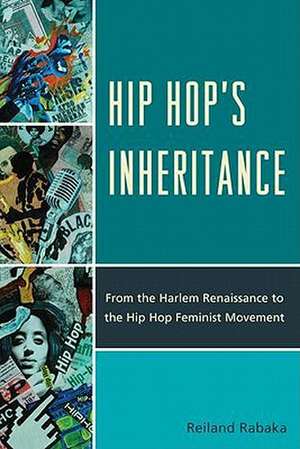
Hip Hop's Inheritance: From the Harlem Renaissance to the Hip Hop Feminist Movement
Autor Reiland Rabakaen Limba Engleză Hardback – 31 mar 2011
Preț: 710.87 lei
Preț vechi: 1054.21 lei
-33%
Puncte Express: 1066
Carte tipărită la comandă
Livrare economică 04-18 decembrie
Livrare prin curier în România Termenul estimat este afișat lângă disponibilitate.
Transport gratuit pentru acest produs Plată online sau ramburs, în funcție de opțiunile comenzii.
Retur gratuit în 14 zile Comandă securizată și suport în română.
Specificații
ISBN-13: 9780739164808
ISBN-10: 0739164805
Pagini: 302
Dimensiuni: 160 x 232 x 24 mm
Greutate: 0.59 kg
Ediția:New.
Editura: Bloomsbury Publishing
Colecția Lexington Books
Locul publicării:New York, United States
ISBN-10: 0739164805
Pagini: 302
Dimensiuni: 160 x 232 x 24 mm
Greutate: 0.59 kg
Ediția:New.
Editura: Bloomsbury Publishing
Colecția Lexington Books
Locul publicării:New York, United States
Cuprins
Chapter 1 Preface and Acknowledgments: Of the Black Souls Who Sang Neo-Sorrow Songs at the Dawn of the Twenty-First Century Chapter 2 Chapter 1: "It's Bigger Than Hip Hop!": Toward a Critical Theory of Hip Hop Culture and Contemporary Society Chapter 3 Chapter 2: "Civil Rights by Copyright" (Da ReMix!): From the Harlem Renaissance to the Hip Hop Generation Chapter 4 Chapter 3: "Say It Loud! - I'm Black and I'm Proud!": From the Black Arts Movement and Blaxploitation Films to the Conscious and Commercial Rap of the Hip Hop Generation Chapter 5 Chapter 4: "The Personal Is Political!" (Da Hip Hop Feminist ReMix): From the Black Women's Liberation and Feminist Art Movements to the Hip Hop Feminist Movement Chapter 6 Chapter 5: Is Hip Hop Dead? or, At the Very Least, Dying?: On the Pitfalls of Postmodernism, the Riddles of Contemporary Rap Music,and the Continuing Conundrums of Hip Hop Culture
Recenzii
Rabaka (Univ. of Colorado, Boulder) offers a sweeping historical assessment of cultural ideologies connecting hip-hop to artistic innovations of the Harlem Renaissance and Black Arts movements. He mobilizes cultural theorists - Baraka, Foucault, DuBois, Jameson, Said, Fanon, Hurston - to describe the evolution of African American intellectual and cultural history via 'radical humanism, and democratic socialism.' Sprawling overviews of Africana critical theory, feminist theory, and queer theory imagine, 'anti-racist, anti-capitalist, anti-colonialist, and sexual orientation-sensitive critical theory of contemporary society.' The author provides interesting, if diffuse, discussion of gay literary voices in the Harlem Renaissance in relation to the contemporary homo-hop movement; Black Arts Movement members' perception of the 'aesthetic radicalism of the Harlem Renaissance'; and the 'black aesthetic' sensibility that ''authentic' black art was always historically grounded, politically engaged, socially uplifting, and consciousness-raising.' In exploring the relationships between the black women's liberation, feminist art, and hip-hop feminist movements, Rabaka mines work by Patricia Collins. In a final chapter, he considers postmodernist approaches to popular culture while asserting that 'rap music re-Africanizes and reanimates African American music, all the while continuing the African Americanization of mainstream American music and popular culture....' Summing Up: Recommended. Upper-division undergraduates, graduate students.
You remember when you fell in love with hip-hop. Now, be reminded why.
Reiland Rabaka demonstrates, with great agility, that hip-hop has wide-reaching artistic and intellectual roots in the history of African American cultural production. This book is an essential addition to an expanding corpus of rich scholarship on hip-hop. It is a welcome contribution with fresh perspectives on the dynamics of gender, class and race in the context of hip-hop-beyond beats and rhymes.
Hip-Hop's Inheritance is an extraordinary journey through the last decade of hip-hop criticism that situates the contemporary hip-hop moment into the historical continuum of black political, cultural and gender struggles in the US. With unflinching compassion, piercing intellect and unwavering scholarship,Reiland Rabaka advances a long overdue critical theory of hip-hop culture.
You remember when you fell in love with hip-hop. Now, be reminded why.
Reiland Rabaka demonstrates, with great agility, that hip-hop has wide-reaching artistic and intellectual roots in the history of African American cultural production. This book is an essential addition to an expanding corpus of rich scholarship on hip-hop. It is a welcome contribution with fresh perspectives on the dynamics of gender, class and race in the context of hip-hop-beyond beats and rhymes.
Hip-Hop's Inheritance is an extraordinary journey through the last decade of hip-hop criticism that situates the contemporary hip-hop moment into the historical continuum of black political, cultural and gender struggles in the US. With unflinching compassion, piercing intellect and unwavering scholarship,Reiland Rabaka advances a long overdue critical theory of hip-hop culture.