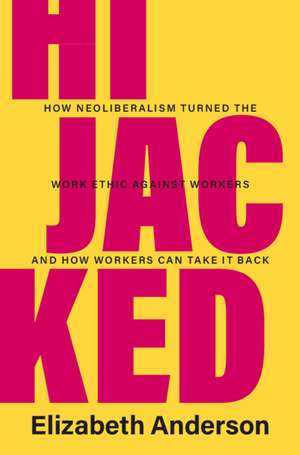
Hijacked: The Seeley Lectures
Autor Elizabeth Andersonen Limba Engleză Hardback – 21 sep 2023

Preț: 184.22 lei
Puncte Express: 276
Carte disponibilă
Livrare economică 11-25 noiembrie
Livrare express 27-31 octombrie pentru 96.89 lei
Livrare prin curier în România Termenul estimat este afișat lângă disponibilitate.
Transport gratuit de la 400.00 lei Plată online sau ramburs, în funcție de opțiunile comenzii.
Retur gratuit în 14 zile Comandă securizată și suport în română.
Specificații
ISBN-13: 9781009275439
ISBN-10: 1009275437
Pagini: 384
Ilustrații: Worked examples or Exercises
Dimensiuni: 157 x 235 x 27 mm
Greutate: 0.78 kg
Editura: Cambridge University Pr.
Seria The Seeley Lectures
Locul publicării:Cambridge, United Kingdom
ISBN-10: 1009275437
Pagini: 384
Ilustrații: Worked examples or Exercises
Dimensiuni: 157 x 235 x 27 mm
Greutate: 0.78 kg
Editura: Cambridge University Pr.
Seria The Seeley Lectures
Locul publicării:Cambridge, United Kingdom
Cuprins
Preface; 1. The dual nature of the Protestant work ethic and the birth of utilitarianism; 2. Locke and the progressive work ethic; 3. How conservatives hijacked the work ethic and turned it against workers; 4. Welfare reform, famine, and the ideology of the conservative work ethic; 5. The progressive work ethic (1): Smith, Ricardo, and Ricardian socialists; 6. The progressive work ethic (2): J. S. Mill; 7. The progressive work ethic (3): Marx; 8. Social democracy as the culmination of the progressive work ethic; 9. Hijacked again: Neoliberalism as the return of the conservative work ethic; 10. Conclusion: What should the work ethic mean for us today?; Acknowledgments; Major works cited; Notes; Index.
Recenzii
'Hijacked is an important and fascinating book that tells the spellbinding story of the struggle between conservatives and progressives over the Protestant work ethic. Nobody matches Anderson's distinctive combination of historical, political, and philosophical insight.' Stephen Darwall, author of Modern Moral Philosophy: From Grotius to Kant
'This critical examination of the Protestant work ethic and its evolution in social and economic theory outlines the challenges of preserving rewarding and purposeful work in liberal economies where free market capitalism has eroded both aspirations and capabilities, undermining the intrinsic dignity and meaning of work.' Richard Donkin, author of The History of Work
'Most of us will spend a significant part of our lives at work. But work conditions differ radically and the working poor often face brutal and dehumanizing workplaces. In this brilliant book, Anderson uncovers the role of a skewed version of the work ethic in shaping these harsh conditions. This skewed version turned the values of industry, prudence, and frugality against workers, while leaving the predatory and idle rich off the hook. Not only does Anderson offer a subtle diagnosis of the origins of today's stigmatization and deprivation of the poor, but she offers creative ideas for reclaiming the work ethic in the service of democracy. Her superb analysis, connecting political philosophy with both history and political economy, will stimulate wide debate.' Debra Satz, coauthor of Economic Analysis, Moral Philosophy, and Public Policy
'This critical examination of the Protestant work ethic and its evolution in social and economic theory outlines the challenges of preserving rewarding and purposeful work in liberal economies where free market capitalism has eroded both aspirations and capabilities, undermining the intrinsic dignity and meaning of work.' Richard Donkin, author of The History of Work
'Most of us will spend a significant part of our lives at work. But work conditions differ radically and the working poor often face brutal and dehumanizing workplaces. In this brilliant book, Anderson uncovers the role of a skewed version of the work ethic in shaping these harsh conditions. This skewed version turned the values of industry, prudence, and frugality against workers, while leaving the predatory and idle rich off the hook. Not only does Anderson offer a subtle diagnosis of the origins of today's stigmatization and deprivation of the poor, but she offers creative ideas for reclaiming the work ethic in the service of democracy. Her superb analysis, connecting political philosophy with both history and political economy, will stimulate wide debate.' Debra Satz, coauthor of Economic Analysis, Moral Philosophy, and Public Policy
Descriere
Shows how the work ethic has been used to oppress workers, and also to liberate them.