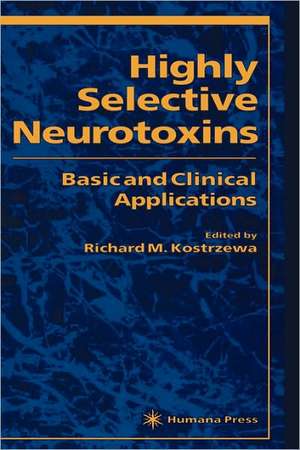
Highly Selective Neurotoxins
Editat de Richard Kostrzewaen Limba Engleză Hardback – 30 oct 1997
Preț: 1472.12 lei
Preț vechi: 1549.59 lei
-5%
Puncte Express: 2208
Carte tipărită la comandă
Livrare economică 04-18 decembrie
Livrare prin curier în România Termenul estimat este afișat lângă disponibilitate.
Transport gratuit pentru acest produs Plată online sau ramburs, în funcție de opțiunile comenzii.
Retur gratuit în 14 zile Comandă securizată și suport în română.
Specificații
ISBN-13: 9780896034655
ISBN-10: 0896034658
Pagini: 404
Ilustrații: XII, 404 p. 9 illus.
Dimensiuni: 165 x 236 x 28 mm
Greutate: 0.84 kg
Ediția:1998 edition
Editura: Humana Press Inc.
Locul publicării:Totowa, NJ, United States
ISBN-10: 0896034658
Pagini: 404
Ilustrații: XII, 404 p. 9 illus.
Dimensiuni: 165 x 236 x 28 mm
Greutate: 0.84 kg
Ediția:1998 edition
Editura: Humana Press Inc.
Locul publicării:Totowa, NJ, United States
V-ar putea interesa
-
 Drug Delivery StrategiesDennis Douroumis-5%Preț: 1344.71 lei1415.48 lei
 -
 Mycotoxin ProtocolsMary W. Trucksess-5%Preț: 747.73 lei787.08 lei
 -
 Toxicity Assessment AlternativesSidney A. Katz-5%Preț: 1133.69 lei1193.35 lei
 -
 Handbook of NeurotoxicologyEdward J. Massaro-5%Preț: 1496.95 lei1575.73 lei
 -
 Handbook of NeurotoxicityRichard M. Kostrzewa-18%Preț: 3082.09 lei3758.65 lei
 -
 Principles of ToxicologyKaren E. Stine-5%Preț: 803.18 lei845.45 lei
 -
 Staging Neuropsychiatric DisordersTomás Palomo-5%Preț: 1266.82 lei1333.50 lei
 -
 AlcoholLaura E. Nagy-5%Preț: 1149.28 lei1209.77 lei
 -
 Genetic ToxicologyJames M. Parry-5%Preț: 765.63 lei805.93 lei
 -
 Developmental ToxicologyCraig Harris-5%Preț: 768.05 lei808.48 lei
 -
 -27%Preț: 1250.75 lei1703.36 lei
 -
 NanotoxicityJoshua Reineke-5%Preț: 764.04 lei804.25 lei
 -
 Computational ToxicologyBrad Reisfeld-5%Preț: 1174.24 lei1236.04 lei
 -
 -23%Preț: 608.29 lei793.96 lei
 -
 Botulinum Toxins & BotulismCharlotte Reynolds-23%Preț: 1041.81 lei1361.38 lei
 -
 -29%Preț: 50.46 lei71.57 lei
 -
 Englisch in der ApothekeDagmar CarraPreț: 269.27 lei
Public țintă
ResearchCuprins
1 6-Hydroxydopamine and Related Catecholaminergic Neurotoxins: Molecular Mechanisms.- 2 The Use of Neurotoxins to Lesion Catecholamine-Containing Neurons to Model Clinical Disorders: Approach for Defining Adaptive Neural Mechanisms and Role of Neurotrophic Factors in Brain.- 3 6-Hydroxydopamine as a Tool for Studying Catecholamines in Adult Animals: Lessons from the Neostriatum.- 4 6-Hydroxydopa, a Catecholamine Neurotoxin and Endogenous Excitotoxin at Non-NMDA Receptors.- 5 2-Chloroethylamines (DSP4 and Xylamine): Toxic Actions on Noradrenergic Neurons.- 6 MPTP: A Dopaminergic Neurotoxin.- 7 Haloperidol-Derived Pyridinium Metabolites: Structural and Toxicological Relationships to MPP+-Like Neurotoxins.- 8 The Neurotoxic Effects of Continuous Cocaine and Amphetamine in Habenula.- 9 Evidence for and Mechanism of Action of Neurotoxicity of Amphetamine Related Compounds.- 10 Molecular Mechanisms of Action of 5,6- and 5,7-Dihydroxytryptamine.- 11 Use of 5,6- and 5,7-Dihydroxytryptamine to Lesion Serotonin Neurons.- 12 Selective Cholinergic Neurotoxins: AF64A and 192-IgG-Saporin.- 13 Glutamatergic Receptor Agonists and Brain Pathology.- 14 Neurotoxicity of NMDA Receptor Antagonists.- 15 Toxic Vanilloids.
Textul de pe ultima copertă
In Highly Selective Neurotoxins, experienced experimentalists critically review and evaluate the most common and important neurotoxins used today to precisely destroy selected neurons. Each informative chapter thoroughly describes the significant mechanisms of action of a neurotoxin, as well as fully discussing the limits on its use and its clinical applicability. Several clinically oriented chapters are significant for neurologists treating Parkinsonism, for psychiatrists treating drug abuse and neurodegenerative disorders, and for primary care physicians treating patients with appetite suppressants.
Highly Selective Neurotoxins provides all the basic knowledge needed to obtain a predictable experimental outcome with these neurotoxins. Its authoritative coverage of the newest findings on experimentally important neurotoxins makes their proper use and their limitations clear and practical from both experimental and theoretical points of view.
Highly Selective Neurotoxins provides all the basic knowledge needed to obtain a predictable experimental outcome with these neurotoxins. Its authoritative coverage of the newest findings on experimentally important neurotoxins makes their proper use and their limitations clear and practical from both experimental and theoretical points of view.