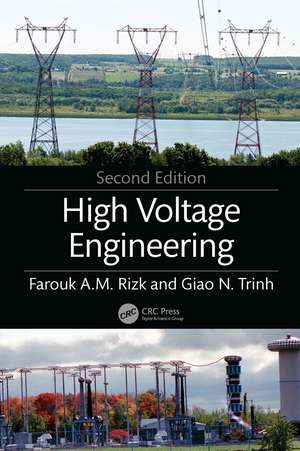
High Voltage Engineering
Autor Farouk A.M. Rizk, Giao N. Trinhen Limba Engleză Hardback – 21 mai 2026
- Discusses power system overvoltages, electric field calculation, and statistical analysis of ionization and breakdown phenomena essential for proper planning and interpretation of high‑voltage tests
- Considers the breakdown of gases (SF6), liquids (insulating oil), solids, and composite materials, as well as the breakdown characteristics of long air gaps
- Describes insulation systems currently used in high‑voltage engineering, including air insulation and insulators in overhead power transmission lines, gas‑insulated substation (GIS) and cables, oil‑paper insulation in power transformers, paper‑oil insulation in high‑voltage cables, and polymer insulation in cables
- Examines contemporary practices in insulation coordination in association with the International Electrotechnical Commission (IEC) definition and the latest standards
- Explores high‑voltage testing and measuring techniques, from the generation of test voltages to digital measuring methods
Preț: 1972.25 lei
Preț vechi: 2405.18 lei
-18%
Puncte Express: 2958
Carte tipărită la comandă
Livrare economică 28 noiembrie-12 decembrie
Livrare prin curier în România Termenul estimat este afișat lângă disponibilitate.
Transport gratuit pentru acest produs Plată online sau ramburs, în funcție de opțiunile comenzii.
Retur gratuit în 14 zile Comandă securizată și suport în română.
Specificații
ISBN-13: 9781032969428
ISBN-10: 1032969423
Pagini: 892
Ilustrații: 1212
Dimensiuni: 178 x 254 mm
Greutate: 1.42 kg
Ediția:2. Auflage
Editura: CRC Press
Colecția CRC Press
ISBN-10: 1032969423
Pagini: 892
Ilustrații: 1212
Dimensiuni: 178 x 254 mm
Greutate: 1.42 kg
Ediția:2. Auflage
Editura: CRC Press
Colecția CRC Press
V-ar putea interesa
-
 Neural Networks for Robotics: An Engineering PerspectiveNancy Arana-Daniel-18%Preț: 1303.91 lei1590.13 lei
 -
 -18%Preț: 1243.72 lei1516.74 lei
 -
 Engineering Emergence: A Modeling and Simulation ApproachLarry B. Rainey-18%Preț: 1329.64 lei1621.51 lei
 -
 -8%Preț: 451.69 lei490.96 lei
 -
 Weather Modeling and Forecasting of PV Systems OperationMarius Paulescu-18%Preț: 989.09 lei1206.20 lei
 -
 Wind Energy: An IntroductionMohamed A. El-Sharkawi-18%Preț: 937.15 lei1142.87 lei
 -
 FPGA-Based Embedded System Developer's GuideA. Arockia Bazil Raj-18%Preț: 1536.13 lei1873.32 lei
 -
 Nonlinearity in Energy Harvesting SystemsElena Blokhina-15%Preț: 673.55 lei792.41 lei
 -
 High Speed Rail and Access Transit NetworksLara Rita Brunello-15%Preț: 722.00 lei849.42 lei
 -
 Advances in Sustainable AviationTahir Hikmet Karakoç-18%Preț: 816.05 lei995.18 lei
 -
 Piezoelectric Vibration Energy HarvestingSajid Rafique-18%Preț: 979.35 lei1194.34 lei
 -
 Behaviour of Lithium-Ion Batteries in Electric VehiclesGianfranco Pistoia-18%Preț: 1157.27 lei1411.31 lei
 -
 Wind Energy Exploitation in Urban EnvironmentLorenzo Battisti-18%Preț: 982.09 lei1197.68 lei
 -
 Piezoelectric Actuators and Generators for Energy HarvestingSergey N. Shevtsov-24%Preț: 893.74 lei1175.98 lei
 -
 Preț: 119.38 lei
 -
 Preț: 119.23 lei
 -
 Preț: 119.03 lei
 -
 Preț: 119.38 lei
 -
 -18%Preț: 997.53 lei1216.50 lei
 -
 Sustainable Power SystemsNava Raj Karki-24%Preț: 775.92 lei1020.96 lei
 -
 -24%Preț: 902.72 lei1187.79 lei
 -
 -18%Preț: 920.96 lei1123.12 lei
 -
 -18%Preț: 928.79 lei1132.68 lei
 -
 -18%Preț: 1024.41 lei1249.28 lei
Public țintă
Professional ReferenceCuprins
1. Power System Overvoltages. 2. Electric Field Calculation. 3. Application of Statistical Analysis in High Voltage Engineering 4. Electric Breakdown in Gases. 5. Breakdown Characteristics of Long Air Gaps. 6. Electric Breakdown in Liquids. 7. Electric Breakdown in Solids and Composite Materials. 8. Selection of Overhead Transmission Line Conductors. 9. Lightning Incidence and Lightning Protection. 10. High-Voltage Insulators. 11. High-Voltage (Underground) Cables. 12. Power Transformers. 13. Insulation Coordination. 14. High-Voltage Testing and Measuring Techniques.
Notă biografică
Farouk A.M. Rizk holds a BSc Eng and an MSc from Cairo University; a PhD from the Royal Institute of Technology, Stockholm, Sweden; and a DTech from Chalmers University of Technology, Gothenburg, Sweden.
He worked as a research engineer with ASEA (ABB), Sweden, in the High Power Laboratory, Ludvika, from 1960 to 1963, and in the Computer Department, Vasteras, in 1963. He worked for the Egyptian Electricity Authority (1964–1971), becoming manager, High Voltage, in 1968. He joined the Hydro-Québec Institute of Research (IREQ) as a senior research scientist in 1972, subsequently passing from scientific director (1976) to vice president of laboratories (1986). He also held the title of fellow research scientist from 1986 to 1996.
His research work covers a wide range of topics in high voltage and high power engineering: arc dynamics in circuit breakers, polluted insulators, single‑pole switching, electromagnetic shielding, compressed gas and liquid breakdown, long air gaps, and lightning attachment.
He was elected IEEE fellow in 1982 “for contributions to the science of high voltage technology and for technical leadership in the advancement of the electric power industry.” He has served as chairman of the 10th International Symposium on High Voltage Engineering (ISH) in 1997 and as chairman of the ISH Steering Committee. He received prize paper awards from the IEEE Transmission and Distribution Committee in 1989, 1991, and 1995 and from the Power Engineering Society of IEEE in 1996. He was awarded the IEEE Herman Halperin Electric Transmission Award in 1996 for outstanding contributions to electric power transmission and distribution. He is a distinguished member of the International Council on Large High Voltage Electrical Systems (CIGRE) and a recipient of the CIGRE Technical Committee Award, 1997.
He made major contributions to standardization work, particularly during his tenure as international chairman of IEC Technical Committee 28: Insulation Co‑ordination, 1983–1996. Under his leadership, the whole area of insulation co‑ordination was revised, which led to the new standards IEC 71‑1 and IEC 71‑2. His efforts to promote insulation co‑ordination of high‑voltage DC transmission led to standardization work now undertaken by IEC TC 28.
He currently serves as president of Lightning Electrotechnologies Inc., a lightning protection equipment manufacturer, and Expodev Inc., a consulting engineering firm, both of which are in Montréal, Québec, Canada.
Giao N. Trinh received his BSc in electrical engineering in 1963 and his PhD in high voltage engineering from Laval University, Québec City, Québec, Canada, in 1969. His study of corona discharges in atmospheric air helped establish the various corona discharge modes developed at high-voltage line conductors.
He joined the Hydro‑Quebec Institute of Research (IREQ), Varennes, Québec, Canada, in 1968. Until 1977, he participated in various research activities, studying the corona performance of high‑voltage transmission lines up to the ultra‑high‑voltage level of 1,200 kV AC and ・}600 kV DC. His main contribution has been to the development of a method for evaluating the corona performance of high‑voltage line conductors, based on cage‑test results obtained under artificial rain conditions.
In 1978, his research activities shifted to the field of insulation of high-voltage equipment, and until 1997, he carried out studies on practical insulation systems, including the following:
He was elected fellow of the IEEE in 1997 for his “contribution to understanding of dielectric and arc phenomena in gas insulated cables.” He is a member of the Power Engineers Society (PES), where he participates in the activities of PES‑nsulated Conductors and PES Substation Committees, and of the Dielectrics and Electrical Insulation Society (DEIS), where he has served as secretary of DEIS‑dCom from 1993 to 1994 and as chairman of the DEIS Statistics Committee from 1995 to 1997. From 1976 to 2002, he served as an invited professor at Ecole Polytechnique de Montréal, Montréal, Quebec, Canada, where he taught a graduate course on high voltage engineering. He currently serves as a consultant in high voltage engineering.
He worked as a research engineer with ASEA (ABB), Sweden, in the High Power Laboratory, Ludvika, from 1960 to 1963, and in the Computer Department, Vasteras, in 1963. He worked for the Egyptian Electricity Authority (1964–1971), becoming manager, High Voltage, in 1968. He joined the Hydro-Québec Institute of Research (IREQ) as a senior research scientist in 1972, subsequently passing from scientific director (1976) to vice president of laboratories (1986). He also held the title of fellow research scientist from 1986 to 1996.
His research work covers a wide range of topics in high voltage and high power engineering: arc dynamics in circuit breakers, polluted insulators, single‑pole switching, electromagnetic shielding, compressed gas and liquid breakdown, long air gaps, and lightning attachment.
He was elected IEEE fellow in 1982 “for contributions to the science of high voltage technology and for technical leadership in the advancement of the electric power industry.” He has served as chairman of the 10th International Symposium on High Voltage Engineering (ISH) in 1997 and as chairman of the ISH Steering Committee. He received prize paper awards from the IEEE Transmission and Distribution Committee in 1989, 1991, and 1995 and from the Power Engineering Society of IEEE in 1996. He was awarded the IEEE Herman Halperin Electric Transmission Award in 1996 for outstanding contributions to electric power transmission and distribution. He is a distinguished member of the International Council on Large High Voltage Electrical Systems (CIGRE) and a recipient of the CIGRE Technical Committee Award, 1997.
He made major contributions to standardization work, particularly during his tenure as international chairman of IEC Technical Committee 28: Insulation Co‑ordination, 1983–1996. Under his leadership, the whole area of insulation co‑ordination was revised, which led to the new standards IEC 71‑1 and IEC 71‑2. His efforts to promote insulation co‑ordination of high‑voltage DC transmission led to standardization work now undertaken by IEC TC 28.
He currently serves as president of Lightning Electrotechnologies Inc., a lightning protection equipment manufacturer, and Expodev Inc., a consulting engineering firm, both of which are in Montréal, Québec, Canada.
Giao N. Trinh received his BSc in electrical engineering in 1963 and his PhD in high voltage engineering from Laval University, Québec City, Québec, Canada, in 1969. His study of corona discharges in atmospheric air helped establish the various corona discharge modes developed at high-voltage line conductors.
He joined the Hydro‑Quebec Institute of Research (IREQ), Varennes, Québec, Canada, in 1968. Until 1977, he participated in various research activities, studying the corona performance of high‑voltage transmission lines up to the ultra‑high‑voltage level of 1,200 kV AC and ・}600 kV DC. His main contribution has been to the development of a method for evaluating the corona performance of high‑voltage line conductors, based on cage‑test results obtained under artificial rain conditions.
In 1978, his research activities shifted to the field of insulation of high-voltage equipment, and until 1997, he carried out studies on practical insulation systems, including the following:
- Gas insulation: He studied the influence of epoxy spacers on dielectric performance and the risk of burn-through of gas-insulated cables. He participated in the commissioning tests of the first few GIS introduced at Hydro-Québec in the Montréal region in the late 1970s.
- Power transformers: He studied the breakdown of large oil volumes, which clearly established the important role of particle contamination with regard to the withstand capability of transformer insulation.
- High-voltage cables: He participated in a study group on the feasibility of a river crossing for Hydro-Québec’s 500 kV dc line at Grondines and participated in the testing of the type cable selected for the project.
He was elected fellow of the IEEE in 1997 for his “contribution to understanding of dielectric and arc phenomena in gas insulated cables.” He is a member of the Power Engineers Society (PES), where he participates in the activities of PES‑nsulated Conductors and PES Substation Committees, and of the Dielectrics and Electrical Insulation Society (DEIS), where he has served as secretary of DEIS‑dCom from 1993 to 1994 and as chairman of the DEIS Statistics Committee from 1995 to 1997. From 1976 to 2002, he served as an invited professor at Ecole Polytechnique de Montréal, Montréal, Quebec, Canada, where he taught a graduate course on high voltage engineering. He currently serves as a consultant in high voltage engineering.
Descriere
High Voltage Engineering merges the latest research with the extensive experience of the best in the field to deliver a comprehensive treatment of electrical insulation systems for the next generation of utility engineers and electric power professionals.
Recenzii
"The most comprehensive and in-depth presentation of all aspects of HV engineering. ... The rigor and thoroughness with which the different topics are presented in the book reflect the vast experience of the authors and the significant contributions they have made to HV engineering."
—P. Sarma Maruvada, from IEEE Power and Energy Magazine, November/December 2015
"The best part of this book is that it contains numerous experimental results gathered from many references over the past two decades that pertain to high voltage breakdown and related phenomena. It is very convenient to have all this type of data in one handy reference book. Power engineers and those who design power distribution systems with regard to the power components will find this book useful in designing such systems."
—John J. Shea, Eaton Corporation, Moon Township, Pennsylvania, USA, from IEEE Electrical Insulation Magazine, May/June 2015
"High Voltage Engineering condenses many insights from the authors’ combined 100 years’ experience into only 773 pages. Calculation of electric fields describes some specific examples, such as Rogowski and Bruce profile electrodes, that can be used to ensure that practitioners understand their sophisticated software in a cylindrically symmetric problem before using it in 3-D. There is extensive treatment of statistics for high voltage testing as well. Inside this chapter, I found a nice discussion on the minimum number of tests (9) and also some new insight into the relationship between 1-minute and 30-minute withstand test results. The extensive work on electrical breakdown of gases is the best place to find the currents associated with various positive and negative corona modes. The treatment of long air gap breakdown is succinct and relies on the close agreement between Dr. Rizk’s continuous leader inception model and test data in the range of 2 to 20m. A comparison of the models for correcting for absolute humidity in the range of 5 to 15 g/m3 highlights another advantage of Rizk’s physical approach. This model is also highlighted in the treatment of lightning attachment, considering the 100m ‘final jump’ from leader to grounded structure as a class of flashover problem. In chapter 10, I found a new data point for the ratio of non-soluble deposit density (NSDD) to equivalent salt deposit density (ESDD) of about 5:1, 18% ESDD by weight. I also found a satisfactory explanation for a point that has always bothered me. Dimensional analysis suggests a linear relation of ESDD to wind speed and exposure time, but a velocity-cubed relationship was found near the sea. The answer is that the density of salt particles is proportional to the square of wind speed. The important role of ac re-ignition in the contamination flashover process is clearly identified. Dielectric recovery across dry bands was one of Rizk’s contributions from 43 years ago, but this aspect is still missed when researchers use dc models to fit ac test results. I also enjoyed a practical focus in the section on high voltage testing and measuring techniques related to the currents and voltages induced in signal cables as well as the effect of large HV divider surge impedance. Congratulations to Drs. Rizk and Trinh on their impressive book."
—Dr. William A. Chisholm, from INMR Magazine
—P. Sarma Maruvada, from IEEE Power and Energy Magazine, November/December 2015
"The best part of this book is that it contains numerous experimental results gathered from many references over the past two decades that pertain to high voltage breakdown and related phenomena. It is very convenient to have all this type of data in one handy reference book. Power engineers and those who design power distribution systems with regard to the power components will find this book useful in designing such systems."
—John J. Shea, Eaton Corporation, Moon Township, Pennsylvania, USA, from IEEE Electrical Insulation Magazine, May/June 2015
"High Voltage Engineering condenses many insights from the authors’ combined 100 years’ experience into only 773 pages. Calculation of electric fields describes some specific examples, such as Rogowski and Bruce profile electrodes, that can be used to ensure that practitioners understand their sophisticated software in a cylindrically symmetric problem before using it in 3-D. There is extensive treatment of statistics for high voltage testing as well. Inside this chapter, I found a nice discussion on the minimum number of tests (9) and also some new insight into the relationship between 1-minute and 30-minute withstand test results. The extensive work on electrical breakdown of gases is the best place to find the currents associated with various positive and negative corona modes. The treatment of long air gap breakdown is succinct and relies on the close agreement between Dr. Rizk’s continuous leader inception model and test data in the range of 2 to 20m. A comparison of the models for correcting for absolute humidity in the range of 5 to 15 g/m3 highlights another advantage of Rizk’s physical approach. This model is also highlighted in the treatment of lightning attachment, considering the 100m ‘final jump’ from leader to grounded structure as a class of flashover problem. In chapter 10, I found a new data point for the ratio of non-soluble deposit density (NSDD) to equivalent salt deposit density (ESDD) of about 5:1, 18% ESDD by weight. I also found a satisfactory explanation for a point that has always bothered me. Dimensional analysis suggests a linear relation of ESDD to wind speed and exposure time, but a velocity-cubed relationship was found near the sea. The answer is that the density of salt particles is proportional to the square of wind speed. The important role of ac re-ignition in the contamination flashover process is clearly identified. Dielectric recovery across dry bands was one of Rizk’s contributions from 43 years ago, but this aspect is still missed when researchers use dc models to fit ac test results. I also enjoyed a practical focus in the section on high voltage testing and measuring techniques related to the currents and voltages induced in signal cables as well as the effect of large HV divider surge impedance. Congratulations to Drs. Rizk and Trinh on their impressive book."
—Dr. William A. Chisholm, from INMR Magazine