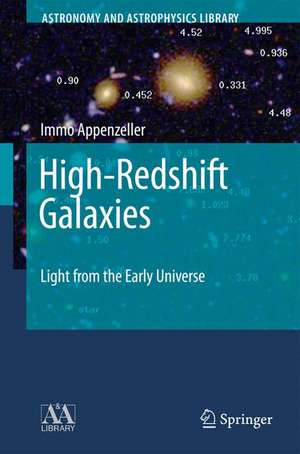
High-Redshift Galaxies: Light from the Early Universe: Astronomy and Astrophysics Library
Autor Immo Appenzelleren Limba Engleză Hardback – 9 iul 2009
Publicată în seria Astronomy and Astrophysics Library, ediția din 2009 a volumului High-Redshift Galaxies marchează un moment de maturitate pentru un domeniu care, cu doar două decenii în urmă, era abia la începuturi. Putem afirma că acest volum nu este doar o actualizare, ci o sinteză necesară a datelor acumulate după finalizarea programelor inițiale ale Telescopului Spațial Hubble și ale marilor telescoape optice de la sol. Găsim în această ediție o evaluare riguroasă a tehnicii Lyman-break, care a permis identificarea primelor eșantioane semnificative de galaxii îndepărtate, oferind cititorului un fundament solid în înțelegerea luminii provenite din universul timpuriu.
Structura cărții reflectă o progresie didactică și analitică clară. Autorul organizează materialul în patru secțiuni distincte: de la contextul universului apropiat, la metodele și limitările tehnice actuale, culminând cu interpretarea rezultatelor observaționale și o privire spre viitoarele facilități de cercetare. Reținem în special capitolele dedicate derivării parametrilor fizici și distribuției spațiale a galaxiilor, elemente esențiale pentru orice cercetător care dorește să intre în acest domeniu.
Cititorii familiarizați cu Galaxies at High Redshift de I. Pérez-Fournon vor aprecia la Immo Appenzeller abordarea unitară a unui singur autor, care reușește să lege teoria de practica observațională mai strâns decât un volum de tip conferință. În contextul operei sale, această lucrare completează temele abordate în Evolution of Galaxies Astronomical Observations și Introduction to Astronomical Spectroscopy, ducând analiza dincolo de principiile generale ale spectroscopiei către aplicarea lor specifică în studiul obiectelor de la marginea universului observabil. Este o resursă care documentează tranziția astrofizicii către o eră a preciziei în cosmologia observațională.
Din seria Astronomy and Astrophysics Library
- 15%
 Preț: 557.48 lei
 -
 Preț: 428.02 lei
 -
 Preț: 376.97 lei
 - 18%
 Preț: 1017.44 lei
 - 15%
 Preț: 617.33 lei
 - 24%
 Preț: 959.12 lei
 - 15%
 Preț: 679.53 lei
 - 19%
 Preț: 557.25 lei
 - 15%
 Preț: 684.98 lei
 - 18%
 Preț: 825.80 lei
 - 15%
 Preț: 614.91 lei
 - 18%
 Preț: 1039.20 lei
 -
 Preț: 405.45 lei
 - 27%
 Preț: 887.52 lei
 -
 Preț: 379.25 lei
 - 18%
 Preț: 999.65 lei
 - 18%
 Preț: 988.22 lei
 - 15%
 Preț: 681.44 lei
 -
 Preț: 375.81 lei
 - 18%
 Preț: 1373.13 lei
 - 18%
 Preț: 769.81 lei
 - 15%
 Preț: 616.89 lei
 - 20%
 Preț: 643.71 lei
 - 15%
 Preț: 663.81 lei
 - 24%
 Preț: 1357.20 lei
 - 18%
 Preț: 988.44 lei
 - 15%
 Preț: 679.29 lei
 - 15%
 Preț: 674.48 lei
 - 19%
 Preț: 596.04 lei
 - 15%
 Preț: 631.98 lei
 - 18%
 Preț: 991.47 lei
 - 15%
 Preț: 680.33 lei
 - 18%
 Preț: 1451.74 lei
 - 15%
 Preț: 672.94 lei
 - 18%
 Preț: 771.23 lei
 - 18%
 Preț: 1610.57 lei
 -
 Preț: 424.20 lei
 - 15%
 Preț: 482.58 lei
 - 15%
 Preț: 675.60 lei
 - 15%
 Preț: 402.35 lei
 -
 Preț: 405.36 lei
Preț: 649.44 lei
Preț vechi: 764.05 lei
-15%
Carte disponibilă
Livrare economică 16-30 noiembrie
Specificații
ISBN-10: 3540758232
Pagini: 400
Ilustrații: XIV, 352 p.
Dimensiuni: 155 x 235 x 23 mm
Greutate: 0.61 kg
Ediția:2009
Editura: Springer Berlin, Heidelberg
Colecția Springer
Seria Astronomy and Astrophysics Library
Locul publicării:Berlin, Heidelberg, Germany
V-ar putea interesa
-
 The Copernicus ComplexCaleb ScharfPreț: 115.32 lei
 -
 Visual Art and Education in an Era of Designer CapitalismKenneth A LoparoPreț: 257.91 lei
 -
 15 Million DegreesLucie Green-20%Preț: 74.83 lei92.98 lei
 -
 Destiny or Chance RevisitedStuart Ross Taylor-25%Preț: 249.18 lei334.43 lei
 -
 Reports on Astronomy 2010-2012 (IAU XXVIIIA)Ian F. Corbett-11%Preț: 566.31 lei636.31 lei
 -
 A Student's Guide to the Mathematics of AstronomyDaniel FleischPreț: 201.92 lei
 -
 Weird AstronomyDavid A. J. SeargentPreț: 257.49 lei
 -
 Imaging the Southern SkyStephen ChadwickPreț: 344.88 lei
 -
 The Hatfield Lunar AtlasAnthony Cook-15%Preț: 462.73 lei544.39 lei
 -
 Making WavesM. GossPreț: 254.97 lei
 -
 Spiegelfernrohre - selbst gebautMartin TrittelvitzPreț: 499.48 lei
Public țintă
ResearchDe ce să citești această carte
Această carte este recomandată cercetătorilor și studenților la doctorat care au nevoie de o bază teoretică și practică solidă în studiul galaxiilor îndepărtate. Cititorul câștigă o înțelegere profundă a tehnicilor de detectare și a modului în care datele de la telescoapele de mare putere sunt transformate în modele cosmologice. Este un instrument esențial pentru a naviga literatura vastă și rapidă a astrofizicii moderne.
Despre autor
Immo Appenzeller este profesor emerit de astronomie la Universitatea din Heidelberg, Germania, și fost director al Observatorului de Stat din Heidelberg. Cu o carieră dedicată astrofizicii observaționale, el a contribuit semnificativ la înțelegerea evoluției stelare și galactice. Experiența sa vastă este reflectată în numeroase lucrări de referință, inclusiv contribuții în cadrul tranzacțiilor Uniunii Astronomice Internaționale (IAU). Expertiza sa în spectroscopie și observații astronomice complexe îl poziționează ca una dintre autoritățile europene în studiul structurilor la scară largă ale universului.
Descriere scurtă
Cuprins
Recenzii
Notă biografică
Textul de pe ultima copertă
In view of the potential importance of the observational results of the high-redshift universe for basic physics the book is written for astronomers as well as for physicists without prior astronomical knowledge. For this purpose it contains introductory chapters describing the basic concepts and notations used in modern astronomy and a brief overview of the present knowledge of the local universe. The individual chapters provide detailed information, summaries and references on all important aspects and problems pertaining to the subject. The objective of the book is therefore to provide a thorough introduction to the topic for interested researchers. Students interested in extragalactic astronomy will find important information not (yet) available in standard academic texts. The book will also be a valuable companion text for special lectures on the high-redshift universe and cosmic evolution. And it will be an important tool for research students starting a thesis in the field of extragalactic astronomy and observational cosmology.