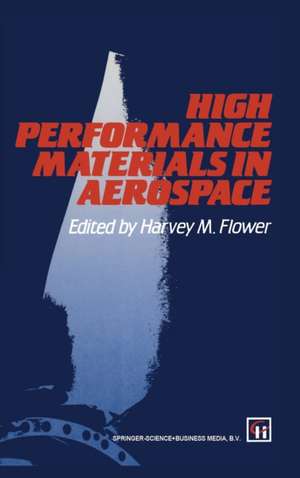
High Performance Materials in Aerospace
Autor Harvey M. Floweren Limba Engleză Hardback – 24 noi 1994
Preț: 592.51 lei
Preț vechi: 697.07 lei
-15%
Puncte Express: 889
Carte tipărită la comandă
Livrare economică 07-21 octombrie
Livrare prin curier în România Termenul estimat este afișat lângă disponibilitate.
Transport gratuit pentru acest produs Plată online sau ramburs, în funcție de opțiunile comenzii.
Retur gratuit în 14 zile Comandă securizată și suport în română.
Specificații
ISBN-13: 9780412533501
ISBN-10: 0412533502
Pagini: 396
Dimensiuni: 160 x 241 x 27 mm
Greutate: 0.76 kg
Editura: Springer Nature B.V.
ISBN-10: 0412533502
Pagini: 396
Dimensiuni: 160 x 241 x 27 mm
Greutate: 0.76 kg
Editura: Springer Nature B.V.
V-ar putea interesa
-
 Materials: Engineering, Science, Processing and DesignMichael F. Ashby-30%Preț: 414.77 lei591.12 lei
 -
 Aircraft Structures for Engineering StudentsT. H. G. Megson-31%Preț: 471.85 lei681.72 lei
 -
 Alloys for Powder-Based Additive ManufacturingHossein Eskandari Sabzi-30%Preț: 439.75 lei627.82 lei
 -
 Fabricating Plasticity in AluminumHeather RobergePreț: 349.49 lei
 -
 Manufacturing Processes for Design ProfessionalsRob Thompson-17%Preț: 487.89 lei586.22 lei
 -
 -23%Preț: 675.72 lei877.57 lei
 -
 Aerospace Thermal Structures and Materials for a New Era 168: ""Earl A. Thornton-8%Preț: 390.70 lei424.67 lei
 -
 Titanium Alloys: Preparation, Properties & ApplicationsPedro N SanchezPreț: 1701.41 lei
 -
 -31%Preț: 95.45 lei137.36 lei
 -
 Advanced Aluminium Composites and AlloysLeszek A. Dobrza¿ski-23%Preț: 792.25 lei1028.89 lei
 -
 Superalloys 2020Sammy Tin-24%Preț: 3017.21 lei3970.01 lei
 -
 Joining Operations for Aerospace MaterialsSelim Gürgen-18%Preț: 892.98 lei1089.00 lei
 -
 The Engineer's Guide to MaterialsK. T. Voisey-15%Preț: 462.61 lei544.26 lei
 -
 Advances in Manufacturing for Aerospace AlloysSelim Gürgen-18%Preț: 860.77 lei1049.73 lei
 -
 Aerospace Materials and Material TechnologiesN. Eswara Prasad-18%Preț: 1411.23 lei1721.01 lei
 -
 Advanced Multicomponent AlloysZengbao Jiao-24%Preț: 939.96 lei1236.80 lei
 -
 Advances in Material Science and MetallurgyBhingole Pramod P.-18%Preț: 954.26 lei1163.72 lei
 -
 -24%Preț: 1014.03 lei1334.24 lei
 -
 Advances in Materials and ProcessingSupratik Roychowdhury-18%Preț: 1178.28 lei1436.93 lei
 -
 Advanced Materials and ManufacturingJitendra Kumar Katiyar-18%Preț: 1402.65 lei1710.55 lei
 -
 -18%Preț: 1357.25 lei1655.19 lei
 -
 -18%Preț: 1406.64 lei1715.41 lei
 -
 Advances in Materials EngineeringPramod Bhingole-18%Preț: 1168.82 lei1425.38 lei
 -
 Advances in Materials and Agile ManufacturingNarendra Kumar-18%Preț: 1156.63 lei1410.52 lei
Cuprins
1 Design requirements for aerospace structural materials.- 1.1 Introduction.- 1.2 Properties that affect structural efficiency ab initio.- 1.3 Properties affecting cost of ownership.- 1.4 Cost-effective design.- 1.5 Concluding remarks.- References.- 2 Aluminium alloys: physical metallurgy, processing andproperties.- 2.1 Introduction.- 2.2 Aluminium alloys: processing and properties.- 2.3 Conventional aerospace aluminium alloys.- 2.4 Advanced aerospace aluminium alloys.- 2.5 Conclusions.- References.- Further reading.- 3 Titanium alloys: production, behaviour and application.- 3.1 Introduction.- 3.2 Brief summary of the metallurgy of conventional Ti alloys.- 3.3 The production of Ti alloys and Ti alloy components.- 3.4 The mechanical behaviour and properties of commonTi alloys.- 3.5 Ti-based intermetallic compounds.- 3.6 Summary.- Acknowledgements.- References.- Further reading.- 4 Nickel-based alloys: recent developments for the aero-gasturbine.- 4.1 Background.- 4.2 Alloy constitution and development trends.- 4.3 Processing developments.- 4.4 Microstructure and high temperature deformation.- 4.5 Turbine disk applications.- 4.6 Future prospects.- References.- 5 Structural steels.- 5.1 Introduction.- 5.2 Gear steels.- 5.3 Bearing steels.- 5.4 Ultra high strength steels.- Acknowledgements.- References.- 6 Ceramic materials in aerospace.- 6.1 Introduction.- 6.2 Monolithic and toughened ceramics.- 6.3 Composite ceramics.- 7 Polymeric-based composite materials.- 7.1 Introduction.- 7.2 Reinforcements.- 7.3 Matrices.- 7.4 Interface.- 7.5 Processing.- 7.6 Properties.- 7.7 Joining composites.- 7.8 Non-destructive testing (NDT).- 7.9 Advantages of composite materials.- 8 Metal-based composite materials.- 8.1 Introduction.- 8.2 Metal—ceramic composites.- 8.3 Laminates.- 8.4Cost.- 8.5 Applications.- 8.6 Appendix.- References.- 9 Superplastic forming.- 9.1 Introduction.- 9.2 Superplasticity and its characteristics.- 9.3 Aerospace superplastic alloys.- 9.4 Post-superplastic straining mechanical properties.- 9.5 Superplastic forming (SPF).- 9.6 Advantages of SPF in aerospace structural design/manufacture.- 9.7 Aerospace applications of SPF.- 9.8 SPF/DB.- 9.9 Advantages of SPF/DB in aerospace structural design/manufacture.- 9.10 Aerospace applications of SPF/DB.- 9.11 Background to the application of SPF and SPF/DB in aerospace.- References.- 10 Joining advanced materials by diffusion bonding.- 10.1 Introduction.- 10.2 Diffusion bonding mechanisms.- 10.3 Effect of surface roughness and contamination on bondinterface defects.- 10.4 Testing of diffusion bonded joints.- 10.5 Diffusion bonding techniques of metals.- 10.6 Diffusion bonding of intermetallics.- 10.7 Diffusion bonding of ceramics.- 10.8 Diffusion bonding of composites.- 10.9 Diffusion bonding of dissimilar metallic materials.- 10.10 Diffusion bonding of metastable alloys.- 10.11 Manufacture of components by diffusion bonding techniques.- 10.12 Conclusions.- Acknowledgements.- References.- 11 Adhesive bonding for aerospace applications.- 11.1 Introduction.- 11.2 Bonded wooden aircraft.- 11.3 Principles of bonding.- 11.4 Aerospace adhesive types.- 11.5 Surface treatments.- 11.6 Design of bonded joints.- References.- 12 Rapid solidification and powder technologies for aerospace.- 12.1 Introduction.- 12.2 Production technologies.- 12.3 Effects on microstructure.- 12.4 Benefits of rapid solidification foraerospace applications.- 12.5 Conclusions.- References.- 13 Hot isostatic processing.- 13.1 Introduction.- 13.2 Removal of porosity.- 13.3 Benefits of HIP.- 13.4 Applications of HIP.- 13.5 Powder products.- 13.6 Diffusion bonding.- 13.7 Other applications.