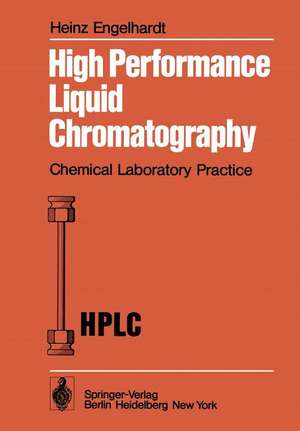
High Performance Liquid Chromatography: Chemical Laboratory Practice
Autor Heinz Engelhardt Traducere de G. Gutnikoven Limba Engleză Paperback – 19 ian 2012
Preț: 376.92 lei
Puncte Express: 565
Carte tipărită la comandă
Livrare economică 27 noiembrie-11 decembrie
Livrare prin curier în România Termenul estimat este afișat lângă disponibilitate.
Transport gratuit de la 400.00 lei Plată online sau ramburs, în funcție de opțiunile comenzii.
Retur gratuit în 14 zile Comandă securizată și suport în română.
Specificații
ISBN-13: 9783642670664
ISBN-10: 3642670660
Pagini: 268
Ilustrații: XII, 254 p.
Dimensiuni: 170 x 244 x 15 mm
Greutate: 0.47 kg
Ediția:Softcover reprint of the original 1st ed. 1979
Editura: Springer
Colecția Chemical Laboratory Practice
Seria Chemical Laboratory Practice
Locul publicării:Berlin, Heidelberg, Germany
ISBN-10: 3642670660
Pagini: 268
Ilustrații: XII, 254 p.
Dimensiuni: 170 x 244 x 15 mm
Greutate: 0.47 kg
Ediția:Softcover reprint of the original 1st ed. 1979
Editura: Springer
Colecția Chemical Laboratory Practice
Seria Chemical Laboratory Practice
Locul publicării:Berlin, Heidelberg, Germany
V-ar putea interesa
-
 Distillation: Fundamentals and PrinciplesAndrzej Gorak-28%Preț: 944.99 lei1309.72 lei
 -
 -9%Preț: 1465.68 lei1610.63 lei
 -
 Chemistry Experiments for Instrumental MethodsDonald T. Sawyer-27%Preț: 1033.19 lei1415.33 lei
 -
 Bioanalysis of PharmaceuticalsSteen Honore HansenPreț: 481.00 lei
 -
 -23%Preț: 656.28 lei852.31 lei
 -
 Introduction to Solid-State NMR SpectroscopyMelinda J. Duer-23%Preț: 593.16 lei770.34 lei
 -
 Using Commercial Amateur Astronomical SpectrographsJeffrey L. HopkinsPreț: 328.37 lei
 -
 -15%Preț: 693.29 lei815.64 lei
Public țintă
ResearchCuprins
I. Chromatographic Processes.- References Chapter I.- II. Fundamentals of Chromatography.- A. Retention.- B. Linear Flow Rate, Porosity, Permeability.- C. Band Broadening.- D. Resolution.- E. Dependence of Band Broadening on Flow Rate.- F. Band Broadening and Particle Size.- G. Extra-Column Band Broadening.- H. Optimum Analysis Conditions and Analysis Time.- I. Selection of a Suitable Column.- References Chapter II.- III. Equipment for HPLC.- A. Solvent Reservoir — Degassing of the Eluent.- B. Pumps.- C. Damping of the Pulsations.- D. Sample Introduction.- E. The Column.- F. Thermostating.- G. Measurement of the Flow Rate.- H. Fraction Collectors.- I. Recorders.- J. Instrumentation for Gradient Elution.- K. Safety Measures.- References Chapter III.- IV. Detectors.- A. UV Detectors.- B. Differential Refractometer.- C. Microadsorption Detector.- D. Transport Detector (Flame Ionization Detector).- E. Fluorescence Detector.- F. Other Detectors.- G. Comparison of the Important Detectors.- H. Reaction Detectors.- References Chapter IV.- V. Stationary Phases.- A. Packing Materials for Adsorption and Partition Chromatography.- B. Chemically Modified Supports.- C. Ion Exchangers.- D. Stationary Phases for Exclusion Chromatography.- References Chapter V.- VI. Adsorption Chromatography.- I. Polar Stationary Phases.- II. Nonpolar Stationary Phases.- III. The General Elution Problem.- IV. Applications of Adsorption Chromatography.- References Chapter VI.- VII. Partition Chromatography.- A. Introduction.- B. Supports and Liquid Phases.- C. Properties of the Column.- D. Applications.- E. Ion-pair Chromatography.- References Chapter VII.- VIII. Ion-Exchange Chromatography.- A. Principle.- B. Ion Exchange Materials.- C. Characterization of the Ion Exchangers.- D. Optimizing aSeparation.- E. Applications.- References Chapter VIII.- IX. Exclusion Chromatography. Gel Permeation Chromatography.- A. Introduction.- B. Basics of Exclusion Chromatography.- C. Stationary Phases for Exclusion Chromatography.- D. Applications of Exclusion Chromatography.- References Chapter IX.- X. Selection of the Separation System.- References Chapter X.- XI. Special Techniques.- A. Preparative Chromatography.- B. Qualitative Analysis.- C. Quantitative Analysis.- D. Trace Analysis.- References Chapter XI.- XII. Purification of Solvents.- References Chapter XII.