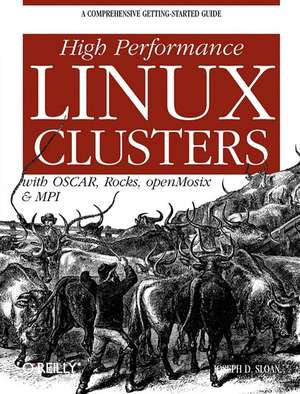
High Performance Linux Clusters
Autor Joseph D Sloanen Limba Engleză Paperback – 21 dec 2004
- MPI, the most popular programming library for clusters. This book offers simple but realistic introductory examples along with some pointers for advanced use.
- OSCAR and Rocks, two comprehensive installation and administrative systems
- openMosix (a convenient tool for distributing jobs), Linux kernel extensions that migrate processes transparently for load balancing
- PVFS, one of the parallel filesystems that make clustering I/O easier
- C3, a set of commands for administering multiple systems
Preț: 197.14 lei
Preț vechi: 246.42 lei
-20%
Puncte Express: 296
Carte disponibilă
Livrare economică 29 octombrie-12 noiembrie
Livrare prin curier în România Termenul estimat este afișat lângă disponibilitate.
Transport gratuit de la 400.00 lei Plată online sau ramburs, în funcție de opțiunile comenzii.
Retur gratuit în 14 zile Comandă securizată și suport în română.
Specificații
ISBN-13: 9780596005702
ISBN-10: 0596005709
Pagini: 350
Dimensiuni: 177 x 235 x 27 mm
Greutate: 0.59 kg
Editura: O'Reilly
Locul publicării:United States
ISBN-10: 0596005709
Pagini: 350
Dimensiuni: 177 x 235 x 27 mm
Greutate: 0.59 kg
Editura: O'Reilly
Locul publicării:United States
V-ar putea interesa
-
 An Introduction to Parallel ProgrammingPeter Pacheco-41%Preț: 382.32 lei644.49 lei
 -
 Multicore and GPU Programming: An Integrated ApproachGerassimos Barlas-40%Preț: 530.07 lei888.37 lei
 -
 -40%Preț: 492.21 lei824.42 lei
 -
 High Performance Computing: Modern Systems and PracticesThomas Sterling-40%Preț: 427.05 lei717.27 lei
 -
 -20%Preț: 439.67 lei549.59 lei
 -
 -20%Preț: 330.38 lei412.98 lei
 -
 Practical Computing for BiologistsSteven H. D. Haddock-27%Preț: 797.38 lei1092.30 lei
 -
 Linux Bible, Tenth EditionC Negus-20%Preț: 339.87 lei424.84 lei
 -
 Lpic-1 Linux Professional Institute Certification Study GuideChristine Bresnahan-20%Preț: 332.21 lei415.26 lei
 -
 -20%Preț: 209.59 lei261.99 lei
 -
 Linux Command Line and Shell Scripting BibleRichard Blum-20%Preț: 291.11 lei363.88 lei
 -
 -38%Preț: 237.02 lei380.81 lei
 -
 CompTIA Linux+ Study GuideRichard Blum-19%Preț: 410.16 lei506.36 lei
 -
 Ubuntu Linux Bible 11eChristopher Negus-20%Preț: 370.87 lei463.59 lei
 -
 Linux Command Line and Shell Scripting BibleRichard Blum-20%Preț: 410.23 lei512.80 lei
 -
 macOS Tahoe For DummiesHart-DavisPreț: 173.96 lei
 -
 Pro Ubuntu Server AdministrationSander Van Vugt-20%Preț: 222.33 lei277.92 lei
 -
 Linux for BeginnersJason Cannon-20%Preț: 131.95 lei164.93 lei
 -
 Openshift in ActionJamie Duncan-20%Preț: 369.33 lei461.66 lei
 -
 System Programming in Linux: A Hands-On IntroductionStewart Weiss-35%Preț: 477.62 lei737.92 lei
Notă biografică
Joseph D. Sloan has been working with computers since the mid-1970s.He began using Unix as a graduate student in 1981, first as anapplications programmer and later as a system programmer and systemadministrator. Since 1988 he has taught computer science, first atLander University and more recently at Wofford College where he can befound using the software described in this book.
Cuprins
Preface; Audience; Organization; Conventions; How to Contact Us; Using Code Examples; Acknowledgments; Part I: An Introduction to Clusters; Chapter 1: Cluster Architecture; 1.1 Modern Computing and the Role of Clusters; 1.2 Types of Clusters; 1.3 Distributed Computing and Clusters; 1.4 Limitations; 1.5 My Biases; Chapter 2: Cluster Planning; 2.1 Design Steps; 2.2 Determining Your Cluster's Mission; 2.3 Architecture and Cluster Software; 2.4 Cluster Kits; 2.5 CD-ROM-Based Clusters; 2.6 Benchmarks; Chapter 3: Cluster Hardware; 3.1 Design Decisions; 3.2 Environment; Chapter 4: Linux for Clusters; 4.1 Installing Linux; 4.2 Configuring Services; 4.3 Cluster Security; Part II: Getting Started Quickly; Chapter 5: openMosix; 5.1 What Is openMosix?; 5.2 How openMosix Works; 5.3 Selecting an Installation Approach; 5.4 Installing a Precompiled Kernel; 5.5 Using openMosix; 5.6 Recompiling the Kernel; 5.7 Is openMosix Right for You?; Chapter 6: OSCAR; 6.1 Why OSCAR?; 6.2 What's in OSCAR; 6.3 Installing OSCAR; 6.4 Security and OSCAR; 6.5 Using switcher; 6.6 Using LAM/MPI with OSCAR; Chapter 7: Rocks; 7.1 Installing Rocks; 7.2 Managing Rocks; 7.3 Using MPICH with Rocks; Part III: Building Custom Clusters; Chapter 8: Cloning Systems; 8.1 Configuring Systems; 8.2 Automating Installations; 8.3 Notes for OSCAR and Rocks Users; Chapter 9: Programming Software; 9.1 Programming Languages; 9.2 Selecting a Library; 9.3 LAM/MPI; 9.4 MPICH; 9.5 Other Programming Software; 9.6 Notes for OSCAR Users; 9.7 Notes for Rocks Users; Chapter 10: Management Software; 10.1 C3; 10.2 Ganglia; 10.3 Notes for OSCAR and Rocks Users; Chapter 11: Scheduling Software; 11.1 OpenPBS; 11.2 Notes for OSCAR and Rocks Users; Chapter 12: Parallel Filesystems; 12.1 PVFS; 12.2 Using PVFS; 12.3 Notes for OSCAR and Rocks Users; Part IV: Cluster Programming; Chapter 13: Getting Started with MPI; 13.1 MPI; 13.2 A Simple Problem; 13.3 An MPI Solution; 13.4 I/O with MPI; 13.5 Broadcast Communications; Chapter 14: Additional MPI Features; 14.1 More on Point-to-Point Communication; 14.2 More on Collective Communication; 14.3 Managing Communicators; 14.4 Packaging Data; Chapter 15: Designing Parallel Programs; 15.1 Overview; 15.2 Problem Decomposition; 15.3 Mapping Tasks to Processors; 15.4 Other Considerations; Chapter 16: Debugging Parallel Programs; 16.1 Debugging and Parallel Programs; 16.2 Avoiding Problems; 16.3 Programming Tools; 16.4 Rereading Code; 16.5 Tracing with printf; 16.6 Symbolic Debuggers; 16.7 Using gdb and ddd with MPI; 16.8 Notes for OSCAR and Rocks Users; Chapter 17: Profiling Parallel Programs; 17.1 Why Profile?; 17.2 Writing and Optimizing Code; 17.3 Timing Complete Programs; 17.4 Timing C Code Segments; 17.5 Profilers; 17.6 MPE; 17.7 Customized MPE Logging; 17.8 Notes for OSCAR and Rocks Users; Part V: Appendix; Appendix A: References; A.1 Books; A.2 URLs; Colophon;