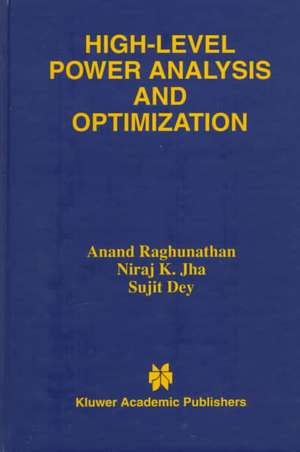
High-Level Power Analysis and Optimization
Autor Anand Raghunathan, Niraj K. Jha, Sujit Deyen Limba Engleză Hardback – 30 noi 1997
High-Level Power Analysis and Optimization surveys the state-of-the-art research on the following topics: power estimation/macromodeling techniques for architecture-level designs, high-level power management techniques, and high-level synthesis optimizations for low power.
High-Level Power Analysis and Optimization will be very useful reading for students, researchers, designers, design methodology developers, and EDA tool developers who are interested in low-power VLSI design or high-level design methodologies.
Preț: 664.69 lei
Preț vechi: 781.98 lei
-15%
Puncte Express: 997
Carte tipărită la comandă
Livrare economică 26 noiembrie-10 decembrie
Livrare prin curier în România Termenul estimat este afișat lângă disponibilitate.
Transport gratuit pentru acest produs Plată online sau ramburs, în funcție de opțiunile comenzii.
Retur gratuit în 14 zile Comandă securizată și suport în română.
Specificații
ISBN-13: 9780792380733
ISBN-10: 0792380738
Pagini: 200
Ilustrații: XIX, 175 p.
Dimensiuni: 183 x 260 x 16 mm
Greutate: 0.52 kg
Ediția:1998
Editura: Springer
Locul publicării:New York, NY, United States
ISBN-10: 0792380738
Pagini: 200
Ilustrații: XIX, 175 p.
Dimensiuni: 183 x 260 x 16 mm
Greutate: 0.52 kg
Ediția:1998
Editura: Springer
Locul publicării:New York, NY, United States
V-ar putea interesa
-
 Power Over Ethernet Interoperability GuideSanjaya Maniktala-40%Preț: 813.24 lei1351.06 lei
 -
 -12%Preț: 235.40 lei267.91 lei
 -
 High Speed Signal PropagationHoward Johnson-18%Preț: 790.48 lei963.99 lei
 -
 The Verilog(r) Hardware Description LanguageDonald Thomas-15%Preț: 508.12 lei597.79 lei
 -
 Esd TestingSteven H Voldman-9%Preț: 761.87 lei837.22 lei
 -
 Pulse Width Modulation for Power ConvertersD Grahame Holmes-23%Preț: 1166.20 lei1514.54 lei
 -
 Digital DesignWilliam James Dally-19%Preț: 562.19 lei694.07 lei
 -
 Understanding Fabless IC TechnologyJeorge S. Hurtarte-23%Preț: 554.99 lei720.77 lei
 -
 Circuit BoardsMorrison-8%Preț: 585.91 lei636.86 lei
 -
 Interactive DisplaysBhowmik-9%Preț: 915.89 lei1006.48 lei
 -
 Fundamentals of Liquid Crystal Devices, 2nd EditionDeng Ke Yang-9%Preț: 842.52 lei925.85 lei
 -
 Grounding and Shielding 6e CMorrison-9%Preț: 721.52 lei792.88 lei
 -
 Addressing Techniques of Liquid Crystal DisplaysTemkar N Ruckmongathan-20%Preț: 721.68 lei902.10 lei
 -
 -9%Preț: 807.57 lei887.43 lei
 -
 Encyclopedia of Electronic Components Volume 2Charles PlattPreț: 177.11 lei
 -
 Encyclopedia of Electronic Components, Volume 3Charles PlattPreț: 175.17 lei
Public țintă
ResearchCuprins
1. Introduction.- 1.1 Low power design.- 1.2 Design abstraction and levels of the design hierarchy.- 1.3 Benefits of high-level power analysis and optimization.- 1.4 Book overview.- 2. Background.- 2.1 Sources of power consumption.- 2.2 Methods for reducing power and energy consumption.- 2.3 High-level design techniques.- 2.4 High-level synthesis application domains.- 3. Architecture-Level Power Estimation.- 3.1 Analytical power models.- 3.2 Characterization based activity and power macromodels.- 3.3 Power and switching activity estimation techniques for control logic.- 3.4 Conclusions.- 4. Power Management.- 4.1 Clock-based power management: Gated and multiple clocks.- 4.2 Pre-computation.- 4.3 Scheduling to enable power management.- 4.4 Operand isolation.- 4.5 Power management through constrained register sharing.- 4.6 Controller-based power management.- 4.7 Conclusions.- 5. High-Level Synthesis For Low Power.- 5.1 Behavioral transformations.- 5.2 Module selection.- 5.3 Resource sharing.- 5.4 Scheduling.- 5.5 Supply voltage vs. switched capacitance trade-offs.- 5.6 Optimizing memory power consumption during high-level synthesis.- 5.7 Reducing glitching power consumption during high-level design.- 5.8 Conclusions.- 6. Conclusions And Future Work.- References.