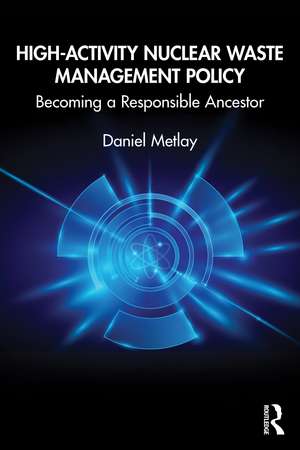
High-Activity Nuclear Waste Management Policy: Becoming a Responsible Ancestor
Autor Daniel S. Metlayen Limba Engleză Paperback – 25 mar 2026
Unlike other democracies with mature nuclear power programs, the United States lacks a permanent management plan for its high-activity radioactive waste. This book analyzes how the United States reached this negligent position and examines how eight other countries have addressed five critical waste management activities: establishing and implementing organizations, selecting a repository site, executing phased repository development, licensing a repository, and addressing technical controversies. It concludes with recommendations for reconstituting an effective waste management program in the United States.
The book will interest nuclear waste and nuclear energy and safety researchers, policy makers, and administrators. It will also benefit graduate students taking specialized courses in nuclear waste management, technology ethics, and public/energy policy.
Preț: 408.28 lei
Preț vechi: 443.78 lei
-8% Nou
Puncte Express: 612
Carte disponibilă
Livrare economică 18 mai-01 iunie
Livrare express 02-08 mai pentru 34.24 lei
Specificații
ISBN-13: 9781032866086
ISBN-10: 103286608X
Pagini: 268
Ilustrații: 120
Dimensiuni: 156 x 234 mm
Greutate: 0.5 kg
Ediția:1
Editura: CRC Press
Colecția Routledge
ISBN-10: 103286608X
Pagini: 268
Ilustrații: 120
Dimensiuni: 156 x 234 mm
Greutate: 0.5 kg
Ediția:1
Editura: CRC Press
Colecția Routledge
V-ar putea interesa
-
 Command and ControlEric Schlosser-19%Preț: 85.14 lei104.65 lei
 -
 Preț: 249.58 lei
 -
 Don't Burn Anyone at the Stake TodayNaomi AldermanPreț: 115.45 lei
 -
 The Technological RepublicAlexander C KarpPreț: 164.65 lei
 -
 The Power of NuclearMarco Visscher-27%Preț: 95.10 lei129.67 lei
 -
 The New Nuclear AgeAnkit PandaPreț: 157.99 lei
 -
 The Taiwan TinderboxJ Michael ColePreț: 157.29 lei
 -
 Nuclear Waste: Questions & ProposalsMartin A Wooten-30%Preț: 1066.13 lei1529.45 lei
 -
 Spent Nuclear Fuel: Storage Options & EffortsPhillip T Crawford-30%Preț: 917.39 lei1316.15 lei
 -
 Nuclear WarAnnie Jacobsen-19%Preț: 61.38 lei76.10 leiRecomandat
 -
 FalloutFred PearcePreț: 68.41 lei
 -
 Going NuclearTim GregoryPreț: 118.10 lei
 -
 The Technological RepublicAlexander C. Karp-20%Preț: 94.13 lei117.19 lei
 -
 Preț: 410.79 lei
 -
 Discounting the FutureLiliana DoganovaPreț: 155.02 lei
 -
 Preț: 431.97 lei
 -
 Radioactive Waste Engineering and ManagementShinya Nagasaki-18%Preț: 1171.07 lei1428.14 lei
 -
 Decision-making in High-Risk ProjectsAkio Torii-15%Preț: 670.30 lei788.59 lei
Public țintă
Academic, Postgraduate, and Professional ReferenceRecenzii
"Daniel Metlay’s exquisite sense of nuclear waste history and technical statesmanship combine in producing a path to becoming responsible ancestors by emphasizing social acceptability as a critical dimension in nuclear waste management."
- Ronald M. Latanision, former member of the Nuclear Waste Technical Review Board and Professor Emeritus, Massachusetts Institute of Technology
- Ronald M. Latanision, former member of the Nuclear Waste Technical Review Board and Professor Emeritus, Massachusetts Institute of Technology
Cuprins
1. Introduction. Part I. The Waste Management Program In The United States. 2. In the Beginning. 3. Setting the Path. 4. Creating a Regulatory and Legal Foundation. 5. The Rise of the Yucca Mountain Repository. 6. The Fall of the Yucca Mountain Repository. Part II. Lessons from Other Countries. 7. Designing an Implementing Organization. 8. Selecting a Repository Site. 9. Phased Repository Development. 10. Repository Licensing. 11. Addressing Technical Controversies. Part III. What Can We Learn?. 12. To Become a Responsible Ancestor.
Notă biografică
Daniel S. Metlay is an independent researcher in the field of nuclear waste management. He graduated in 1967 from Caltech with a double major in molecular biology and medieval history. He later entered the Ph.D. program for political science at the University of California, Berkeley. While there, he was invited to join a Task Force established by the U.S. Nuclear Regulatory Commission to develop the first set of goals and objectives for nuclear waste management. Dr. Metlay taught organization theory and public policy at Indiana University and MIT for more than a dozen years. He was later appointed to direct a Secretary of Energy Task Force charged with recommending ways to merit and sustain public trust and confidence in DOE’s nuclear waste management program. He then joined the staff of U.S. Nuclear Waste Technical Review Board, preparing reports to Congress and serving as the micro-agency’s international liaison. Throughout his career, Dr. Metlay has published over 100 articles, technical reports, presentations, and government documents. He retired in 2018 after three decades of public service.
Descriere
This book describes the technical, social, and political challenges of developing a deep-mined, geologic repository for high-activity nuclear waste. It emphasizes how the technical estimates of repository performance affect non-technical considerations, such as trust and risk perceptions, and vice versa.