
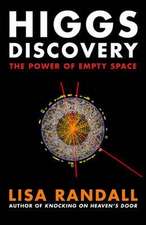
Higgs Discovery: Ecco
Autor Lisa Randallen Limba Engleză Paperback – 10 ian 2020
Din seria Ecco
-
 Preț: 156.31 lei
 -
 Preț: 91.42 lei
 -
 Preț: 206.18 lei
 -
 Preț: 258.62 lei
 -
 Preț: 161.72 lei
 -
 Preț: 88.87 lei
 -
 Preț: 153.69 lei
 -
 Preț: 252.13 lei
 -
 Preț: 154.35 lei
 -
 Preț: 109.17 lei
 -
 Preț: 100.67 lei
 -
 Preț: 105.16 lei
 -
 Preț: 107.33 lei
 -
 Preț: 95.60 lei
 -
 Preț: 106.20 lei
 -
 Preț: 114.05 lei
 -
 Preț: 115.98 lei
 -
 Preț: 164.58 lei
 -
 Preț: 89.79 lei
 -
 Preț: 252.50 lei
 -
 Preț: 188.41 lei
 -
 Preț: 155.23 lei
 -
 Preț: 86.30 lei
Preț: 70.19 lei
Carte disponibilă
Livrare economică 09-23 noiembrie
Specificații
ISBN-10: 0062300474
Pagini: 112
Dimensiuni: 134 x 203 x 10 mm
Greutate: 0.1 kg
Ediția:New.
Editura: Harpercollins
Colecția Ecco
Seria Ecco
V-ar putea interesa
-
 Dreams Of A Final TheorySteven WeinbergPreț: 115.08 lei
 -
 Knocking On Heaven's DoorLisa Randall-19%Preț: 74.83 lei92.95 lei
 -
 Dark Matter and the DinosaursLisa Randall-18%Preț: 76.76 lei94.09 lei
 -
 Warped PassagesLisa RandallPreț: 134.00 lei
 -
 Elementary Atomic StructureG. K. Woodgate-29%Preț: 410.61 lei574.51 lei
 -
 Molecular BeamsNorman Ramsey-31%Preț: 574.64 lei829.00 lei
 -
 -21%Preț: 364.97 lei461.42 lei
 -
 -22%Preț: 474.68 lei611.28 lei
 -
 -28%Preț: 516.21 lei717.85 lei
 -
 Nuclear Physics - Principles & ApplicationsJohn LilleyPreț: 400.16 lei
 -
 Introduction to High Energy PhysicsDonald H. Perkins-23%Preț: 739.48 lei960.36 lei
 -
 A Walk through the Southern SkyMilton HeifetzPreț: 286.48 lei
 -
 -15%Preț: 680.10 lei800.11 lei
 -
 Preț: 98.04 lei
 -
 Introducing Particle PhysicsTom WhyntiePreț: 63.96 lei
 -
 Quantum PhysicsAlistair I M RaePreț: 65.69 lei
 -
 INTR TO BLACK HOLES, INFORMATION & THE..Susskind LeonardPreț: 133.11 lei
Notă biografică
Lisa Randall studies theoretical particle physics and cosmology at Harvard University, where she is Frank B. Baird, Jr., Professor of Science. A member of the National Academy of Sciences, the American Philosophical Society, and the American Academy of Arts and Sciences, she is the recipient of many awards and honorary degrees. Professor Randall was included in Time magazine's "100 Most Influential People" of 2007 and was among Esquire magazine's "75 Most Influential People of the 21st Century." Professor Randall's two books, Warped Passages (2005) and Knocking on Heaven's Door (2011) were New York Times bestsellers and 100 Notable Books. Her stand-alone e-book, Higgs Discovery: The Power of Empty Space, was published in 2012.