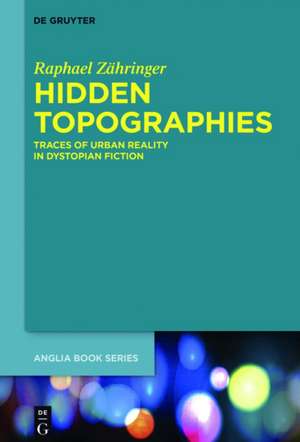
Hidden Topographies: Traces of Urban Reality in Dystopian Fiction: Buchreihe der Anglia / Anglia Book Series, cartea 57
Autor Raphael Zähringeren Limba Engleză Electronic book text – 19 apr 2017
Din seria Buchreihe der Anglia / Anglia Book Series
-
 Preț: 127.68 lei
 -
 Preț: 139.58 lei
 -
 Preț: 176.97 lei
 - nou
 Preț: 551.86 lei
 - 27%
 Preț: 790.97 lei
 - 27%
 Preț: 790.97 lei
 - 27%
 Preț: 1457.19 lei
 - 27%
 Preț: 1022.49 lei
 - 27%
 Preț: 790.97 lei
 - 27%
 Preț: 1094.94 lei
 - 27%
 Preț: 696.46 lei
 - nou
 Preț: 551.86 lei
 - 23%
 Preț: 551.86 lei
 - 23%
 Preț: 551.86 lei
 - 23%
 Preț: 551.86 lei
 - 27%
 Preț: 626.22 lei
 - nou
 Preț: 551.86 lei
 - 27%
 Preț: 732.68 lei
 - 27%
 Preț: 732.68 lei
 - 27%
 Preț: 732.68 lei
 - 23%
 Preț: 636.31 lei
 - 27%
 Preț: 877.58 lei
Preț: 732.68 lei
Preț vechi: 1003.67 lei
-27% Precomandă
Puncte Express: 1099
Nepublicat încă
Livrare prin curier în România Precomanda se expediază când titlul devine disponibil.
Transport gratuit pentru acest produs Plată online sau ramburs, în funcție de opțiunile comenzii.
Retur gratuit în 14 zile Comandă securizată și suport în română.
Doresc să fiu notificat când acest titlu va fi disponibil:
Se trimite...
Specificații
ISBN-13: 9783110533965
ISBN-10: 3110533960
Pagini: 300
Editura: De Gruyter
Colecția De Gruyter Mouton
Seria Buchreihe der Anglia / Anglia Book Series
Locul publicării:Berlin/Boston
ISBN-10: 3110533960
Pagini: 300
Editura: De Gruyter
Colecția De Gruyter Mouton
Seria Buchreihe der Anglia / Anglia Book Series
Locul publicării:Berlin/Boston
V-ar putea interesa
-
 Chinese Literature: A Very Short IntroductionSabina Knight-20%Preț: 56.62 lei70.82 lei
 -
 -20%Preț: 55.78 lei70.14 lei
 -
 The Strangeness of TragedyPaul Hammond-23%Preț: 509.99 lei659.88 lei
 -
 William Hazlitt: The First Modern ManDuncan Wu-14%Preț: 116.77 lei136.00 lei
 -
 -22%Preț: 422.12 lei543.26 lei
 -
 -12%Preț: 303.17 lei345.27 lei
 -
 The Art of Eloquence: Byron, Dickens, Tennyson, JoyceMatthew Bevis-22%Preț: 394.85 lei508.65 lei
 -
 -13%Preț: 271.95 lei312.54 lei
 -
 -28%Preț: 507.63 lei707.38 lei
 -
 Dante EncyclopediaRichard Lansing-8%Preț: 644.00 lei700.00 lei
 -
 Landscape and LiteratureStephen SiddallPreț: 200.82 lei
 -
 The Arden Shakespeare MiscellanyJane Armstrong-23%Preț: 122.81 lei158.54 lei
 -
 York Notes Companions Nineteenth Century American LiteratureRowland HughesPreț: 94.46 lei
 -
 The TempestRosie DickinsPreț: 47.85 lei
 -
 Peter of AuvergneChristoph Flüeler-23%Preț: 1055.80 lei1371.16 lei
 -
 Preț: 179.07 lei
 -
 Law and Justice in Literature, Film and TheaterKaren-Margrethe Simonsen-23%Preț: 951.88 lei1236.21 lei
Notă biografică
Raphael Zähringer, University of Tübingen, Germany.
Descriere
This book examines dystopian fiction’s recent paradigm shift towards urban dystopias. It links the dystopian tradition with the literary history of the novel, spatio-philosophical concepts against the backdrop of the spatial turn, and systems-theory. Five dystopian novels are discussed in great detail: China Miéville’s Perdido Street Station (2000) and The City & The City (2009), City of Bohane (2011) by Kevin Barry, John Berger’s Lilac and Flag (1992), and Divided Kingdom (2005) by Rupert Thomson. The book includes chapters on the literary history of the dystopian tradition, the referential interplay of maps and literature, urban spaces in literature, borders and transgressions, and on systems-theory as a tool for charting dystopian fiction. The result is a detailed overview of how dystopian fiction constantly adapts to – and reflects on – the actual world.