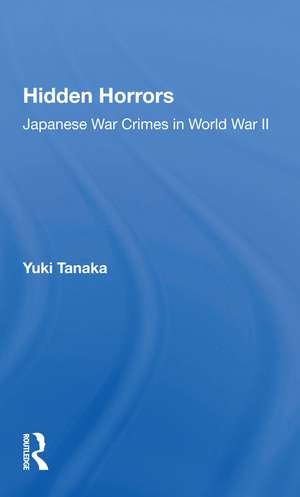
Hidden Horrors: Japanese War Crimes in World War II
Autor Yuki Tanakaen Limba Engleză Paperback – 7 dec 2020
Considerăm că Hidden Horrors vine să completeze o lacună persistentă în literatura academică dedicată celui de-al Doilea Război Mondial, oferind o documentare riguroasă a atrocităților japoneze care, timp de decenii, au fost fie ignorate, fie marginalizate în discursul istoric oficial. Această a doua ediție revizuită nu se limitează la o simplă trecere în revistă a faptelor, ci propune o analiză profundă a mecanismelor instituționale și psihologice care au permis dezumanizarea extremă în teatrul de operațiuni din Pacific.
Structura volumului este organizată tematic, debutând cu o analiză a tribunalelor pentru crime de război și evoluând spre studii de caz cutremurătoare: de la masacrele și marșurile morții din lagărul Sandakan (Borneo), până la capitole dedicate canibalismului și experimentelor biologice. Un element distinctiv al acestei ediții este capitolul nou despre insula Nauru, unde Yuki Tanaka investighează uciderea pacienților cu lepră și strămutarea forțată a populației native. Această lucrare reprezintă o alternativă necesară la Japanese War Crimes during World War II de Frank Jacob pentru cursurile de istoria Asiei, având avantajul unei ancorări mai adânci în arhivele japoneze și a unei perspective critice asupra lipsei de asumare a responsabilității colective în societatea niponă contemporană.
În contextul operei sale, Hidden Horrors consolidează temele explorate în Comfort Woman, extinzând cercetarea de la sclavia sexuală la spectrul complet al violenței sistematice. Stilul autorului este precis și clinic, lăsând faptele și hărțile incluse să vorbească despre amploarea fenomenului, în timp ce concluzia substanțial revizuită oferă interpretări noi asupra proceselor istorice care au modelat structura militară imperială.
Preț: 362.18 lei
Preț vechi: 408.45 lei
-11%
Carte indisponibilă temporar
Specificații
ISBN-10: 0367160021
Pagini: 304
Dimensiuni: 136 x 212 x 23 mm
Greutate: 0.56 kg
Ediția:1
Editura: Taylor & Francis
Colecția Routledge
Locul publicării:Oxford, United Kingdom
V-ar putea interesa
-
 Age of AmbitionEvan OsnosPreț: 120.73 lei
 -
 Life along the Silk RoadSusan WhitfieldPreț: 210.35 lei
 -
 The Mongol EmpireJohn Man-25%Preț: 64.57 lei85.59 lei
 -
 China and TaiwanSteven M GoldsteinPreț: 203.82 lei
 -
 A History of the Modern Middle EastWilliam L. Cleveland-15%Preț: 453.31 lei533.31 lei
 -
 The Arab-Israeli ConflictT. G. Fraser-17%Preț: 199.88 lei240.22 lei
 -
 The Nile: Downriver Through Egypt’s Past and PresentToby Wilkinson-28%Preț: 86.20 lei119.91 lei
 -
 China, Christianity, and the Question of CultureYang HuilinPreț: 504.63 lei
 -
 The Seasons of TroubleRohini MohanPreț: 235.85 lei
 -
 KohimaArthur Swinson-32%Preț: 125.94 lei184.24 lei
 -
 Without You, There is No UsSuki Kim-29%Preț: 83.89 lei118.60 lei
De ce să citești această carte
Recomandăm această carte studenților și cercetătorilor în istorie și științe politice care doresc o înțelegere nuanțată a conflictului din Pacific. Hidden Horrors nu este doar o cronică a brutalității, ci un instrument esențial pentru a înțelege cum ideologia și structura statală pot justifica atrocitățile. Cititorul câștigă acces la date de arhivă rare și la o analiză sociologică a modului în care memoria istorică este construită sau reprimată în Japonia postbelică.
Despre autor
Yuki Tanaka este un istoric de renume mondial, fost profesor de cercetare la Institutul de Pace din cadrul Universității din Hiroshima până în 2015. Cariera sa a fost dedicată scoaterii la lumină a aspectelor ascunse ale istoriei militare japoneze, fiind un critic vocal al politicilor de negare a crimelor de război. Pe lângă lucrarea de referință Hidden Horrors, acesta este autorul volumului Japan's Comfort Women și co-editor al lucrării Bombing Civilians. Expertiza sa îmbină rigoarea academică cu un angajament profund pentru pace și dreptate istorică în regiunea Asia-Pacific.
Descriere scurtă
Cuprins
Notă biografică
Recenzii
Summing Up: Essential. All levels/libraries.
How can we understand the inhumanity of war? Yuki Tanaka's book remains the most searingly honest attempt to make sense of the cruelty of the Japanese military forces during the Asia-Pacific War. Drawing attention to the relationship between atrocity and the everyday lives of ordinary people, it is a warning to us all.
Yuki Tanaka writes with compelling authenticity and refreshing candor on Japanese atrocities during World War II. His eagerly anticipated second edition of Hidden Horrors provides a seminal and authoritative analysis. This scholarly contribution is welcome and constitutes compulsory reading for any who take the subject matter seriously.
For years, Yuki Tanaka's book has been essential, harrowing reading on the effects of Japanese imperialism on Asia in the mid-twentieth century. This revised edition draws on new thinking and research to make its powerful case with even more clarity.
Praise for the first edition:
In a shocking brief . . . Japanese historian Tanaka challenges the idea of Japan as a victim in WWII. The core of his thesis is that in the aftermath of the Russo-Japanese War of 1904-1905, an 'Emperor ideology' based on the 'family state' came to dominate Japan. Responsibility was seen as unlimited, while rights existed only in a collective context; this set the stage for various tragedies and atrocities.
Praise for the first edition:
A scholar's harrowing . . . briefing on largely unpunished and long-ignored atrocities committed by Japan's military during WW II. Drawing on hitherto untapped archives, Tanaka documents a series of appalling war crimes that, with few exceptions, have escaped notice in standard histories of the global conflict. . . . After reviewing the frightful particulars of his case studies, moreover, the author offers anecdotal evidence of similar behavior by other belligerents, eventually concluding, however, that Japanese barbarity was sui generis. . . . Shocking annals that bear gruesome witness to the darker realities of what historian John W. Dower (who contributed a thoughtful foreword to the American edition) called a war without mercy.