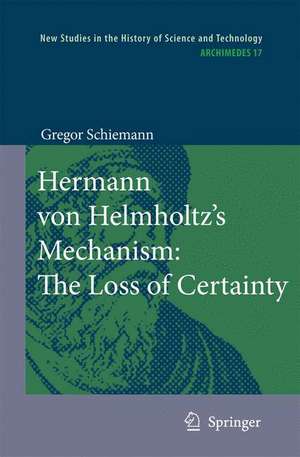
Hermann Von Helmholtz's Mechanism: The Loss of Certainty
Autor Gregor Schiemann Traducere de Cynthia Klohren Limba Engleză Hardback – 9 dec 2008
Preț: 621.11 lei
Preț vechi: 730.71 lei
-15% Nou
Puncte Express: 932
Preț estimativ în valută:
109.94€ • 128.15$ • 96.14£
109.94€ • 128.15$ • 96.14£
Carte tipărită la comandă
Livrare economică 21 ianuarie-04 februarie 26
Preluare comenzi: 021 569.72.76
Specificații
ISBN-13: 9781402056291
ISBN-10: 140205629X
Pagini: 284
Ilustrații: X, 284 p.
Dimensiuni: 166 x 242 x 21 mm
Greutate: 0.57 kg
Ediția:2009 edition
Editura: Springer
Locul publicării:Dordrecht, Netherlands
ISBN-10: 140205629X
Pagini: 284
Ilustrații: X, 284 p.
Dimensiuni: 166 x 242 x 21 mm
Greutate: 0.57 kg
Ediția:2009 edition
Editura: Springer
Locul publicării:Dordrecht, Netherlands
V-ar putea interesa
-
 -18%Preț: 150.32 lei182.83 lei
 -
 -11%Preț: 368.99 lei414.60 lei
 -
 Introduction to Medieval LogicAlexander Broadie-14%Preț: 674.79 lei784.64 lei
 -
 -8%Preț: 323.66 lei351.12 lei
 -
 -40%Preț: 728.63 lei1206.14 lei
 -
 ConditionalsMichael Woods-15%Preț: 296.99 lei349.95 lei
 -
 A Structural Account of MathematicsCharles S. Chihara-14%Preț: 367.21 lei428.28 lei
 -
 -14%Preț: 490.45 lei567.54 lei
 -
 The Uses of Sense: Wittgenstein's Philosophy of LanguageCharles Travis-14%Preț: 368.33 lei428.88 lei
 -
 Aspects of HobbesNoel MalcolmPreț: 366.10 lei
 -
 Themes from G. E. Moore: New Essays in Epistemology and EthicsSusana Nuccetelli-27%Preț: 844.95 lei1153.45 lei
 -
 New Essays on the Knowability ParadoxJoe Salerno-14%Preț: 680.50 lei791.27 lei
 -
 -14%Preț: 581.45 lei676.11 lei
 -
 Kant and SpinozismB. Lord-18%Preț: 699.34 lei852.86 lei
 -
 Preț: 248.32 lei
 -
 Emmanuel LevinasSeán HandPreț: 230.40 lei
 -
 Wittgenstein: A Guide for the PerplexedDr Mark AddisPreț: 161.94 lei
 -
 Lane, J: Timeless SimplicityJohn Lane-41%Preț: 59.57 lei101.38 lei
Public țintă
ResearchCuprins
Mechanism Between the Classical and the Modern Conception of Science.- The Conception of Mechanism.- The Classical Conception of Science.- Three Traditions in Mechanism.- Contours of Modern Philosophy of Nature.- Helmholtz's Mechanism at the Dawn of Modernity.- Helmholtz, a Bildungsbürger, Scientist, and Research Strategist.- Helmholtz’s Classical Mechanism.- The Hypothetization of Helmholtz’s Mechanism.- Conditions and Causes for the Change in Helmholtz’s Conception of Science and Nature.
Textul de pe ultima copertă
Two seemingly contradictory tendencies have accompanied the development of the natural sciences in the past 150 years. On the one hand, the natural sciences have been instrumental in effecting a thoroughgoing transformation of social structures and have made a permanent impact on the conceptual world of human beings. This historical period has, on the other hand, also brought to light the merely hypothetical validity of scientific knowledge. As late as the middle of the 19th century the truth-pathos in the natural sciences was still unbroken. Yet in the succeeding years these claims to certain knowledge underwent a fundamental crisis. For scientists today, of course, the fact that their knowledge can possess only relative validity is a matter of self-evidence.
The present analysis investigates the early phase of this fundamental change in the concept of science through an examination of Hermann von Helmholtz's conception of science and his mechanistic interpretation of nature. Helmholtz (1821-1894) was one of the most important natural scientists in Germany. The development of this thought offers an impressive but, until now, relatively little considered report from the field of the experimental sciences chronicling the erosion of certainty.
The present analysis investigates the early phase of this fundamental change in the concept of science through an examination of Hermann von Helmholtz's conception of science and his mechanistic interpretation of nature. Helmholtz (1821-1894) was one of the most important natural scientists in Germany. The development of this thought offers an impressive but, until now, relatively little considered report from the field of the experimental sciences chronicling the erosion of certainty.
Caracteristici
First English comprehensive contribution to one of the leading German physicists in the 19th century An informative account of a highly important part of the history of science and a reconstruction of a conception of science that is greatly widespread to this day Profound analysis of the interaction between classical physics and philosophy of nature New insights into the impact of Immanuel Kant’s philosophy of science and metaphysics of nature on the philosophy of physics