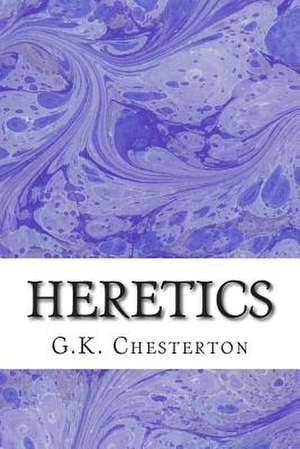
Heretics
Autor G. K. Chestertonen Limba Engleză Paperback
Preț: 48.16 lei
Puncte Express: 72
Carte disponibilă
Livrare economică 24 octombrie-07 noiembrie
Livrare prin curier în România Termenul estimat este afișat lângă disponibilitate.
Transport gratuit de la 400.00 lei Plată online sau ramburs, în funcție de opțiunile comenzii.
Retur gratuit în 14 zile Comandă securizată și suport în română.
Specificații
ISBN-13: 9781508731788
ISBN-10: 1508731780
Pagini: 134
Dimensiuni: 152 x 229 x 7 mm
Greutate: 0.19 kg
Editura: CREATESPACE
ISBN-10: 1508731780
Pagini: 134
Dimensiuni: 152 x 229 x 7 mm
Greutate: 0.19 kg
Editura: CREATESPACE
V-ar putea interesa
-
 G K Chesterton: a ReappraisalConlon DenisPreț: 247.25 lei
 -
 What's Wrong with the WorldG. K. ChestertonPreț: 82.13 lei
 -
 OrthodoxyG. K. Chesterton-18%Preț: 29.30 lei35.91 lei
 -
 Why I Am Not a ChristianBertrand RussellPreț: 106.13 lei
 -
 Collected Works of G.K. ChestertonG. K. ChestertonPreț: 124.34 lei
 -
 What's Wrong with the WorldG. K. ChestertonPreț: 44.19 lei
 -
 George Bernard ShawG. K. ChestertonPreț: 40.86 lei
 -
 OrthodoxyGilbert K. ChestertonPreț: 47.95 lei
 -
 A Miscellany of MenG. K. ChestertonPreț: 40.46 lei
 -
 In Defense of SanityG. K. ChestertonPreț: 124.44 lei
 -
 The Complete ThinkerDale AhlquistPreț: 110.31 lei
 -
 Heretics and OrthodoxyG. K. ChestertonPreț: 90.29 lei
 -
 The Everlasting ManG. K. ChestertonPreț: 54.08 lei
 -
 The Everyman ChestertonG. K. Chesterton-16%Preț: 123.15 lei147.20 lei
 -
 The Man Who Was ThursdayG. K. ChestertonPreț: 38.95 lei
 -
 The Ball and the CrossG. K. ChestertonPreț: 44.87 lei
 -
 ManaliveG. K. ChestertonPreț: 38.39 lei
 -
 The New JerusalemG. K. ChestertonPreț: 44.37 lei
Notă biografică
G. K. Chesterton (1874-1936) was a prolific English writer, philosopher, lay theologian, and literary and art critic. He is best known in mystery circles as the creator of the fictional priest-detective Father Brown and for the metaphysical thriller The Man Who Was Thursday. Often referred to as "the prince of paradox," Chesterton frequently made his points by turning familiar sayings and proverbs inside out. Chesterton attended the Slade School of Art, a department of University College London, where he took classes in illustration and literature, though he did not complete a degree in either subject. In 1895, at the age of twenty-one, he began working for the London publisher George Redway. A year later he moved to another publisher, T. Fisher Unwin, where he undertook his first work in journalism, illustration, and literary criticism. In addition to writing fifty-three Father Brown stories, Chesterton authored articles and books of social criticism, philosophy, theology, economics, literary criticism, biography, and poetry.
Cuprins
I. Introductory Remarks on the Importance of Orthodoxy II. On the Negative Spirit III. On Mr. Rudyard Kipling and Making the World Small IV. Mr. Bernard Shaw V. Mr. H. G. Wells and the Giants VI. Christmas and the Æsthetes VII. Omar and the Sacred Vine VIII. The Mildness of the Yellow Press IX. The Moods of Mr. George Moore X. On Sandals and Simplicity XI. Science and the Savages XII. Paganism and Mr. Lowes Dickinson XIII. Celts and Celtophiles XIV. On Certain Modern Writers and the Institution of the Family XV. On Smart Novelists and the Smart Set XVI. On Mr. McCabe and a Divine Frivolity XVII. On the Wit of Whistler XVIII. The Fallacy of the Young Nation XIX. Slum Novelists and the Slums XX. Concluding Remarks on the Importance of Orthodoxy