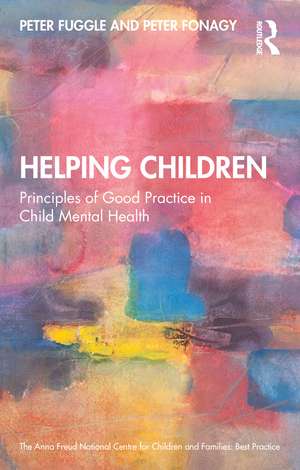
Helping Children: Principles of Good Practice in Child Mental Health: Anna Freud
Autor Peter Fuggle, Peter Fonagyen Limba Engleză Paperback – 7 iul 2026
This book argues that the mental health needs of children cannot be met by specialist services in isolation. Instead, it calls for a new approach that brings together parents, teachers, peers and communities alongside mental health professionals, each playing an equal part in supporting children’s wellbeing. Drawing on research, policy and practice experience, this book identifies six principles of effective help: the active involvement of parents and carers; the importance of listening to children’s own wishes; creating environments of psychological safety; recognising that help can come from many sources; embedding support within everyday community life; and building a culture where caring for children’s mental health becomes everyone’s shared responsibility.
Written by leading figures in child mental health, this book offers a powerful new framework for rethinking how society responds to young people’s distress. It speaks to professionals, educators, parents and policymakers alike, showing how families, schools and communities can work together to nurture resilience and belonging, reducing dependence on overstretched specialist services.
Preț: 311.38 lei
Preț vechi: 327.76 lei
-5%
Puncte Express: 467
Carte disponibilă
Livrare economică 13-27 noiembrie
Livrare express 30 octombrie-05 noiembrie pentru 33.52 lei
Livrare prin curier în România Termenul estimat este afișat lângă disponibilitate.
Transport gratuit de la 400.00 lei Plată online sau ramburs, în funcție de opțiunile comenzii.
Retur gratuit în 14 zile Comandă securizată și suport în română.
Specificații
ISBN-13: 9780367702915
ISBN-10: 0367702916
Pagini: 238
Ilustrații: 2
Dimensiuni: 138 x 216 mm
Greutate: 0.44 kg
Ediția:1
Editura: Taylor & Francis
Colecția Routledge
Seria Anna Freud
Locul publicării:Oxford, United Kingdom
ISBN-10: 0367702916
Pagini: 238
Ilustrații: 2
Dimensiuni: 138 x 216 mm
Greutate: 0.44 kg
Ediția:1
Editura: Taylor & Francis
Colecția Routledge
Seria Anna Freud
Locul publicării:Oxford, United Kingdom
Public țintă
Postgraduate, Professional, and Professional Practice & DevelopmentCuprins
1. Introduction: children and young people 2. Providing help: the problems for mental health services 3. Providing help: the problems for families 4. The Thrive Framework 5. The helping process: the role of families 6. The helping process: the role of professionals 7. Supporting safety 8. Taking an active part in help 9. Measuring help 10. It takes a village 11. Implications for direct help 12. Implications for how services work 13. Implications for designing and planning services 14. Summary and conclusions
Recenzii
‘This accessible and engaging text is a must read for anyone with an interest in Children and Young People’s Mental Health is full of practical advice grounded in many years of expert practice and leadership. The authors’ absolute belief in the essential role of parents and carers coupled with the explanation of how networks of care are structured, will build parents and carer confidence as they navigate complex systems. Professionals from all agencies will appreciate the balanced and thoughtful demonstration of how their contribution sits in within the system of wider support for those in difficulty and areas they may like to improve. It will be particularly helpful to commissioners and policy makers as they seek to improve outcomes and a truly integrated approach. By identifying key principles and weaving case studies throughout , the authors create a compelling narrative that gives hope whilst being realistic about challenges that cannot always be overcome even with our best efforts. But by giving our children , young people, and those who care for them, agency, input as equals into developing a choice of what, who, when and where help is provided, building system wide collaboration and clear leadership with expert training and supervision, whilst monitoring and reflecting on outcomes with curiosity, honesty and humility, we can make a real difference.’
Kathryn Pugh, MBE and former Deputy Head of Mental Health in NHS England leading the Children and Young People’s Mental Health Community Transformation Programme
‘Following a decade of implementation of the THRIVE Framework for system change this timely and compassionate book offers an evidence-informed approach to helping children and young people with mental health needs that recognises the importance of clinical intervention where indicated, whilst challenging the idea that therapy alone is sufficient.
With clarity and warmth, it illustrates the ways in which adverse conditions amplify risks and hinder recovery, highlighting the powerful roles of families, schools and communities in supporting young people alongside professionals, attending to their life context and drawing on trusted relationships to create psychologically safe environments where children live their everyday lives.
Clear, accessible and hopeful, it promotes a practical approach to supporting children and young people where mental health and wellbeing is everyone’s responsibility through a robust, collaborative and effective “helping system” to meet rising mental health need.’
Dr Rachel James, Director of Clinical Services, Tavistock & Portman NHS Foundation Trust
‘This book is an invaluable text for anyone concerned about child and adolescent mental health, and for anyone supporting children and young people in a personal or professional capacity. Based on their extensive clinical, academic, and policy experience, and illustrated sensitively with reference to the lived experiences of families, the authors communicate their confidence in the ability of the many different people who are present in children and young people’s lives to work together to support them. By providing opportunities, empowerment and support, the clear principles provided here outline how this wider system can contribute, in complementary ways, to positive outcomes for children and young people.’
Professor Cathy Creswell, University of Oxford
‘This book offers an excellent exploration of the concept of "Help" through the experiences of six young individuals.
Using the THRIVE Framework as an organising structure, "Helping Children" serves as an accessible and practical guide to better understand children’s mental health and the diverse range of experiences associated with it. It emphasises the need for a varied support system around each child to effectively meet their unique needs.
The book reminds us of our collective responsibility to support children's mental health by strengthening resources within the community and families. It encourages us to engage in shared decision-making, involving young people in the design of support services which promotes their participation and improves the effectiveness of the help provided.’
Rose McCarthy, Senior Organisational Consultant and National i-THRIVE Programme Lead at Tavistock Consulting
‘For all of us working with young people who are trying to cope with their mental health challenges, this is an important and accessible book on how to best help such young people by really listening to their stories and needs. Based upon the principle that it is not just direct work that is needed, but effective engagement and support with family and wider networks, this book will really help professionals and carers in supporting such young people and their networks.’
Brian Littlechild, Professor Emeritus, University of Hertfordshire
'Significant and much needed progress has been made over the past decade to radically rethink that way that child and adolescent mental health services are delivered. Despite this progress ongoing variation in and fragmentation of delivery persists, impacting on lives of many children and young people. This book brings together many of the foundations for developing an exciting new model for all child and adolescent mental health services, from crucial insights into how services should be configured, how they can best engage, intervene and include young people in their care, to emphasising the importance of measuring change, supporting safe care, and ensuring that all those in contact with children, young people and families have a responsibility to consider and provide for their emotional health and well-being. It brings together learning from a wide range of sources to provide a practical framework for delivering services that are responsive to, and co-constructed with children young people and their families, following individual young person stories throughout to eloquently illustrate the importance of adopting a new paradigm for care. Set in the context the innovative THRIVE framework for system change, this ambitious book is a key text to be read by practitioners, managers, commissioners, strategic decision-makers and service users alike.'
Dr Paul Wallis, Director of Psychological Services – MFT CAMHS, Chief Psychological Professions Officer MFT, GM iTHRIVE/CAMHS Workforce Lead, Manchester University Hospitals NHS Foundation Trust
‘This is an important and timely book. One that invites professional experts and system organisers to engage humbly with the awkward fact that despite over an hundred years of research and development into what works for whom in the treatment of children and adolescents with mental health needs (a project both authors have long and intimate experience of) 'we' have signally failed to create systems of help commensurate to the burdens that epidemiology shows us are prevalent across the world.
Our best evidence-based treatments help only a proportion of the children and young people they are directed at, and are insufficient to bridge the 'treatment gap' by orders of magnitude. Even the evidence that strict fidelity to evidence-based models of specialist therapies offers more than marginal gains in terms of outcomes is weak at best; meanwhile, the impact of systemic, social and cultural factors is consistently underestimated. This book invites us to consider a significant rebalancing of the nature of professional help, and the part that it might play alongside the necessary acknowledgement, active engagement with, and scaffolding of those 'extant helping systems' (albeit often fragile, and perhaps even actively harmful) that inevitably exist around all children and young people. These are the informal real-world networks that professionals can only hope to join, rather than to (re)build from scratch. As the saying goes, "Culture eats strategy for breakfast", and this is relevant especially if by 'strategy' we mean decades of effort to develop evidence-based interventions and the systems to target and deliver these efficiently. Through the use of well-worked case examples that illustrate six core principles centred on the nature of the helping process itself (emphasising collaboration between professional and non-professional helpers, active participation by young people and families, outcome measurement, safety, and whole-system approaches) this book makes a powerful argument for a more systemically- (and, if truth be told, reality-) rooted approach that - without in any way dismissing the value of technical professional expertise - invites it into a profoundly new relationship, one less managerial and power-suffused and instead more grounded, in and with the worlds which our patients inhabit. I thoroughly recommend this book to anyone embarking on a career in the 'helping professions', to service planners and managers, and even, dare I say it, to the politicians who hold the power to direct the energy and financial resources intended for their constituents' future wellbeing.’
Dr Dickon Bevington MA MBBS MRCPsych PGCert, Consultant in Child and Adolescent Psychiatry, Medical Director, Anna Freud
Kathryn Pugh, MBE and former Deputy Head of Mental Health in NHS England leading the Children and Young People’s Mental Health Community Transformation Programme
‘Following a decade of implementation of the THRIVE Framework for system change this timely and compassionate book offers an evidence-informed approach to helping children and young people with mental health needs that recognises the importance of clinical intervention where indicated, whilst challenging the idea that therapy alone is sufficient.
With clarity and warmth, it illustrates the ways in which adverse conditions amplify risks and hinder recovery, highlighting the powerful roles of families, schools and communities in supporting young people alongside professionals, attending to their life context and drawing on trusted relationships to create psychologically safe environments where children live their everyday lives.
Clear, accessible and hopeful, it promotes a practical approach to supporting children and young people where mental health and wellbeing is everyone’s responsibility through a robust, collaborative and effective “helping system” to meet rising mental health need.’
Dr Rachel James, Director of Clinical Services, Tavistock & Portman NHS Foundation Trust
‘This book is an invaluable text for anyone concerned about child and adolescent mental health, and for anyone supporting children and young people in a personal or professional capacity. Based on their extensive clinical, academic, and policy experience, and illustrated sensitively with reference to the lived experiences of families, the authors communicate their confidence in the ability of the many different people who are present in children and young people’s lives to work together to support them. By providing opportunities, empowerment and support, the clear principles provided here outline how this wider system can contribute, in complementary ways, to positive outcomes for children and young people.’
Professor Cathy Creswell, University of Oxford
‘This book offers an excellent exploration of the concept of "Help" through the experiences of six young individuals.
Using the THRIVE Framework as an organising structure, "Helping Children" serves as an accessible and practical guide to better understand children’s mental health and the diverse range of experiences associated with it. It emphasises the need for a varied support system around each child to effectively meet their unique needs.
The book reminds us of our collective responsibility to support children's mental health by strengthening resources within the community and families. It encourages us to engage in shared decision-making, involving young people in the design of support services which promotes their participation and improves the effectiveness of the help provided.’
Rose McCarthy, Senior Organisational Consultant and National i-THRIVE Programme Lead at Tavistock Consulting
‘For all of us working with young people who are trying to cope with their mental health challenges, this is an important and accessible book on how to best help such young people by really listening to their stories and needs. Based upon the principle that it is not just direct work that is needed, but effective engagement and support with family and wider networks, this book will really help professionals and carers in supporting such young people and their networks.’
Brian Littlechild, Professor Emeritus, University of Hertfordshire
'Significant and much needed progress has been made over the past decade to radically rethink that way that child and adolescent mental health services are delivered. Despite this progress ongoing variation in and fragmentation of delivery persists, impacting on lives of many children and young people. This book brings together many of the foundations for developing an exciting new model for all child and adolescent mental health services, from crucial insights into how services should be configured, how they can best engage, intervene and include young people in their care, to emphasising the importance of measuring change, supporting safe care, and ensuring that all those in contact with children, young people and families have a responsibility to consider and provide for their emotional health and well-being. It brings together learning from a wide range of sources to provide a practical framework for delivering services that are responsive to, and co-constructed with children young people and their families, following individual young person stories throughout to eloquently illustrate the importance of adopting a new paradigm for care. Set in the context the innovative THRIVE framework for system change, this ambitious book is a key text to be read by practitioners, managers, commissioners, strategic decision-makers and service users alike.'
Dr Paul Wallis, Director of Psychological Services – MFT CAMHS, Chief Psychological Professions Officer MFT, GM iTHRIVE/CAMHS Workforce Lead, Manchester University Hospitals NHS Foundation Trust
‘This is an important and timely book. One that invites professional experts and system organisers to engage humbly with the awkward fact that despite over an hundred years of research and development into what works for whom in the treatment of children and adolescents with mental health needs (a project both authors have long and intimate experience of) 'we' have signally failed to create systems of help commensurate to the burdens that epidemiology shows us are prevalent across the world.
Our best evidence-based treatments help only a proportion of the children and young people they are directed at, and are insufficient to bridge the 'treatment gap' by orders of magnitude. Even the evidence that strict fidelity to evidence-based models of specialist therapies offers more than marginal gains in terms of outcomes is weak at best; meanwhile, the impact of systemic, social and cultural factors is consistently underestimated. This book invites us to consider a significant rebalancing of the nature of professional help, and the part that it might play alongside the necessary acknowledgement, active engagement with, and scaffolding of those 'extant helping systems' (albeit often fragile, and perhaps even actively harmful) that inevitably exist around all children and young people. These are the informal real-world networks that professionals can only hope to join, rather than to (re)build from scratch. As the saying goes, "Culture eats strategy for breakfast", and this is relevant especially if by 'strategy' we mean decades of effort to develop evidence-based interventions and the systems to target and deliver these efficiently. Through the use of well-worked case examples that illustrate six core principles centred on the nature of the helping process itself (emphasising collaboration between professional and non-professional helpers, active participation by young people and families, outcome measurement, safety, and whole-system approaches) this book makes a powerful argument for a more systemically- (and, if truth be told, reality-) rooted approach that - without in any way dismissing the value of technical professional expertise - invites it into a profoundly new relationship, one less managerial and power-suffused and instead more grounded, in and with the worlds which our patients inhabit. I thoroughly recommend this book to anyone embarking on a career in the 'helping professions', to service planners and managers, and even, dare I say it, to the politicians who hold the power to direct the energy and financial resources intended for their constituents' future wellbeing.’
Dr Dickon Bevington MA MBBS MRCPsych PGCert, Consultant in Child and Adolescent Psychiatry, Medical Director, Anna Freud
Notă biografică
Peter Fuggle has been a clinical psychologist working with children since 1984. He was the clinical director at NHS Islington Child Mental Health Service and then at Anna Freud. He contributed to the development of child‑IAPT, the Thrive Approach, Community Wellbeing Practitioners and Educational Mental Health Practitioners. With Dickon Bevington, he co‑developed the AMBIT Programme for young people with multiple needs.
Peter Fonagy, CBE, is a Professor of Contemporary Psychoanalysis and Developmental Science and Head of the Division for Psychology and Language Sciences, UCL. He is also Senior National Clinical Adviser for NHS England on Children and Young People’s Mental Health. He was the Chief Executive of Anna Freud for over 20 years.
Peter Fonagy, CBE, is a Professor of Contemporary Psychoanalysis and Developmental Science and Head of the Division for Psychology and Language Sciences, UCL. He is also Senior National Clinical Adviser for NHS England on Children and Young People’s Mental Health. He was the Chief Executive of Anna Freud for over 20 years.
Descriere
Young people’s mental health is recognized as one of society’s most pressing challenges. Distress & disorders have risen sharply while services struggle to keep pace. Waiting lists & public concern highlight the gap between the need and the professional systems with the expectation that therapy alone should provide the answer.