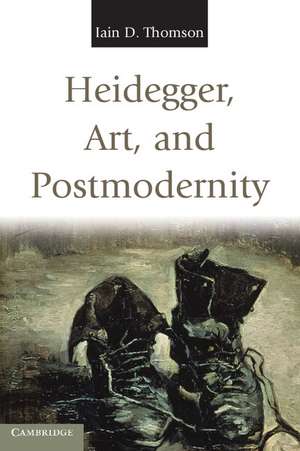
Heidegger, Art, and Postmodernity
Autor Iain D. Thomsonen Limba Engleză Paperback – 28 apr 2011
Nivel de studiu: masterat, doctorat și referință profesională. În această lucrare publicată de Cambridge University Press, Iain D. Thomson propune o reinterpretare radicală a filozofiei târzii a lui Martin Heidegger, concentrându-se pe capacitatea artei de a ghida umanitatea dincolo de nihilismul ontoteologic. Remarcăm efortul autorului de a clarifica concepte dificile din tratatul 'Contribuții la filozofie (Despre eveniment)', oferind o perspectivă accesibilă asupra a ceea ce înseamnă postmodernitatea pentru cel mai important critic al modernității.
Apreciem structura narativă a volumului, care progresează de la analiza istoriei ontoteologice către aplicații surprinzătoare în cultura populară. Heidegger, Art, and Postmodernity nu se limitează la hermeneutica tradițională; Iain D. Thomson deconstruiește fenomenul benzilor desenate și analizează estetica simulacrelor prin prisma trupei U2, demonstrând relevanța ontologiei heideggeriene în secolul XXI. Comparabil cu Nietzsche, Heidegger, and the Transition to Postmodernity de Gregory Bruce Smith în rigurozitate, volumul de față este actualizat pentru contextul culturii vizuale contemporane, trecând de la teoria pură la analiza practică a mediilor post-moderne.
Această lucrare continuă preocupările autorului din Heidegger on Ontotheology, extinzând critica tehnologiei către sfera estetică. Dacă în lucrări precum Heidegger on Technology's Danger and Promise in the Age of AI accentul cădea pe transformările provocate de inteligența artificială, aici accentul este pus pe arta ca „promisiune” salvatoare. Tonul este precis, academic, dar infuzat de o pasiune pedagogică ce facilitează înțelegerea legăturii dintre filozofia continentală și teoria artei.
Preț: 207.61 lei
Carte tipărită la comandă
Livrare economică 05-19 iunie
Specificații
ISBN-10: 0521172497
Pagini: 266
Ilustrații: 6 b/w illus.
Dimensiuni: 152 x 226 x 15 mm
Greutate: 0.36 kg
Editura: Cambridge University Press
Colecția Cambridge University Press
Locul publicării:New York, United States
V-ar putea interesa
-
 Critical Aesthetics and PostmodernismPaul Crowther-22%Preț: 326.46 lei418.33 lei
 -
 The Mind of God and the Works of ManEdward Craig-22%Preț: 363.43 lei465.18 lei
 -
 -21%Preț: 367.60 lei467.39 lei
 -
 -24%Preț: 404.48 lei531.20 lei
 -
 Knowledge and Reality: Selected EssaysColin McGinn-21%Preț: 322.67 lei410.84 lei
 -
 -14%Preț: 349.92 lei408.87 lei
 -
 -15%Preț: 455.18 lei535.51 lei
 -
 The Cambridge Companion to Merleau-PontyTaylor CarmanPreț: 280.81 lei
 -
 The Cambridge Companion to HeideggerCharles B. GuignonPreț: 267.62 lei
 -
 The Cambridge Companion to CarnapMichael FriedmanPreț: 283.95 lei
 -
 Consciousness and LanguageJohn R. SearlePreț: 295.56 lei
 -
 French Philosophy in the Twentieth CenturyGary GuttingPreț: 380.16 lei
 -
 The Cambridge Introduction to Michel FoucaultLisa DowningPreț: 178.87 lei
 -
 The Cambridge Companion to Leo StraussSteven B. SmithPreț: 277.14 lei
 -
 ParadoxesR. M. SainsburyPreț: 215.44 lei
 -
 Political Ideas In The Romantic AgeIsaiah Berlin-25%Preț: 135.80 lei182.18 lei
De ce să citești această carte
Recomandăm această carte cercetătorilor și studenților avansați care doresc să înțeleagă legătura dintre filozofia târzie a lui Heidegger și estetica contemporană. Cititorul câștigă o metodă riguroasă de analiză a operelor de artă moderne, de la pictură la cultura pop, învățând cum să identifice mecanismele prin care arta poate contesta dominația tehnologică și nihilismul. Este o resursă esențială pentru cursuri de estetică și filozofie continentală.
Despre autor
Iain D. Thomson este profesor de filozofie la Universitatea din New Mexico și un specialist recunoscut internațional în opera lui Martin Heidegger. Expertiza sa acoperă istoria filozofiei occidentale, cu un accent deosebit pe ontoteologie și impactul tehnologiei asupra educației și culturii. Pe lângă contribuțiile sale în The Cambridge History of Philosophy, 1945-2015, Thomson a explorat teme fundamentale precum moartea și existența în Rethinking Death in and after Heidegger. Lucrările sale sunt apreciate pentru claritatea cu care traduc concepte filozofice dense în analize relevante pentru societatea contemporană și era digitală.
Descriere scurtă
Cuprins
Recenzii
'Iain Thomson has a real knack for getting Heidegger to speak to contemporary concerns. Against the background of Thomson's pathbreaking interpretation of Heidegger's idea of 'ontotheology', the essays in this volume illuminate a sense of 'postmodernity' that responds to the nihilism of modernity's technological paradigm without falling into nostalgia for a single meaning of being. The resulting pluralism is adroitly explored through examples from high art and popular culture in ways that make Heidegger's difficult late works come alive.' Steven Crowell, Rice University
'I learned a lot from Iain Thomson's book. He has a masterful grasp of the diverse art forms he discusses and he writes about even the most obscure thinkers with verve and clarity. One can trust his critical evaluations, especially his appreciation of the ontological pluralism that stands at the center of Heidegger's hope for a postmodern understanding of being.' Hubert L. Dreyfus, University of California, Berkeley
'… excellent … Thomson's explanations of Heidegger's difficult later works are unfailingly clear, carefully laying out the arguments and explaining all technical terms. Furthermore, the book's organization guides the reader so smoothly through the steps of his discussion that it should make knee-jerk objections about Heideggerian obscurantism much harder to make … After reading his book, I now see some of Heidegger's ideas and writings in a new light … By inspiring and drawing out new ideas, Iain Thomson's book takes its rightful place along with Julian Young's excellent Heidegger's Philosophy of Art as an important piece of scholarship on this topic. In keeping with its own precepts, it does not definitively settle Heidegger's views on this topic once and for all but, like a work of art, opens up new questions and pathways for thought.' Lee Braver, Notre Dame Philosophical Reviews
'Iain Thomson's Heidegger, Art, and Postmodernity is an exceptional piece of Heidegger scholarship, providing detailed, informative analysis while remaining highly readable … [It] is filled with compelling insights not only about Heidegger, but also about the nature of art, modernity, and humanity's hopes for the future. Thomson has remarked that when one speaks of ontotheology or postmodernity philosophers tend to look for the door. This excellent book will surely change that.' Irene McMullin, Journal of the History of Philosophy
'… [Thomson] is a teacher, deeply concerned to impart, passionate about the subject, infectiously fascinating … This book is a circumspect, analytical, often profoundly critical, examination of the key role that art plays in Heidegger's philosophy. [It] convincingly demonstrates, in the most critically efficient terms, that it is not possible for the theoretical discourse of contemporary aesthetics to assimilate Heidegger without disturbing that discourse to its core. Thomson's alternative Heideggerian proposal is that art (more accurately, the 'ontological epiphany' that art elicits) provides one particularly powerful vehicle of awakening for this alternative mode of thinking; for art has the capacity to stimulate the kind of meditative thinking capable of transcending the dominant metaphysical infrastructure of late-modern cognition.' Kieran Cashell, Journal of Critical Realism