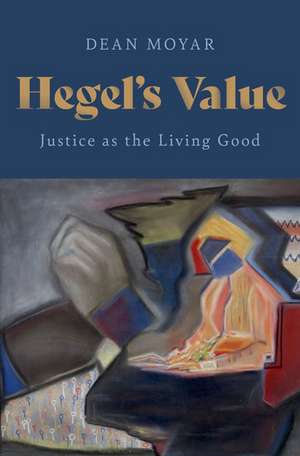
Hegel's Value: OXFORD UNIV PR
Autor Dean Moyaren Limba Engleză Hardback – 31 mar 2021
Din seria OXFORD UNIV PR
- 11%
 Preț: 556.22 lei
 -
 Preț: 229.40 lei
 - 18%
 Preț: 348.80 lei
 - 20%
 Preț: 298.58 lei
 - 28%
 Preț: 378.98 lei
 - 30%
 Preț: 949.79 lei
 - 31%
 Preț: 602.19 lei
 - 23%
 Preț: 368.20 lei
 - 19%
 Preț: 388.40 lei
 - 31%
 Preț: 635.38 lei
 - 15%
 Preț: 406.18 lei
 - 20%
 Preț: 242.75 lei
 - 11%
 Preț: 266.59 lei
 - 20%
 Preț: 258.54 lei
 - 23%
 Preț: 186.08 lei
 - 31%
 Preț: 726.87 lei
 - 9%
 Preț: 353.39 lei
 -
 Preț: 361.18 lei
 - 28%
 Preț: 368.78 lei
 - 35%
 Preț: 538.59 lei
 - 33%
 Preț: 854.69 lei
 - 18%
 Preț: 314.30 lei
 - 28%
 Preț: 435.85 lei
 - 23%
 Preț: 601.95 lei
 - 28%
 Preț: 347.35 lei
 - 28%
 Preț: 380.69 lei
 - 31%
 Preț: 892.23 lei
 - 20%
 Preț: 274.68 lei
 - 13%
 Preț: 296.03 lei
 - 31%
 Preț: 980.33 lei
 - 14%
 Preț: 834.01 lei
 - 29%
 Preț: 416.49 lei
 - 18%
 Preț: 129.08 lei
 - 29%
 Preț: 440.34 lei
 - 6%
 Preț: 298.13 lei
 - 22%
 Preț: 356.05 lei
 - 14%
 Preț: 727.14 lei
 - 18%
 Preț: 357.55 lei
 - 32%
 Preț: 532.88 lei
 -
 Preț: 384.91 lei
 - 31%
 Preț: 693.75 lei
 - 31%
 Preț: 677.42 lei
 - 20%
 Preț: 258.17 lei
 - 31%
 Preț: 709.10 lei
 - 19%
 Preț: 369.21 lei
 - 23%
 Preț: 221.33 lei
 - 29%
 Preț: 439.67 lei
 - 24%
 Preț: 141.95 lei
 - 21%
 Preț: 340.85 lei
 - 20%
 Preț: 274.64 lei
Preț: 657.69 lei
Preț vechi: 764.75 lei
-14%
Puncte Express: 987
Carte disponibilă
Livrare economică 13-18 noiembrie
Livrare prin curier în România Termenul estimat este afișat lângă disponibilitate.
Transport gratuit pentru acest produs Plată online sau ramburs, în funcție de opțiunile comenzii.
Retur gratuit în 14 zile Comandă securizată și suport în română.
Specificații
ISBN-13: 9780197532539
ISBN-10: 0197532535
Pagini: 384
Dimensiuni: 157 x 234 x 33 mm
Greutate: 0.64 kg
Editura: Oxford University Press
Colecția OUP USA
Seria OXFORD UNIV PR
Locul publicării:New York, United States
ISBN-10: 0197532535
Pagini: 384
Dimensiuni: 157 x 234 x 33 mm
Greutate: 0.64 kg
Editura: Oxford University Press
Colecția OUP USA
Seria OXFORD UNIV PR
Locul publicării:New York, United States
Recenzii
Moyar has succeeded in identifying a teleological theory of value that runs through Hegel's discussions of rights, contract, law, the family, and the state, one that avoids the pitfalls of both ideal theory and stark realism ... Moyar's book is lucidly written, engages a broad range of contemporary thinkers, and offers an insightful and original perspective on Hegel's political theory.
It is an incredibly well-researched, historically informed, and original contribution to the study of Hegel's practical philosophy and to political philosophy in general.
This is excellent and original work that both makes new and more specific use of a current strand of Hegel interpretation
This highly anticipated study offers an original perspective on Hegel's Philosophy of Right as a whole and answers many questions readers such as myself have had, i.e. how to situate Hegel's distinctive method inside the ideal-nonideal debate. It makes a compelling case for taking the concept of value as a unifying thread for systematically reconstructing Hegel's theory of justice. An exceptionally clear and deep piece of scholarship, it is sure to set the terms for future approaches to Hegel's political philosophy." -Andreja Novakovic, University of California at Berkeley
Dean Moyar intends to offer a full reconstruction of all of Hegel's Philosophy of Right. Most of his book is concerned with the 1820 published version, but he also takes into account the transcripts of the lectures Hegel gave afterwards on it until 1831. His book is thorough, learned, and clearly written. I myself was completely taken up in reading it. With so many new insights, it is a major statement in Hegel scholarship and in political theory more generally.
Moyar's Hegel's Value is essential reading for those interested in Hegel's Philosophy of Right and will be a cornerstone for generations of future scholars.
It is an incredibly well-researched, historically informed, and original contribution to the study of Hegel's practical philosophy and to political philosophy in general.
This is excellent and original work that both makes new and more specific use of a current strand of Hegel interpretation
This highly anticipated study offers an original perspective on Hegel's Philosophy of Right as a whole and answers many questions readers such as myself have had, i.e. how to situate Hegel's distinctive method inside the ideal-nonideal debate. It makes a compelling case for taking the concept of value as a unifying thread for systematically reconstructing Hegel's theory of justice. An exceptionally clear and deep piece of scholarship, it is sure to set the terms for future approaches to Hegel's political philosophy." -Andreja Novakovic, University of California at Berkeley
Dean Moyar intends to offer a full reconstruction of all of Hegel's Philosophy of Right. Most of his book is concerned with the 1820 published version, but he also takes into account the transcripts of the lectures Hegel gave afterwards on it until 1831. His book is thorough, learned, and clearly written. I myself was completely taken up in reading it. With so many new insights, it is a major statement in Hegel scholarship and in political theory more generally.
Moyar's Hegel's Value is essential reading for those interested in Hegel's Philosophy of Right and will be a cornerstone for generations of future scholars.
Notă biografică
Dean Moyar is Associate Professor in the Department of Philosophy at Johns Hopkins University. He is the co-editor (with Michael Quante) of Hegel's Phenomenology of Spirit: A Critical Guide (Cambridge University Press, 2007), the editor of the Routledge Companion to Nineteenth Century Philosophy (2010) and of the Oxford Handbook of Hegel (2017). He is the author of Hegel's Conscience (Oxford University Press, 2011).
Cuprins
- Introduction
- 1. Political Moralism and Critical Realism
- 2. An Overlooked Theory of Value
- 3. Hegel's Teleological Inferentialism
- 4. Justice and the Living Institutional System
- 5. The Basic Argument
- Chapter 1: Individual Right and the Living Ethical Order
- 1.1. Mutual Recognition and the Externalism of Modern Right
- 1.2. The Critique of Fichte and the Appeal to Life
- 1.3. Self-Consciousness and the Rationality of Life
- 1.4. The Emergence of Value in the Work of the Servant
- 1.5. The Tragedy of Immediate Justice
- Chapter 2: The Inferences of Right
- 2.1. Free Spirit and Infinite Value
- 2.2. Expressively Valid Inferences of the Free Will
- 2.3. Immanent Development and the Basic Argument of Right
- Chapter 3: Value in the Development and Conclusion of Abstract Right
- 3.1. The Purpose of Personality
- 3.2. Property Rights as Expressions of the Free Will
- 3.3. Value as the "true substantiality" of Property
- 3.4. Forms of Value as Types of Alienation
- 3.5. Contract and Inferential Equivalence Value
- 3.6. The Inferentialism of Crime and Punishment
- 3.7. Value in the Transition to Morality
- Chapter 4: The Incorporation of Subjective Value into the Good
- 4.1. The Process and Purpose of Morality
- 4.2. The Deficient Practical Inference of the Deed
- 4.3. Objective and Subjective Value in Intentional Action
- 4.4. The Right of Necessity and the Transition to Universal Value
- 4.5. The Good as the Final Purpose of the World
- 4.6. Conscience and Reflective Equilibrium
- Chapter 5: The Living Good
- 5.1. Sittlichkeit as the Just System of Value
- 5.2. The System of Practical Inferences
- 5.3. Ethical Mutuality and the Equivalence of Rights and Duties
- 5.4. How to Build a Living Institution
- 5.5. The Family as the Living Good
- Chapter 6: The Circulation of Value in Civil Society and the State
- 6.1. Completing the Inference of Needs through Education
- 6.2. The Value of Work and the Division into Estates
- 6.3. The Return of the Good in "The Police and the Corporation"
- 6.4. Settling One's Own Account with the State
- 6.5. The Living State as a Totality of Inferences
- 6.6. The Executive Branch and Governance "From Below"
- Chapter 7: Law and Public Reason
- 7.1. Inferentialism and Processes of Law
- 7.2. Hegel's Legal Positivism
- 7.3. The Contextualism of Justice and the Limits of Philosophy
- 7.4. The Court as the Prototype of Public Reason
- 7.5. Hegel's Constitutionalism
- 7.6. Public Reason and Representative Interests
- Chapter 8: The Sovereignty of the Good
- 8.1. Internal Sovereignty and the Justice of the Whole
- 8.2. External Sovereignty and Mutual Recognition between States
- 8.3. Purpose and Justice in History
- 8.4. Moral and Civil Religion
- 8.5. Liberation and Reconciliation