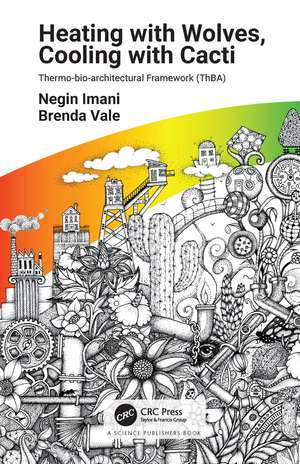
Heating with Wolves, Cooling with Cacti: Thermo-bio-architectural Framework (ThBA)
Autor Negin Imani, Brenda Valeen Limba Engleză Paperback – 29 ian 2024
Preț: 478.17 lei
Puncte Express: 717
Carte tipărită la comandă
Livrare economică 20 noiembrie-04 decembrie
Livrare prin curier în România Termenul estimat este afișat lângă disponibilitate.
Transport gratuit pentru acest produs Plată online sau ramburs, în funcție de opțiunile comenzii.
Retur gratuit în 14 zile Comandă securizată și suport în română.
Specificații
ISBN-13: 9780367534400
ISBN-10: 0367534401
Pagini: 258
Ilustrații: 104
Dimensiuni: 156 x 234 x 15 mm
Greutate: 0.78 kg
Ediția:1
Editura: CRC Press
Colecția CRC Press
ISBN-10: 0367534401
Pagini: 258
Ilustrații: 104
Dimensiuni: 156 x 234 x 15 mm
Greutate: 0.78 kg
Ediția:1
Editura: CRC Press
Colecția CRC Press
Notă biografică
Negin Imani is a lecturer in Architectural and Building Science at Otago Polytechnic, New Zealand, with a PhD (2020) in Architecture from Victoria University of Wellington. Since 2013, she has been engaged in teaching and supervising research conducted by graduate and postgraduate students. Her research is focused on sustainable architecture and biomimetic energy efficient building design. For the last six years she has been working as a researcher in the Centre for Building Performance Research at Victoria University of Wellington in New Zealand from where she obtained her PhD.
Brenda Vale is a professorial research fellow in the School of Architecture at Victoria University of Wellington. She has extended her life-time interest in low energy and autonomous buildings to also embrace the environmental impact of those that live in them. This interest has led to a number of recent books focused on reducing the impact of buildings and the built environment, some of which, like this current one, have been written with former students.
Brenda Vale is a professorial research fellow in the School of Architecture at Victoria University of Wellington. She has extended her life-time interest in low energy and autonomous buildings to also embrace the environmental impact of those that live in them. This interest has led to a number of recent books focused on reducing the impact of buildings and the built environment, some of which, like this current one, have been written with former students.
Cuprins
1. Building Energy Use and Climate Change 2. Thermal Issues and Building Design 3. Biomimicry and Its Approaches to Energy-Efficient Building Design 4. Linking Biology and Buildings 5. Developing a Structure for the ThBA 6. Thermoregulation in Nature 7. Parallels in Building Design 8. Testing the ThBA 9. Developing a Framework for Bio-Inspired Energy-Efficient Building Design
Descriere
This book describes the detailed process behind the development of a comprehensive thermo-bio-architectural framework (the ThBA). This framework systematically connects the thermal performance requirements of a building to relevant solutions found in the natural world.