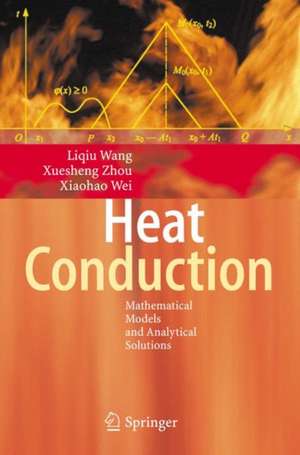
Heat Conduction
Autor Liqiu Wang, Xuesheng Zhou, Xiaohao Weien Limba Engleză Hardback – 2 ian 2008
Therefore, the present monograph can serve as a reference for researchers working on heat conduction of macro- and micro-scales as well as on mathematical methods of physics. It can also serve as a text for graduate courses on heat conduction or on mathematical equations in physics.
Preț: 997.36 lei
Preț vechi: 1216.29 lei
-18%
Puncte Express: 1496
Carte tipărită la comandă
Livrare economică 30 noiembrie-14 decembrie
Livrare prin curier în România Termenul estimat este afișat lângă disponibilitate.
Transport gratuit pentru acest produs Plată online sau ramburs, în funcție de opțiunile comenzii.
Retur gratuit în 14 zile Comandă securizată și suport în română.
Specificații
ISBN-13: 9783540740285
ISBN-10: 3540740287
Pagini: 532
Ilustrații: XIV, 515 p. 40 illus.
Dimensiuni: 160 x 241 x 33 mm
Greutate: 0.91 kg
Ediția:2008
Editura: Springer
Locul publicării:Berlin, Heidelberg, Germany
ISBN-10: 3540740287
Pagini: 532
Ilustrații: XIV, 515 p. 40 illus.
Dimensiuni: 160 x 241 x 33 mm
Greutate: 0.91 kg
Ediția:2008
Editura: Springer
Locul publicării:Berlin, Heidelberg, Germany
V-ar putea interesa
-
 Latent Heat Transfer: An Introduction to FundamentalsG. S. H. Lock-21%Preț: 339.13 lei427.68 lei
-
 Sustainable Energy Systems and ApplicationsIbrahim Dincer-15%Preț: 757.55 lei891.24 lei
-
 Biological ThermodynamicsDonald T. Haynie-19%Preț: 557.28 lei687.99 lei
-
 -19%Preț: 448.27 lei553.42 lei
-
 -23%Preț: 476.43 lei618.75 lei
-
 Introduction to Thermodynamics of Mechanical FatigueMichael M. Khonsari-18%Preț: 1604.53 lei1956.74 lei
-
 Heat TransferPeter BöckhPreț: 472.08 lei
-
 Transient Heat TransferDonatello AnnaratonePreț: 361.95 lei
-
 Preț: 280.24 lei
Public țintă
ResearchCuprins
Wave Equations.- Heat-Conduction Equations.- Mixed Problems of Hyperbolic Heat-Conduction Equations.- Cauchy Problems of Hyperbolic Heat-Conduction Equations.- Dual-Phase-Lagging Heat-Conduction Equations.- Potential Equations.
Recenzii
From the reviews:
“The book under review may stimulate interest among the researchers to explore the true nature of the heat. … A good number of references at the end of the book may help the readers to further explore the subject. … The book contains many solutions of the problems of technological importance in heat conduction of macro and micro scales and will be useful for researchers in mechanical engineering, chemical engineering, material sciences and applied mathematics.” (K. N. Shukla, Zentralblatt MATH, Vol. 1237, 2012)
“The book under review may stimulate interest among the researchers to explore the true nature of the heat. … A good number of references at the end of the book may help the readers to further explore the subject. … The book contains many solutions of the problems of technological importance in heat conduction of macro and micro scales and will be useful for researchers in mechanical engineering, chemical engineering, material sciences and applied mathematics.” (K. N. Shukla, Zentralblatt MATH, Vol. 1237, 2012)
Textul de pe ultima copertă
Many phenomena in social, natural and engineering fields are governed by wave, potential, parabolic heat-conduction, hyperbolic heat-conduction and dual-phase-lagging heat-conduction equations. These equations are not only appropriate for describing heat conduction at various scales, but also the most important mathematical equations in physics. The focus of the present monograph is on these equations: their solution structures, methods of finding their solutions under various supplementary conditions, as well as the physical implication and applications of their solutions.
Therefore, the present monograph can serve as a reference for researchers working on heat conduction of macro- and micro-scales as well as on mathematical methods of physics. It can also serve as a text for graduate courses on heat conduction or on mathematical equations in physics.
Therefore, the present monograph can serve as a reference for researchers working on heat conduction of macro- and micro-scales as well as on mathematical methods of physics. It can also serve as a text for graduate courses on heat conduction or on mathematical equations in physics.
Caracteristici
Serves as a reference for researchers working on heat conduction of macro- and micro-scales Presents the use of recently introduced phase-lagging constitutive relationships Concise presentation in an easy-to-understand language
Notă biografică
Dr. Pingan Zhu received his Ph.D. in Mechanical Engineering from the University of Hong Kong (HKU) in 2017 and a Bachelor's degree from the University of Science and Technology of China in 2013. He is currently an assistant professor in the Department of Mechanical Engineering at the City University of Hong Kong. His research interests include microfluidics, fluid dynamics, surface wettability, micro/nanorobots, and biomimetics. Dr. Zhu has developed a versatile microfluidic platform for engineering fluid templates into solid materials with tailored properties and interdisciplinary applications, which has been widely featured by local, national, and international media. He has published more than 30 papers in prestigious journals including Science, Nature Communications, Advanced Materials, and Chemical Reviews. His work has been recognized by a number of awards, such as the 2018 TechConnect Global Innovation Award, the honorable mention of the 2017Hong Kong Young Scientist Award, and the 2016-2017 HKU Mechanical Engineering Outstanding Thesis Award.
Prof. Liqiu Wang received his Ph.D. from the University of Alberta, Canada, and is currently a chair professor in the Department of Mechanical Engineering and the Biomedical Engineering Programme at the University of Hong Kong (HKU). He also serves as the Director and the Chief Scientist for the Laboratory for Nanofluids and Thermal Engineering at the Zhejiang Institute of Research and Innovation (HKU-ZIRI), the University of Hong Kong. Prof. Wang has 25 years of HKU experience in transport phenomena, materials, nanotechnology, biotechnology, energy and environment, thermal and power engineering, and mathematics, and ~2 years of industry experience in technology and IP development, management, and transfer as a Chief Scientist and Global CTO. In addition to 11 scholarly monographs/books, five book chapters, 78 keynote lectures at international conferences, and over 170 invited lectures in universities/industries/organizations, Prof. Wang has published over 250 papers in various prestigious journals including Chemical Reviews, Science, Nature Nanotechnology, Materials Today, Advanced Materials, Physics Reports, Nature Communications, Science Advances, PNAS, and Physical Review Letters, many of which have been widely used by researchers all over the world. Prof. Wang has also filed 38 patents and software copyrights, and developed, with an international team consisting of about 100 scientists and engineers, a state-of-the-art thermal control system for the Alpha Magnetic Spectrometer (AMS) on the International Space Station that ensures AMS and all its sub-detectors working at their designed temperatures ± 1 ¿ for an environment temperature variation from -40 ¿ to 60 ¿ every 90 minutes. His work has been widely featured by local, national, and international media, journals, and magazines, and received recognition through a number of awards, including the 2021 Gold Medal of International Exhibition of Inventions of Geneva, the 2018 TechConnect Global Innovation Award, the 2018 Silver Medal of International Exhibition of Inventions of Geneva, the 2017 OSA Innovation Award, and the 2016 First Outstanding Achievement Award of Hangzhou Oversea Scholars, among others.