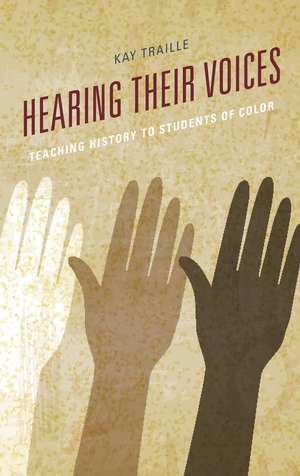
Hearing their Voices: Teaching History to Students of Color
Autor Kay Trailleen Limba Engleză Paperback – 25 dec 2019
Preț: 174.53 lei
Preț vechi: 233.57 lei
-25%
Puncte Express: 262
Carte tipărită la comandă
Livrare economică 07-21 decembrie
Livrare prin curier în România Termenul estimat este afișat lângă disponibilitate.
Transport gratuit de la 400.00 lei Plată online sau ramburs, în funcție de opțiunile comenzii.
Retur gratuit în 14 zile Comandă securizată și suport în română.
Specificații
ISBN-13: 9781475855562
ISBN-10: 1475855567
Pagini: 160
Ilustrații: 1 b/w illustration; 2 tables
Dimensiuni: 148 x 228 x 12 mm
Greutate: 0.48 kg
Editura: Bloomsbury Publishing
Colecția Rowman & Littlefield
Locul publicării:New York, United States
ISBN-10: 1475855567
Pagini: 160
Ilustrații: 1 b/w illustration; 2 tables
Dimensiuni: 148 x 228 x 12 mm
Greutate: 0.48 kg
Editura: Bloomsbury Publishing
Colecția Rowman & Littlefield
Locul publicării:New York, United States
Cuprins
Preface
Chapter 1: The history of history education for students of color since 1800
Chapter 2: How students learn history and why it matters
Chapter 3: Cognitive and Affective Factors and possible impact on the learning of Multicultural Students
Chapter 4: Students of color talk about the role and purpose of history in their lives
Chapter 5: Students decoded
Chapter 6: Counterstories of American History: Students of color examine the past
Chapter 7: An approach for teaching World history
Chapter 8: Cultivating curiosity, complexity and authentic engagement in history classrooms for students of color
Appendices
References
Chapter 1: The history of history education for students of color since 1800
Chapter 2: How students learn history and why it matters
Chapter 3: Cognitive and Affective Factors and possible impact on the learning of Multicultural Students
Chapter 4: Students of color talk about the role and purpose of history in their lives
Chapter 5: Students decoded
Chapter 6: Counterstories of American History: Students of color examine the past
Chapter 7: An approach for teaching World history
Chapter 8: Cultivating curiosity, complexity and authentic engagement in history classrooms for students of color
Appendices
References
Recenzii
Traille, an experienced educator and educational leader, presents the fruits of her research on how students of color respond to traditional patterns of curriculum, instruction, and evaluation in history and social studies education. Chapter 1 offers a limited overview of the history of history and social studies education, chapter 2 examines recent research on how students learn history, and chapter 3 discusses the cognitive and affective factors influencing history teaching and learning. Chapters 4 through 7 present Traille's research on students in secondary and higher education settings in the UK and the US, which highlights the deficits that students of color experience when confronted with traditional historical narratives that marginalize the histories of oppressed groups. In chapter 8, the author provides detailed suggestions and strategies to improve student engagement, emphasizing culturally responsive pedagogy and a broad-based, inclusive study of history. Chapter 8 also includes an excellent summary of why history should be taught and the implications of effective history instruction for students of color. Strongly recommended for teacher educators and practicing classroom teachers of history and social studies. Summing Up: Highly recommended. Lower-division undergraduates through graduate students; professionals.
Kay Traille's Hearing Their Voices: Teaching History to Students of Color is a must-read for educators at all levels of schooling, especially those teaching history. What Traille offers educators is invaluable-interview excerpts from a widely diverse group of students from the United States and Great Britain interwoven with accessible theory and robust analysis. Traille allows students in their own voices to let educators know where they are going wrong in the teaching of history and what they need to do to "cultivate curiosity, complexity, and authentic engagement." Asking provocative guiding questions throughout the text, Traille challenges educators to re-think their taken-for-granted assumptions about students of color and what their assumptions might mean in the teaching of history. While Traille resists simplistic step-by-step formulas for teaching history, she does offer in great detail what a culturally responsive history classroom looks like for students of color, and she reminds us that this kind of classroom is effective for all students. This text will help educators transform how they teach history and help them make their classrooms a welcoming space for all students.
Traille walks readers through the policies, practices, theories, and ideologies that have impacted students of color as they learn about events in history. Through narratives and counterstories, she provides voice to students who are often marginalized and silenced in current texts. Their lived experiences will challenge and provoke educators to create more inclusive spaces of learning.
Kay Traille's Hearing Their Voices: Teaching History to Students of Color is a must-read for educators at all levels of schooling, especially those teaching history. What Traille offers educators is invaluable-interview excerpts from a widely diverse group of students from the United States and Great Britain interwoven with accessible theory and robust analysis. Traille allows students in their own voices to let educators know where they are going wrong in the teaching of history and what they need to do to "cultivate curiosity, complexity, and authentic engagement." Asking provocative guiding questions throughout the text, Traille challenges educators to re-think their taken-for-granted assumptions about students of color and what their assumptions might mean in the teaching of history. While Traille resists simplistic step-by-step formulas for teaching history, she does offer in great detail what a culturally responsive history classroom looks like for students of color, and she reminds us that this kind of classroom is effective for all students. This text will help educators transform how they teach history and help them make their classrooms a welcoming space for all students.
Traille walks readers through the policies, practices, theories, and ideologies that have impacted students of color as they learn about events in history. Through narratives and counterstories, she provides voice to students who are often marginalized and silenced in current texts. Their lived experiences will challenge and provoke educators to create more inclusive spaces of learning.