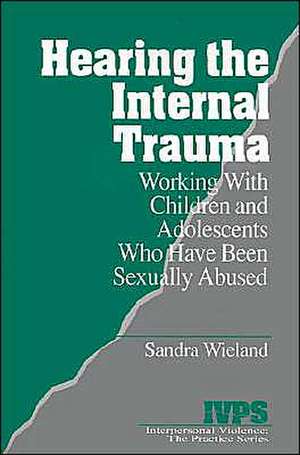
Hearing the Internal Trauma
Autor Sandra Wieland Editat de Jon R. Conteen Limba Engleză Paperback – oct 1997
Preț: 706.08 lei
Preț vechi: 743.24 lei
-5%
Puncte Express: 1059
Carte tipărită la comandă
Livrare economică 04-18 decembrie
Livrare prin curier în România Termenul estimat este afișat lângă disponibilitate.
Transport gratuit pentru acest produs Plată online sau ramburs, în funcție de opțiunile comenzii.
Retur gratuit în 14 zile Comandă securizată și suport în română.
Specificații
ISBN-13: 9780761903666
ISBN-10: 0761903666
Pagini: 252
Dimensiuni: 152 x 229 x 15 mm
Greutate: 0.41 kg
Ediția:1
Editura: SAGE Publications
Locul publicării:Thousand Oaks, United States
ISBN-10: 0761903666
Pagini: 252
Dimensiuni: 152 x 229 x 15 mm
Greutate: 0.41 kg
Ediția:1
Editura: SAGE Publications
Locul publicării:Thousand Oaks, United States
V-ar putea interesa
-
 CutCathy GlassPreț: 63.25 lei
 -
 Never TellCatherine McCallPreț: 115.18 lei
 -
 Mixed BlessingsDiane Lazarus-19%Preț: 63.27 lei78.49 lei
 -
 MonsterAllan HallPreț: 78.10 lei
 -
 Touched by EvilMichele Knight-26%Preț: 75.08 lei101.15 lei
 -
 -27%Preț: 67.87 lei92.81 lei
 -
 Living With EvilCynthia Owen-26%Preț: 69.08 lei93.54 lei
 -
 -25%Preț: 205.01 lei273.74 lei
 -
 -47%Preț: 63.40 lei119.01 lei
 -
 -24%Preț: 225.11 lei296.74 lei
 -
 -24%Preț: 263.53 lei346.99 lei
Cuprins
The Need for a Framework
The Internalization Model
Understanding and Expanding the Play
Children
Recognizing and Addressing the Behavior
Adolescents
Identifying and Changing Messages
Families
Hearing Oneself
The Therapist's Experience
The Internalization Model
Understanding and Expanding the Play
Children
Recognizing and Addressing the Behavior
Adolescents
Identifying and Changing Messages
Families
Hearing Oneself
The Therapist's Experience
Descriere
An innovative clinical approach to working with children and adolescents who have been sexually abused - the Internalization Model - is presented in this volume. It is designed to increase the therapist's recognition and understanding of the effects of such abuse on a young victim's internal sense of self and world. The author argues that abuse-related internalizations, not the symptomatic behaviours resulting from these internalizations, need to be addressed in therapy.