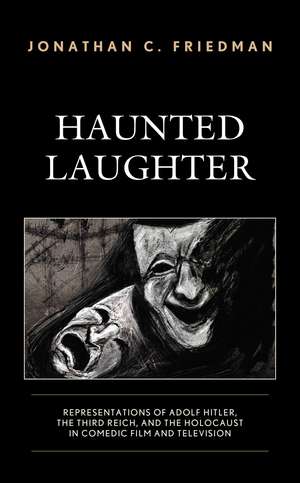
Haunted Laughter: Representations of Adolf Hitler, the Third Reich, and the Holocaust in Comedic Film and Television: Lexington Books
Autor Jonathan C. Friedmanen Limba Engleză Hardback – 17 mar 2022
Haunted Laughter addresses whether it is appropriate to use comedy as a literary form to depict Adolf Hitler, The Third Reich, and the Holocaust. Guided by existing theories of comedy and memory and through a comprehensive examination of comedic film and television productions, from the United States, Israel, and Europe, Jonathan Friedman proposes a model and a set of criteria to evaluate the effectiveness of comedy as a means of representation. These criteria include depth of purpose, relevance to the times, and originality of form and content. Friedman concludes that comedies can be effective if they provide relevant information about life and death in the past, present, or future; break new ground; and serve a purpose or multiple purposes-capturing the dynamic of the Nazi system of oppression, empowering or healing victims, serving as a warning for the future, or keeping those who can never grasp the real horror of genocide from losing perspective.
Din seria Lexington Books
- 32%
 Preț: 729.63 lei
 - 59%
 Preț: 427.24 lei
 - 35%
 Preț: 574.44 lei
 - 22%
 Preț: 341.76 lei
 - 31%
 Preț: 437.25 lei
 - 28%
 Preț: 352.50 lei
 - 23%
 Preț: 321.53 lei
 - 23%
 Preț: 333.36 lei
 - 23%
 Preț: 327.54 lei
 - 35%
 Preț: 593.04 lei
 - 33%
 Preț: 358.06 lei
 - 26%
 Preț: 363.28 lei
 - 24%
 Preț: 374.46 lei
 - 22%
 Preț: 330.56 lei
 - 28%
 Preț: 346.74 lei
 - 24%
 Preț: 308.07 lei
 - 23%
 Preț: 321.63 lei
 - 27%
 Preț: 263.04 lei
 - 24%
 Preț: 369.89 lei
 - 25%
 Preț: 884.44 lei
 - 36%
 Preț: 730.77 lei
 - 29%
 Preț: 345.71 lei
 - 33%
 Preț: 556.03 lei
 - 33%
 Preț: 428.79 lei
 - 34%
 Preț: 616.07 lei
 - 29%
 Preț: 342.12 lei
 - 26%
 Preț: 362.85 lei
 - 22%
 Preț: 338.89 lei
 - 28%
 Preț: 356.18 lei
 - 23%
 Preț: 321.63 lei
 - 28%
 Preț: 346.74 lei
 - 22%
 Preț: 340.40 lei
 - 29%
 Preț: 345.71 lei
 - 22%
 Preț: 329.89 lei
 - 37%
 Preț: 660.07 lei
 - 27%
 Preț: 355.41 lei
 - 32%
 Preț: 727.58 lei
 - 24%
 Preț: 313.51 lei
 - 28%
 Preț: 614.62 lei
 - 24%
 Preț: 309.62 lei
 - 34%
 Preț: 630.22 lei
 - 34%
 Preț: 575.26 lei
 - 34%
 Preț: 607.70 lei
 - 33%
 Preț: 639.19 lei
 - 33%
 Preț: 642.37 lei
 - 33%
 Preț: 640.95 lei
 - 25%
 Preț: 369.74 lei
Preț: 576.93 lei
Preț vechi: 864.73 lei
-33%
Puncte Express: 865
Carte tipărită la comandă
Livrare economică 08-22 decembrie
Livrare prin curier în România Termenul estimat este afișat lângă disponibilitate.
Transport gratuit pentru acest produs Plată online sau ramburs, în funcție de opțiunile comenzii.
Retur gratuit în 14 zile Comandă securizată și suport în română.
Specificații
ISBN-13: 9781793640154
ISBN-10: 1793640157
Pagini: 240
Dimensiuni: 150 x 232 x 20 mm
Greutate: 0.52 kg
Editura: Bloomsbury Publishing
Colecția Lexington Books
Seria Lexington Books
Locul publicării:New York, United States
ISBN-10: 1793640157
Pagini: 240
Dimensiuni: 150 x 232 x 20 mm
Greutate: 0.52 kg
Editura: Bloomsbury Publishing
Colecția Lexington Books
Seria Lexington Books
Locul publicării:New York, United States
Cuprins
Introduction
Chapter One: Famous Comedies from The Great Dictator to JoJo Rabbit
Chapter Two: Comedy Films and TV Shows about Hitler
Chapter Three: Contesting the Nazis and Their System of Terror Through Humor
Chapter Four: Memory, Trauma, and Comedy
Chapter Five: Humor as Social Criticism
Conclusion: Comedy, The Solemn, and The Serious
Chapter One: Famous Comedies from The Great Dictator to JoJo Rabbit
Chapter Two: Comedy Films and TV Shows about Hitler
Chapter Three: Contesting the Nazis and Their System of Terror Through Humor
Chapter Four: Memory, Trauma, and Comedy
Chapter Five: Humor as Social Criticism
Conclusion: Comedy, The Solemn, and The Serious
Recenzii
In his laudable study of the Shoah/Holocaust event and memory, Friedman proposes a setting marked by the collaboration of historical data and filmography. Abounding with contextual readings and resources, this sociohistorical treatment of over a hundred Shoah centered comedic film and TV productions investigates the constituent characteristics of why and how learning and teaching the Shoah tragedy through a comedic framework can be inspirational and not trivial nor irreverent. Friedman's chapters reflect on different aspects of comedy and humor and attempt to show how the personification of laughter is an experiential device to confront, content, and make right not light the trivialization of catastrophic victimhood. The Introduction charts the book's divisions and sections and explains their rationale for selection and interpretation. In the chapters that follow, concise, detailed explanations accompany the narrative on the selected films and videos. They reflect Friedman's instructional expertise: reading, observing, writing, and reasoning. It is pointedly expressed in the title: Haunted Laughter, no post-mortem victory for Hitlerism. The result is an erudite guide to a counter-culture genre that complements epochal approaches in the study of the Shoah. A tour de force contribution to Holocaust education.
With piercing clarity, Friedman raises crucial questions regarding the portrayal of Adolf Hitler, the Third Reich, and the Holocaust in contemporary media comedy. He explores the nature and functions of the comic in the catastrophic context of real historical horrors, uncovering how comedies unleash a testimony to survival, fresh therapeutic perspectives for traumatic memory, and warnings against tyranny and cruelty. Friedman applies diachronic and synchronic analyses, investigating how productions change over time and what tropes and themes endure. In five chapters, he probes how familiar comedies can comfort, subvert, or empower. He explores the comic portrayal of Hitler and dissects comic representations of the Third Reich. His last two chapters concern the constructions of collective memory through Holocaust films with impressive studies of satiric social commentaries, such as South Park and Curb Your Enthusiasm. He astutely demonstrates how comedies reveal information about life and death, expose villainous systems of oppression, and wave red flags by attending to their depth of purpose, contemporary relevance, and originality of form and content. This is a riveting, profound, and provocative book. This book is essential reading for lower-division undergraduates through faculty and professionals, general readers.
With piercing clarity, Friedman raises crucial questions regarding the portrayal of Adolf Hitler, the Third Reich, and the Holocaust in contemporary media comedy. He explores the nature and functions of the comic in the catastrophic context of real historical horrors, uncovering how comedies unleash a testimony to survival, fresh therapeutic perspectives for traumatic memory, and warnings against tyranny and cruelty. Friedman applies diachronic and synchronic analyses, investigating how productions change over time and what tropes and themes endure. In five chapters, he probes how familiar comedies can comfort, subvert, or empower. He explores the comic portrayal of Hitler and dissects comic representations of the Third Reich. His last two chapters concern the constructions of collective memory through Holocaust films with impressive studies of satiric social commentaries, such as South Park and Curb Your Enthusiasm. He astutely demonstrates how comedies reveal information about life and death, expose villainous systems of oppression, and wave red flags by attending to their depth of purpose, contemporary relevance, and originality of form and content. This is a riveting, profound, and provocative book. This book is essential reading for lower-division undergraduates through faculty and professionals, general readers.