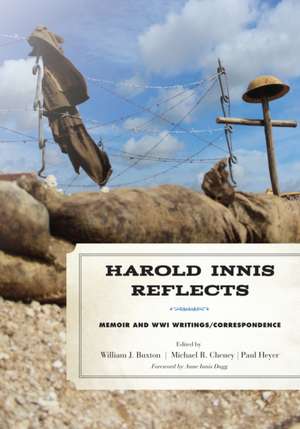
Harold Innis Reflects: Memoir and WWI Writings/Correspondence: Critical Media Studies: Institutions, Politics, and Culture
Editat de William J. Buxton, Michael R. Cheney, Paul Heyer Cuvânt înainte de Anne Innis Daggen Limba Engleză Hardback – 5 oct 2016
Part I, Innis's autobiographical memoir, chronicles his farm-based family background, early education, military service during World War I, and the beginnings of what would become a distinguished academic career. Part II features a selection of correspondence during his military service, revealing both the pain and perceptions derived from that experience, and other war-related writings. It also includes "The Returned Soldier," a detailed piece of research and a compassionate plea to recognize how the aftermath of the Great War would affect those who served as well as the individuals and institutions on the home front. Years before the term "post-traumatic stress disorder" was coined, Innis was acutely aware of the condition and suggested ways in which it might be treated. Other war-related items included are Innis's first published article (dealing with the economics of the solider) and a draft speech composed in the fall of 1918. All original materials have been extensively annotated to provide context for the contemporary reader and researcher.
Din seria Critical Media Studies: Institutions, Politics, and Culture
-
 Preț: 328.63 lei
 - 22%
 Preț: 352.20 lei
 - 22%
 Preț: 299.12 lei
 - 23%
 Preț: 269.89 lei
 -
 Preț: 244.85 lei
 - 23%
 Preț: 241.40 lei
 - 26%
 Preț: 244.06 lei
 - 19%
 Preț: 297.17 lei
 - 19%
 Preț: 349.10 lei
 - 10%
 Preț: 303.96 lei
 - 18%
 Preț: 332.06 lei
 - 28%
 Preț: 337.94 lei
 - 28%
 Preț: 350.27 lei
 - 19%
 Preț: 333.49 lei
 - 30%
 Preț: 515.51 lei
 - 22%
 Preț: 265.97 lei
 - 19%
 Preț: 327.67 lei
 - 23%
 Preț: 264.18 lei
 - 33%
 Preț: 508.54 lei
 - 19%
 Preț: 312.10 lei
 - 26%
 Preț: 250.83 lei
 - 19%
 Preț: 319.90 lei
 - 19%
 Preț: 321.63 lei
 - 22%
 Preț: 322.52 lei
 - 19%
 Preț: 297.69 lei
 - 28%
 Preț: 329.33 lei
 - 28%
 Preț: 381.88 lei
 - 34%
 Preț: 627.56 lei
 - 22%
 Preț: 208.11 lei
 - 27%
 Preț: 331.89 lei
 - 27%
 Preț: 345.90 lei
 - 31%
 Preț: 339.09 lei
 - 22%
 Preț: 291.73 lei
 - 28%
 Preț: 356.61 lei
 - 28%
 Preț: 335.16 lei
 - 22%
 Preț: 308.11 lei
Preț: 614.39 lei
Preț vechi: 922.35 lei
-33%
Puncte Express: 922
Preț estimativ în valută:
108.76€ • 126.32$ • 94.22£
108.76€ • 126.32$ • 94.22£
Carte tipărită la comandă
Livrare economică 03-17 martie
Preluare comenzi: 021 569.72.76
Specificații
ISBN-13: 9781442273993
ISBN-10: 1442273992
Pagini: 260
Ilustrații: 20 b/w illustrations
Dimensiuni: 191 x 262 x 23 mm
Greutate: 0.79 kg
Editura: Bloomsbury Publishing
Colecția Rowman & Littlefield Publishers
Seria Critical Media Studies: Institutions, Politics, and Culture
Locul publicării:New York, United States
ISBN-10: 1442273992
Pagini: 260
Ilustrații: 20 b/w illustrations
Dimensiuni: 191 x 262 x 23 mm
Greutate: 0.79 kg
Editura: Bloomsbury Publishing
Colecția Rowman & Littlefield Publishers
Seria Critical Media Studies: Institutions, Politics, and Culture
Locul publicării:New York, United States
V-ar putea interesa
-
 -22%Preț: 78.77 lei100.95 lei
 -
 SaltMark Kurlansky-20%Preț: 72.44 lei90.03 lei
 -
 Gross, J: A Double ThreadJohn Gross-21%Preț: 53.52 lei67.92 lei
 -
 The Big OysterMark Kurlansky-20%Preț: 70.90 lei89.10 lei
 -
 Sucking EggsPatricia NicolPreț: 110.33 lei
 -
 A Short History of SlaveryJames Walvin-27%Preț: 55.48 lei75.71 lei
 -
 The Making of Victorian SexualityMichael Mason-8%Preț: 298.17 lei324.19 lei
 -
 Preț: 312.01 lei
 -
 Crime and the Courts in England 1660-1800J. M. Beattie-6%Preț: 477.16 lei507.04 lei
 -
 -12%Preț: 388.38 lei442.90 lei
 -
 Life On Air: A History of Radio FourDavid Hendy-17%Preț: 104.78 lei125.59 lei
 -
 The Slave TradeHugh Thomas-23%Preț: 112.04 lei145.03 lei
 -
 Farewell To The East EndJennifer Worth-27%Preț: 54.85 lei75.62 lei
 -
 The Real Gorbals StoryColin MacFarlane-20%Preț: 72.33 lei89.97 lei
 -
 A Scandalous LifeMary S. LovellPreț: 102.71 lei
Cuprins
Acknowledgements
Foreword (by Anne Innis Dagg)
Introduction
Part I - Memoir of Harold Adams Innis (covering the years 1894 - 1922)
Preface to the Memoir (by Anne Innis Dagg)
Chapter 1: Ancestors and Parents
Chapter 2: School and Early Career
Chapter 3: Battle
Chapter 4: After the War
Part II - World War I Writings and Correspondence
Chapter 5: 1916
Chapter 6: 1917
Chapter 7: 1918-1919
List of Persons
Bibliography
Index
Abbreviations
About the Contributors
Foreword (by Anne Innis Dagg)
Introduction
Part I - Memoir of Harold Adams Innis (covering the years 1894 - 1922)
Preface to the Memoir (by Anne Innis Dagg)
Chapter 1: Ancestors and Parents
Chapter 2: School and Early Career
Chapter 3: Battle
Chapter 4: After the War
Part II - World War I Writings and Correspondence
Chapter 5: 1916
Chapter 6: 1917
Chapter 7: 1918-1919
List of Persons
Bibliography
Index
Abbreviations
About the Contributors
Recenzii
The editors of this volume have brought together a variety of writings from the early life of Canadian economic historian and media scholar Harold Adams Innis (1894-1952). Included are a memoir, written in the last year of Innis's life, covering the first 26 years of his life, 44 letters written in 1916 and 1917 (many from France), and miscellaneous documents, including his 1918 master's thesis at McMaster University, which examined the condition of Canadian soldiers returning from World War I and what could be done to help them. This topic of course remains important today. While not exploring the fields of expertise for which Innis became known and respected, these items present the youth of an important Canadian scholar. Clearly a specialized collection of documents, this book will be of interest to Canadian readers and people interested in a personal view of World War I.
Recent developments in media theory and communication studies have renewed interest in the foundational role Harold Innis played in these fields. This carefully-curated set of primary materials-available here for the first time-is a treasure trove for scholars of Innis, political economy, communication, and Canadian history. The material is thrilling in its intimacy and full of fresh insights into Innis's life and thought. It is an indispensable and generative resource for readers across the many fields that Innis's work continues to shape.
Writing to his mother from France in March 1917, Harold Innis reported that "the only way this country could be muddier would be to be bigger." A few months later a piece of German shell casing slammed into his thigh, ending his war. Of course, his war never really ended, and he would spend his career wondering what happened not only to him but to an entire generation. In this carefully edited collection, we see the origins of that intellectual journey in what Innis called "the furnace of war." No one is better suited to bring this volume together than William Buxton, Michael Cheney, and Paul Heyer, all accomplished Innis scholars.
This book provides insights into the formative years of one of Canada's most important intellectuals, economic historian and communications theorist Harold Adams Innis. A strikingly original thinker, Innis continues to be relevant, but few people read the full range of his work. Harold Innis Reflects brings to readers Innis' previously-unpublished reflections upon his early life, including his earliest scholarly writings and thoughts about the effects of the First World War upon soldiers such as himself. The collection is a valuable contribution to Innis scholarship.
Harold Innis-renowned among scholars of history and communications alike for his rigorous academic research and far-ranging theories-here reveals different sides of himself: as a warm-hearted, perceptive, and sometimes darkly comic observer of the horrors of the First World War and as a wry memoirist of his own life. This well-edited and accessible collection offers us invaluable new insights into the life and thought of one of the twentieth century's most probing and original minds.
Few people hated war more than Harold Innis; he found it a venal, stupid business, symptomatic of a West in decline. Even a cursory examination of his academic work shows the impact of World War I on his life and thinking, and with the publication of Harold Innis Reflects, we are now in a better position to understand why that was so. This volume's presentation of Innis's early writings and correspondence gives Innis scholars vital context for a man who still shapes our thinking about the technological past, the communicative present, and the digital future.
Harold Innis Reflects is a vital contribution to our knowledge of one of Canada's great thinkers. More than a half century after the scholar's death, readers are provided the rare treat of reading "Innis on Innis," rendering the "unknown Innis a little less so." By publishing these additions to the Innis record and informing them with comprehensive and insightful annotation, Buxton, Cheney, and Heyer also bring the scholar's critical and personal perspectives to a range of subject matter all the way from life in rural Ontario to the history of Canada's participation in the supposedly "Great War."
Bill Buxton, Michael Cheney, and Paul Heyer-collectively a "dream team" of Innis scholars-have produced a gem of a collection related to the early life of Canada's most famous social scientist. The introduction is lucid and meticulously researched, but the real strength of this work lies in the publication and annotation of Innis's own previously unpublished material. Of greatest import are Innis's own reflections on his background and early life, via the incomplete memoir he began dictating just prior to his death in 1952. This memoir is complemented both by his wartime correspondence to family and friends and also by the inclusion of a fascinating and surprisingly brief (and off-the-cuff) 1918 piece on "The Returned Soldier" of the Great War. Scholars and nonspecialists alike will find the work compelling and will benefit greatly from the detailed annotations of the text.
The publication of Harold Innis's unfinished memoir and selected letters brings Innis to life as a very contemporary observer a hundred years after the events of his rural youth and the First World War. Readers will be struck by how much well-digested life experience-in Canada, Europe, and the United States-Innis had already achieved by his mid-twenties when he began his career at the University of Toronto. His frank and detailed thoughts about farm life, the natural world, his family as settlers in Canada, religion, war, politics, and his chosen field of political economy emerge as the foundation of his life's work. The editors can be commended for continuing their many publications exploring Innis's legacy with this enlightening volume, in which they have had generous assistance from the Innis family.
Recent developments in media theory and communication studies have renewed interest in the foundational role Harold Innis played in these fields. This carefully-curated set of primary materials-available here for the first time-is a treasure trove for scholars of Innis, political economy, communication, and Canadian history. The material is thrilling in its intimacy and full of fresh insights into Innis's life and thought. It is an indispensable and generative resource for readers across the many fields that Innis's work continues to shape.
Writing to his mother from France in March 1917, Harold Innis reported that "the only way this country could be muddier would be to be bigger." A few months later a piece of German shell casing slammed into his thigh, ending his war. Of course, his war never really ended, and he would spend his career wondering what happened not only to him but to an entire generation. In this carefully edited collection, we see the origins of that intellectual journey in what Innis called "the furnace of war." No one is better suited to bring this volume together than William Buxton, Michael Cheney, and Paul Heyer, all accomplished Innis scholars.
This book provides insights into the formative years of one of Canada's most important intellectuals, economic historian and communications theorist Harold Adams Innis. A strikingly original thinker, Innis continues to be relevant, but few people read the full range of his work. Harold Innis Reflects brings to readers Innis' previously-unpublished reflections upon his early life, including his earliest scholarly writings and thoughts about the effects of the First World War upon soldiers such as himself. The collection is a valuable contribution to Innis scholarship.
Harold Innis-renowned among scholars of history and communications alike for his rigorous academic research and far-ranging theories-here reveals different sides of himself: as a warm-hearted, perceptive, and sometimes darkly comic observer of the horrors of the First World War and as a wry memoirist of his own life. This well-edited and accessible collection offers us invaluable new insights into the life and thought of one of the twentieth century's most probing and original minds.
Few people hated war more than Harold Innis; he found it a venal, stupid business, symptomatic of a West in decline. Even a cursory examination of his academic work shows the impact of World War I on his life and thinking, and with the publication of Harold Innis Reflects, we are now in a better position to understand why that was so. This volume's presentation of Innis's early writings and correspondence gives Innis scholars vital context for a man who still shapes our thinking about the technological past, the communicative present, and the digital future.
Harold Innis Reflects is a vital contribution to our knowledge of one of Canada's great thinkers. More than a half century after the scholar's death, readers are provided the rare treat of reading "Innis on Innis," rendering the "unknown Innis a little less so." By publishing these additions to the Innis record and informing them with comprehensive and insightful annotation, Buxton, Cheney, and Heyer also bring the scholar's critical and personal perspectives to a range of subject matter all the way from life in rural Ontario to the history of Canada's participation in the supposedly "Great War."
Bill Buxton, Michael Cheney, and Paul Heyer-collectively a "dream team" of Innis scholars-have produced a gem of a collection related to the early life of Canada's most famous social scientist. The introduction is lucid and meticulously researched, but the real strength of this work lies in the publication and annotation of Innis's own previously unpublished material. Of greatest import are Innis's own reflections on his background and early life, via the incomplete memoir he began dictating just prior to his death in 1952. This memoir is complemented both by his wartime correspondence to family and friends and also by the inclusion of a fascinating and surprisingly brief (and off-the-cuff) 1918 piece on "The Returned Soldier" of the Great War. Scholars and nonspecialists alike will find the work compelling and will benefit greatly from the detailed annotations of the text.
The publication of Harold Innis's unfinished memoir and selected letters brings Innis to life as a very contemporary observer a hundred years after the events of his rural youth and the First World War. Readers will be struck by how much well-digested life experience-in Canada, Europe, and the United States-Innis had already achieved by his mid-twenties when he began his career at the University of Toronto. His frank and detailed thoughts about farm life, the natural world, his family as settlers in Canada, religion, war, politics, and his chosen field of political economy emerge as the foundation of his life's work. The editors can be commended for continuing their many publications exploring Innis's legacy with this enlightening volume, in which they have had generous assistance from the Innis family.