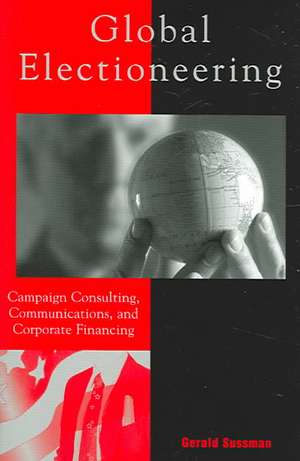
Global Electioneering: Campaign Consulting, Communications, and Corporate Financing: Critical Media Studies: Institutions, Politics, and Culture
Autor Gerald Sussmanen Limba Engleză Paperback – 25 mar 2005
Din seria Critical Media Studies: Institutions, Politics, and Culture
-
 Preț: 342.15 lei
 - 25%
 Preț: 366.64 lei
 - 23%
 Preț: 313.80 lei
 - 24%
 Preț: 281.03 lei
 -
 Preț: 264.37 lei
 - 24%
 Preț: 253.72 lei
 - 24%
 Preț: 255.50 lei
 - 19%
 Preț: 312.23 lei
 - 21%
 Preț: 366.29 lei
 - 33%
 Preț: 645.80 lei
 - 11%
 Preț: 319.08 lei
 - 25%
 Preț: 348.78 lei
 - 30%
 Preț: 354.88 lei
 - 28%
 Preț: 366.50 lei
 - 24%
 Preț: 349.05 lei
 - 36%
 Preț: 515.92 lei
 - 23%
 Preț: 279.43 lei
 - 25%
 Preț: 343.97 lei
 - 23%
 Preț: 277.56 lei
 - 35%
 Preț: 533.59 lei
 - 19%
 Preț: 327.54 lei
 - 23%
 Preț: 263.53 lei
 - 19%
 Preț: 335.82 lei
 - 19%
 Preț: 336.11 lei
 - 19%
 Preț: 338.89 lei
 - 19%
 Preț: 312.23 lei
 - 32%
 Preț: 345.85 lei
 - 28%
 Preț: 399.36 lei
 - 37%
 Preț: 659.11 lei
 - 25%
 Preț: 218.56 lei
 - 31%
 Preț: 348.34 lei
 - 29%
 Preț: 363.77 lei
 - 31%
 Preț: 352.90 lei
 - 22%
 Preț: 303.54 lei
 - 34%
 Preț: 355.64 lei
 - 31%
 Preț: 351.30 lei
Preț: 308.49 lei
Preț vechi: 386.05 lei
-20%
Puncte Express: 463
Carte tipărită la comandă
Livrare economică 19 noiembrie-03 decembrie
Livrare prin curier în România Termenul estimat este afișat lângă disponibilitate.
Transport gratuit de la 400.00 lei Plată online sau ramburs, în funcție de opțiunile comenzii.
Retur gratuit în 14 zile Comandă securizată și suport în română.
Specificații
ISBN-13: 9780742526921
ISBN-10: 0742526925
Pagini: 263
Dimensiuni: 150 x 228 x 20 mm
Greutate: 0.35 kg
Ediția:Updated.
Editura: Bloomsbury Publishing
Colecția Rowman & Littlefield
Seria Critical Media Studies: Institutions, Politics, and Culture
Locul publicării:New York, United States
ISBN-10: 0742526925
Pagini: 263
Dimensiuni: 150 x 228 x 20 mm
Greutate: 0.35 kg
Ediția:Updated.
Editura: Bloomsbury Publishing
Colecția Rowman & Littlefield
Seria Critical Media Studies: Institutions, Politics, and Culture
Locul publicării:New York, United States
Cuprins
Chapter 1 Preface
Chapter 2 1 Political Communication in the Neoliberal Era
Chapter 3 2 Managing the Electorate and the Public Sphere
Chapter 4 3 Campaign Professionals and the Tools of Their Trade
Chapter 5 4 Postwar Electoral Interventions
Chapter 6 5 Globalizing the Political Standard
Chapter 7 6 Elections and the Corporate Agenda
Chapter 8 7 Professionalization, Election Financing, and Democracy
Chapter 9 References
Chapter 2 1 Political Communication in the Neoliberal Era
Chapter 3 2 Managing the Electorate and the Public Sphere
Chapter 4 3 Campaign Professionals and the Tools of Their Trade
Chapter 5 4 Postwar Electoral Interventions
Chapter 6 5 Globalizing the Political Standard
Chapter 7 6 Elections and the Corporate Agenda
Chapter 8 7 Professionalization, Election Financing, and Democracy
Chapter 9 References
Recenzii
Sussman provides us with a compelling account of the way in which money and the professionalization of political campaigning has impoverished democracy. Drawing upon a wealth of evidence, he shows us how an army of political consultants, backed by big business, is turning democracy into a branch of corporate public relations. In so doing, he takes us beyond much of the discussion of 'spin,' to firmly link the process to the global spread of neo-liberalism. Read it and weep.
Global Electioneering provides welcome and fascinating insights into the political economy of campaigning. In doing so, it seeks to broaden and deepen our understanding by challenging the influential modernization thesis and acknowledging the corrosive impact the rise of neo-liberalism has had on democratic practices around the globe.
Finally, a book that peels back the curtain to show the corporate takeover of that public space we used to call grassroots democracy. Sussman's writing is historical, personal, and critical; [he] offers insight into the incorporation of political elections in America and how this mission creep is privatizing elections worldwide.
An insightful exposé of the powerful interests that have hijacked the electoral process at home and abroad. Nicely written, richly informed, and commanding in its analysis.
We in the United States typically feel comfortable talking about our society as a democracy. Gerald Sussman's book reminds us that democracy is a remarkably elastic term. Should it be used to describe an ultra-professionalized, high-tech campaign system dominated by big money in which ordinary people are effectively sidelined? Sussman's research and clear argument remind us how much anti-democratic practice we've come to accept in our democracy. His book is an important wake-up call and a contribution to the planning for how to take back power from elites.
Sussman delivers a stinging indictment of U.S.-style campaigning and electioneering and a warning on the dangers of exporting such practices to the global stage.
Sussman's book is especially valuable because it demonstrates the global spread of the U.S. model of hyperindustrial electioneering, replacing the craft and local specificities of national election practices in Canada, UK, Europe, and Japan. Global Electioneering provides a clearly written and very well-documented analysis in the tradition of some of our best political communication research. The discussion of much-needed reforms that concludes the book will offer students if not a road map out of the abyss, at least suggestions to help them design their own map.
Global Electioneering, a book rich in data and theoretical analysis of political communication methods, encourages us to think seriously on what a democracy worthy of its name requires and signifies, and whether these preconditions are fulfilled in today's political process.
Global Electioneering provides welcome and fascinating insights into the political economy of campaigning. In doing so, it seeks to broaden and deepen our understanding by challenging the influential modernization thesis and acknowledging the corrosive impact the rise of neo-liberalism has had on democratic practices around the globe.
Finally, a book that peels back the curtain to show the corporate takeover of that public space we used to call grassroots democracy. Sussman's writing is historical, personal, and critical; [he] offers insight into the incorporation of political elections in America and how this mission creep is privatizing elections worldwide.
An insightful exposé of the powerful interests that have hijacked the electoral process at home and abroad. Nicely written, richly informed, and commanding in its analysis.
We in the United States typically feel comfortable talking about our society as a democracy. Gerald Sussman's book reminds us that democracy is a remarkably elastic term. Should it be used to describe an ultra-professionalized, high-tech campaign system dominated by big money in which ordinary people are effectively sidelined? Sussman's research and clear argument remind us how much anti-democratic practice we've come to accept in our democracy. His book is an important wake-up call and a contribution to the planning for how to take back power from elites.
Sussman delivers a stinging indictment of U.S.-style campaigning and electioneering and a warning on the dangers of exporting such practices to the global stage.
Sussman's book is especially valuable because it demonstrates the global spread of the U.S. model of hyperindustrial electioneering, replacing the craft and local specificities of national election practices in Canada, UK, Europe, and Japan. Global Electioneering provides a clearly written and very well-documented analysis in the tradition of some of our best political communication research. The discussion of much-needed reforms that concludes the book will offer students if not a road map out of the abyss, at least suggestions to help them design their own map.
Global Electioneering, a book rich in data and theoretical analysis of political communication methods, encourages us to think seriously on what a democracy worthy of its name requires and signifies, and whether these preconditions are fulfilled in today's political process.